

btn_subscribe-top
btn_give-a-gift
btn_login
btn_signup
btn_rss

Archive

From issue: Memos to the President Elect (Fall 2008)

Dispatches from the Field: Guatemala

On-the-ground reporting looking at some of the region's most pressing issues.

In this issue:
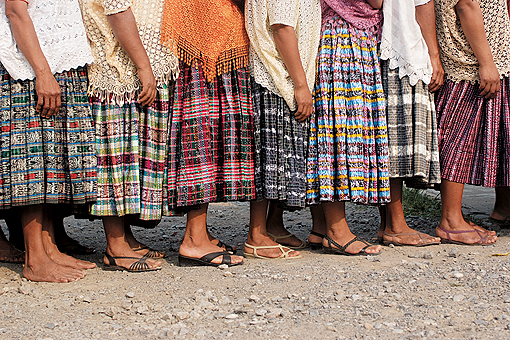
Photograph by Debbie Jefkin-Elnekave
  • Women’s Health: Tracking Cancer in the Guatemalan Highlands

    by Rick Renwick

    A dusty, pocked ribbon of road winds up and down through the rugged mountains of Alta Verapaz, an extremely remote, mostly indigenous area of Guatemala. Temperatures rise and fall according to elevation, and the air is thick with smoke from the traditional burning of cornfields and from deforestation by fire. This land provides subsistence for an estimated 1.2 million Q’eqchi’ Mayans, who have clung tenaciously to it through colonization and the ravages of civil war. Little has changed here over the centuries.

    I recently spent a week traveling this road as a member of a unique medical team involved in a pilot program for screening cervical cancer in poor indigenous women. We visited four communities. At each one, more than 100 women of all ages, attracted by the announcement of our visit on the radio, were already crowded around the village health center when we arrived.

    The contrast between a modern facility in Guatemala City or Antigua and the neglected buildings that serve as health care facilities in the remote villages of Guatemala’s northwest highlands is stark…

    To read more, subscribe and receive an instant digital copy of the latest issue. Already a digital subscriber? Log in now.


  • Political Innovator: Adrián Pérez, Argentina

    Adrián Pérez was only 12 when former Argentine President Raúl Alfonsín came to power in 1983. But Pérez remembers it as a moment of promise for his generation, a time when the country seemed prepared to finally turn the page on its near half century of fractured politics and military rule.

    Pérez has not lost his faith in that promise. In fact, he has become a leading crusader for nonpartisan reform. Now 38, he represents the province of Buenos Aires as a national deputy in the lower house of Congress. Elected in 2003 with the Affirmation for an Egalitarian Republic Party (ARI), he is the president and co-founder of the center-left Coalición Cívica (Civic Coalition), which counts 18 members of Congress among its participants.

    Pérez has led initiatives to establish live TV broadcasts of all sessions of Congress and to make the National Institute for Statistics and Census (INDEC) more independent from the executive office. “The INDEC has been completely distorted in the last couple years,” he says. “We’re working to restore its independence and strengthen other institutions.” The replacement of independent technocrats with staff loyal to the government has undermined confidence in economic statistics produced by the government, scaring off investors and creating insecurity over the actual rate of inflation.

    A member of Red Acción Política, a Buenos Aires-based NGO that promotes dialogue across party lines, Pérez has exploited his contacts and alliances in Argentina’s polarized politics to promote the Fondo del Ingreso Ciudadano de la Niñez (INCINI), a law similar to other countries’ conditional-cash transfer programs. First presented in Congress in 1997, the legislation would provide indigent Argentine families monthly allowances of up to 200 Argentine pesos ($65) on the condition that their children remain in school. The bill was killed in the Senate in 2004. Last year, Pérez played a key role in courting colleagues in Congress to support the bill, which will be presented again in December 2009.

    Perez’ cross-party activism has won him recognition at home and abroad. In 2008 he was one of five legislators to receive a “merit diploma” (an award only given every ten years) for outstanding public service from Fundación Konex, a Buenos Aires-based organization that awards public figures for their contributions to Argentine society. The year before, he was selected by his peers to win the Premio Parlamentario for his legislative work.

    One of Pérez’ primary commitments is finding ways to mobilize a new generation in Argentina’s political life. He believes that many young Argentines are disengaged from politics because they perceive politics as “…corrupt and deceptive.”

    “We can show young people that politics is a noble activity, “ he says, “And that it can change people’s lives. Young people need to see that politics can be done another way.”


  • The Crusading Reporter

    by Jenny Manrique (Colombia)

    “There are no tales about our country that do not include some episode of guerrilla, paramilitary or state violence.”

    I don’t know what it’s like to live in a country at peace. When I was born in the 1980s, the conflict that now plagues Colombia had been going on for more than three decades. Ever since I can remember, peace has been used to express the dreams, proposals and desires of a generation that refuses to die without having lived.

    But there’s another word that’s almost as important: truth. Since I began working as a journalist almost 13 years ago, I have come to realize that in Colombia truth, like peace, disguises itself and is easily manipulated. It is certainly not popular. But a generation of bright, thoughtful young people—my generation—is determined to find both.

    It was during the first 10 years of my life that the bloody, chaotic reign of the big drug trafficking cartels began. The image of my neighbor crying when her niece was killed along with 196 other passengers in a plane explosion during a flight from Bogotá to Cali is seared in my mind. It was November 1989, and the drug lord Pablo Escobar had called for the assassanation of presidential candidate, César Gavíria, who was supposed to be on that plane.

    Day after day, bombs and hitmen ended hundreds of lives across the country: politicians, judges, civilians, journalists. Two months before the plane attack, a car bomb partially destroyed El Espectador newspaper’s headquarters, near my elementary school. When I passed the site, traffic was stopped. I saw ambulances and rubble. The oldest daily publication in Colombia was made to pay for regularly revealing and denouncing the tentacles of drug trafficking in our society. “They set off another bomb” was what I heard on the street. “They” were part of our daily lives.

    My grandfather was a union man with strong convictions, who was a witness to the beginnings of our civil war that erupted in 1948 with the assassination of President Jorge Eliécer Gaitán.

    “When crisis erupts, history can be written in advance,” he told me in one of our conversations before he died. “And has ours been as predictable as was written?” I asked him.

    His answer: “Ours is only half written; it is incomplete. You yourself are writing a small part.”

    I decided to become a journalist and to write a part of this story 10 years ago. I was inspired by the many peace activists whose work has gone unrecognized. I worked for the newspaper Vanguardia Liberal as an “embedded” reporter with several communities that had been displaced in a northeastern region called Santander. When I was 20, I traveled to very remote villages to record testimonies of witnesses and victims of violence, fragile sources who require protection and anonymity. I did not interview presidents, ministers or people in power. On the contrary, I tried to give a voice to those abused by that power: human rights defenders, the displaced, relatives of the disappeared or kidnapped, indigenous people and Afro-Colombians...

    To read more, subscribe and receive an instant digital copy of the latest issue. Already a digital subscriber? Log in now.


  • The Politically Disenchanted

    by Ezequiel Nino (Argentina)

    “Argentine youth are awakening to the realization that inactivity is causing them harm.”

    In 1983 a new era of political participation and popular expectations began in Argentina. The “Alfonsín Spring”—a reference to Raúl Alfonsín, the first democratically-elected president after the transition from military rule—was for many Argentines a belle epoch of political and social activity and enthusiasm.

    It seemed a rebirth, an age of hope in which we thought that the return of democracy would improve our lives in every way. Students debated passionately in high schools and universities. I was still a child, but I remember the sprit of those moments well. The country was recovering from a fierce military dictatorship, preceded by the government of Isabel Perón that had unleashed the paramilitary group Argentine Anti-Communist Alliance (Triple A) on its opponents.

    The feeling of democratic renaissance, though, didn’t last long. The Alfonsín government soon lost popularity as hyperinflation tore into the living standards of the middle and low-income classes. Many progressives were further alienated by laws that appeared to let the military off the hook for the excesses of previous decades. The “Menem Decade” of Carlos Saúl Menem (1989 to 1999) that followed was characterized by unprecedented levels of corruption, a pardoning of the military for crimes committed under its reign, and an ever-widening breach between those in power and the young people interested in public affairs. Confidence in government plunged. Argentina’s authorities received the lowest ratings in citizen surveys in all of Latin America.

    Not much has changed in the post-Menem era with regard to the level of public interest and participation in civil society. Trust in democratic institutions has continued its downward spiral.

    Today, most young people shy away from active engagement in politics. The common perception among the younger population is that those who do participate in a political party do so for personal gain. Many who worked in student movements have been co-opted by national political parties, often leading to a loss of interest and contact with grassroots student demands. Even some independent civil society groups have lost autonomy to political movements and leaders. These examples and the suspicions surrounding politics make it difficult for those who really are interested to become involved...

    To read more, subscribe and receive an instant digital copy of the latest issue. Already a digital subscriber? Log in now.


Subscribe

Web Exclusives

Loading...


Loading...

Subscribe!