
btn_subscribe-top
btn_give-a-gift
btn_login
btn_signup
btn_rss

Fresh Look Reviews

Fresh, unique perspectives on recent books from across the hemisphere originally published in English, Spanish and Portuguese.
In this issue:
Photo courtesy of Lars Klove.

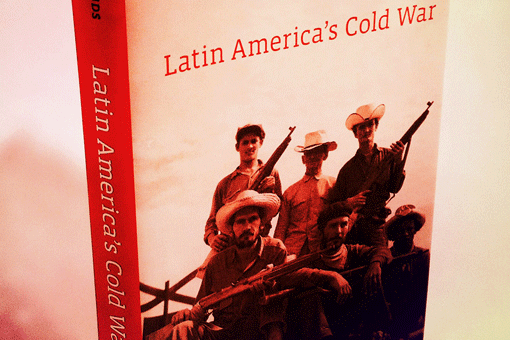
Latin America’s Cold War by Hal Brands

Tom Farer

The Cold War was marked by relative stability in the relationship between the superpowers and their European allies and dependencies, but scarred by bloody tumult in most of the rest of the world. Other than Vietnam, the blood ran thickest in Latin America.

In Latin America’s Cold War, Hal Brands, a security historian and assistant professor of public policy at the Duke University Sanford School of Public Policy, offers a fresh perspective on the period. He acknowledges and often cites the many studies examining the conflict’s impact on Latin America and U.S. policies towards the region during the Cold War. But he proposes, not unpersuasively, that the opening of many archives over the past two decades has enabled a history “that is both multinational and multilayered: multinational in that it deals seriously with all sides of the diplomatic and transnational struggles; multilayered in that it integrates perspectives… from the highest echelons of superpower diplomacy to the everyday negotiation of social and political relationships.”

With the inevitable imperfections that mark history on a grand scale, he has in large measure succeeded, and in the process illuminated the complex causes and morally and politically ambiguous outcomes of Latin America’s convulsions within the loose frame of the global Cold War.

The book has two themes, or theses. The first is that “the intensity of Latin America’s Cold War was a product of its complexity.” The region became a fiery arena where “long-running clashes over social, political and economic arrangements [overlapped with] tension between U.S. power and Latin American nationalism[,]… the ideological ramifications of decolonization and the rise of the Third World and the… bipolar struggle [between the U.S. and the USSR] for preeminence in the developing world.”

The second theme is that “prevailing interpretations of this subject need revision.” This applies to conservatives who view the outcome of Latin America’s Cold War as demonstrating the efficacy and virtue of U.S. intervention and democracy promotion. But the book also challenges progressive scholars who believe that the U.S.—in alliance with local reactionaries—conducted, as Brands puts it, “a ‘savage crusade’ that broke popular movements, ravaged the Left and eviscerated Latin American democracy.” He argues, instead, that a historical assessment “cannot be reduced to a story dominated by Right repression and U.S. complicity. Foreign intervention, internal instability and ideological extremism on both Left and Right fed on and fueled one another.”

The book divides the region’s Cold War into a number of periods which, as the author appears to recognize, tend to bleed into each other rather than be clearly demarcated. In the 1950s, widespread nationalist resentment intensified in response to the United States’ unembarrassed assumption of hegemony in the hemisphere. Politicians took advantage of this sentiment to project onto the U.S. the widespread popular frustration with political instability, economic stagnation and extreme inequality.

The U.S.’s cynical amiability in relations with dictators like Fulgencio Batista in Cuba, Rafael Trujillo in the Dominican Republic and Marcos Pérez Jiménez in Venezuela and, in particular, with the semi-clandestine armed intervention in Guatemala to assist local reactionaries in overthrowing a nationalist-reformist government, fueled popular anti-Americanism. Its most notable manifestation was the riotous assault on then-Vice President Richard Nixon’s motorcade when he visited Caracas in 1958.

For Brands, the first phase concludes with Fidel Castro’s triumph in Cuba. The Cuban revolution then inaugurates phase two, characterized by a flowering of rural insurgencies and, in the early 1960s, a two-pronged U.S. response. On the one hand, there was an effort (the Alliance for Progress) to catalyze reform and transform societies in order to reduce extreme poverty and improve economic opportunities for the working and middle classes. Here, the goal was to preempt the appeal of Castroite revolutions. On the other hand, the U.S. focused on equipping, training and educating armies so that they could become relatively effective instruments of counter-insurgency. When local forces proved insufficient or unreliable, the U.S. directly intervened “to prevent another Cuba.”

The Alliance for Progress failed to achieve the rapid changes in economic and social structures that the Kennedy Administration hoped for; in fact, Brands argues, it aggravated social tensions by facilitating an increase in large-scale commercial agriculture at the expense of already poor tenant farmers. This added to the countryside’s combustiblility just as the military focus was helping to extinguish the Cuban-supported rural insurgencies launched by romantic and deluded urban middle-class revolutionaries.

Reform failed, according to Brands, for a number of reasons. These included: the simplistic theory of economic development (“modernization”) that guided it; the lack of talented, multilingual experts and administrators to execute it in the field, and the obduracy of the region’s ruling classes in response to demands that they yield some piece of social, political and economic power. Hostility within the U.S. political establishment, particularly in Congress, to social—or as some saw it, socialistic—engineering, particularly in the case of land reform, also burdened the Alliance. In evaluating the causes of failure, Brands appears to give preeminence to a supposed U.S. inability to overcome elite resistance to reform. But was this lack of leverage beyond U.S. control?

While Brands does speak of contradictions in U.S. policy, he insufficiently emphasizes the fundamental contradiction between pressing for major reform while simultaneously guaranteeing the status quo in each country against revolutionary change. One could argue, in other words, that the U.S. de-leveraged itself. After all, in Taiwan, after it became the last fortress of the U.S.-backed right-wing nationalists driven off the mainland by the communist armies of Mao Tse Tung, and in South Korea, following the Korean War, U.S. pressure helped persuade very conservative regimes to carry out major land reforms designed to coopt potential rural support for their Communist antagonists. All cases being unique when described in detail, Brands could no doubt have found important distinctions between the Latin American cases and these instances where, without total control (as it had in post-war Japan), the U.S. did achieve its reformist redistributive goals.

In any event, reform proved unnecessary. It turned out that the Latin American countryside, though riddled with injustice, was not ready to burst into revolutionary flame. Campesinos did not flock to the banners planted in their midst by starry-eyed, middle-class, urban revolutionaries. Lacking a popular base, they were quickly liquidated by national military forces assisted by the United States.

This second phase of the region’s Cold War was characterized by a new cohort of men and women who, despairing of nonviolent means for redistributing wealth and opportunity, turned to urban guerrilla warfare. Most notably in Argentina and Uruguay, they succeeded in triggering a devastating response from radicalized military establishments ready to wage pitiless war against not just the armed militants but against reformers of every stripe, even if they spoke in the idiom of human rights rather than Karl Marx.

Phase three of the conflict saw a geographic shift of emphasis from the Southern Cone to Central America. Beginning in the late 1970s, revolutionary movements of varying strength challenged the governments of El Salvador, Guatemala and Nicaragua. The results are well known. An initially successful seizure of power in Nicaragua ultimately wilted in the face of a U.S.-armed and directed counterrevolutionary assault that culminated with the election victory in 1990 of a moderate anticommunist, Violeta Chamorro, over now-President Daniel Ortega, then a leading Sandinista commandante.

The Salvadoran regime, heavily backed by the U.S., and responsible for massacres on a scale exceeded only by its counterpart in Guatemala, managed to survive until the end of the Cold War. At that point, it was pressed by the U.S. into negotiations that allowed the guerrillas to reintegrate into society and turn to political competition for power. Their willingness to put down their arms for the ballot box was made possible by the radical reconstruction of the armed forces into a professional army charged with defending the state’s borders rather than serving as the ruthless guarantors of the business and landowning elite’s privileges.

Four years later, in 1996, Guatemala also achieved a negotiated settlement. Ideologically inspired murder is now rare, lethal restraints on freedom of opinion and association have been lifted, and civilians compete for power through respectable electoral means, apparently freed from the threat of intervention by the sharply downsized and seemingly depoliticized (although thoroughly unrepentant) army. And after 500 years of subjugation, indigenous peoples now enjoy the formal rights of citizenship while continuing to experience high rates of malnutrition and abject poverty. Alongside this misery, the middle class has expanded, but not to the point where it appears positioned to challenge the mastery of a small, traditional, land-holding and business elite.

The Cold War era, Brands concludes, left Latin America with more elements of continuity with prewar conditions than may be apparent to the casual observer. Income and wealth disparities are still hugely skewed (worse than any other region), and the very poor in many countries are even worse off. This explains in part the desperate effort to migrate to the U.S. and the explosion of both common and organized crime in many countries.

As for democracy, Brands argues that its breadth “is only slightly greater than during the late 1950s and its quality [is] probably less than it had been in the wake of World War II.” Even if one sees a somewhat brighter picture of contemporary Latin American societies than Brands sketches (most notably, perhaps, the much reduced violence in political conflict), counting the dead and maimed particularly in Central America, it would be hard even for the most stony utilitarian not to conclude that the price of Latin America’s Cold War has proven grossly disproportionate to even the most optimistic accounting of its gains.


Operación Primicia: El ataque de Montoneros que provocó el golpe de 1976 by Ceferino Reato

Janie Hulse

Over four decades ago, South America experienced a dark period of home-grown terrorism led by socialist revolutionary groups, whose armed rebellion in turn sparked military dictatorships and state terrorism on a massive scale.
By the 1970s, one Argentine group, the Montoneros, stood out from the rest. They had amassed significant clout, with a membership that ranged from Catholic nationalists to young, leftist supporters of former president Juan Domingo Perón, who at first embraced these radical elements in the lead-up to his March 1973 election.

But a few months before his death in July 1974, Perón publicly repudiated them, forcing the Montoneros underground. What happened next is the subject of an absorbing book by Ceferino Reato, chief editor of Perfil, one of Argentina’s most widely read daily papers.

In Operación Primicia: El ataque de Montoneros que provocó el golpe de 1976 (Operation Scoop: The Montoneros Attack that Led to the 1976 Coup), Reato dedicates nearly 400 pages to analyzing a single action perpetrated by the Montoneros on October 5, 1975—an assault on the military barracks in the province of Formosa. It was the group’s first operation against the Argentine military, whom they viewed as—in the words of one of their combatants—a “sell-out army, allied with the oligarchy and Yankee imperialism that had to be replaced by a popular army.” But what also made it significant, according to the author, was that the action triggered the army coup less than six months later—and plunged the country into a military dictatorship that lasted until 1983.

In an account that reads at times like a Hollywood thriller, Reato describes in chilling and suspenseful detail the logistics of planning  a complex, multiphased operation that included the hijacking of Aerolíneas Argentinas flight 706 with 102 passengers and six crewmembers on board; the takeover of the international airport of Formosa, leaving one dead; and the attack on Army Infantry Regiment Monte 29 in a half-hour conflict that left 24 dead (12 from each side, including 10 conscripted soldiers, all Peronists from Formosa).

The book begins with the author’s description of the realities and routines of a provincial military barracks, where the majority of conscripted soldiers were superstitious (a legacy of the native Guaraní in the territory), ill-prepared for combat, and whose officers complacently assumed they faced little risk from guerrillas in a tightly controlled border region. The province bordered Paraguay, which was then ruled by the dictator Alfredo Stroessner.

Reato vividly describes the start of the operation with the blue-clad, gun-wielding Montoneros waking the soldiers out of a Sunday slumber. Meanwhile, another armed contingent dressed as civilians efficiently managed the takeover of the Aerolíneas Argentinas flight for their escape. The attack, orchestrated by the “detail-oriented and obsessive” Raúl Yaguer, also known as “The Gringo,” went largely as planned. But the soldiers’ resistance was unexpected. Not only did this complicate Yaguer’s attack plan, but the public outrage over the soldiers’ deaths fueled a social and government backlash against the resistance movement.

But the book is not only a gripping drama. Reato uses his story as a prism through which he attempts to explain how the country continues to deal with its difficult past. The victims of the tragedy in Formosa received different treatment by the state, political parties and human rights groups. Eight of the 12 Montoneros killed in the attack, for example, figure in the Nunca Más (Never Again) list as victims of “mass execution.”

Many of their families received high-levels of compensation, in stark contrast to the paltry sums given to the soldiers’ families. Reato believes this is unjust and, in a radio interview about his book, he referred to the ever-expanding list of victims of the dictatorship as “a manipulation of the official history which cannot go on for much longer.”

The one-sided approach, according to the author, extended to the Kirchner government’s apparent unwillingness to investigate about 600 reported kidnappings by extremist groups before the military coup in March 1976. He points out that, instead, the government expanded the list of victims of state terrorism to include those killed before the coup. Most chroniclers of the coup period have accepted claims by human rights groups that some 30,000 people were either killed or “disappeared” during the military dictatorship. But the author says his own investigation suggests the number is probably closer to 10,000 people. The author claims that the government “fabricates history to serve its current interests” by exaggerating the number of victims of the dictatorship and glorifying the guerrilla groups.

By focusing on the late, former president Néstor Kirchner´s approach to the Montoneros’ activities, the author underlines the political uses of Argentine history. He suggests that Kirchner’s aim was to create a collective memory that favors “the wonderful youth of the 1970s, of which the Kirchners, their political cohorts and their followers consider themselves rightful inheritors.”

In a promotional book review written by the author and published in La Nación, Reato vehemently disputes this “fictitious history” that permits the Kirchners, under both the Néstor and Cristina Fernández administrations, to strengthen alliances with human rights groups and social movements, and shield their political partners against accusations of corruption. According to the author, this tactic also offers a powerful tool to pressure adversaries and nonsupporting journalists.

Operación Primicia represents a stark contrast with the majority of books about Argentina’s recent past. Without making excuses for the devastating dictatorship that followed, Reato does not, as many official accounts do, treat the socialist revolutionaries as idealists and martyrs. Instead, he offers a well-researched, critical view that directly links the military coup to the bloody atrocities perpetrated by the guerrillas themselves.

In this, he has support from some guerrillas. In fact, some ex-Montoneros interviewed for the book agreed with him that the violence in October 1975 was not only wrong but a strategic misstep.

While the text provides so much detail that it is easy to lose sight of the forest for its trees, Reato’s larger message is clear. Argentines, he suggests, should be wary of accepting official accounts of history that paint the military as the enemy and the revolutionaries as heroes. In Argentina’s contemporary environment, which displays little tolerance for journalists who do not follow the official line, the book is a commendable display of courage.


A construção da sociedade do trabalho no Brasil: uma investigação sobre a persistência secular das desigualdades by Adalberto Moreira Cardoso

Paulo Sotero

According to the Brazilian Institute for Geography and Statistics, half of Brazil’s estimated 60 million poor have entered the lower middle class in recent years. But the country still faces the daunting task of sustaining this trend and overcoming deeply rooted social and economic injustice.

This challenge is brought into sharp focus in Adalberto Moreira Cardoso’s A construção da sociedade do trabalho no Brasil: uma investigação sobre a persistência secular das desigualdades (Building the Workforce in Brazil: An Investigation on the Persistence of Inequalities). Cardoso, a professor and researcher of the sociology of labor at the State University of Rio de Janeiro, investigates the persistence of centuries of inequality in a society only founded on slave labor and that was late to industrialize. This well-written book offers an unvarnished view of the heavy legacy left by what the author describes as the “anti-social state” built by the oligarchies that have ruled on the basis of slave labor for almost four centuries. In Cardoso’s view, the legacy of slavery shaped the structure of the Brazilian capitalist state, which did not create mechanisms for social protection until the 1930s. This meant the state became the engine of “reproduction of hierarchies and social inequalities.”

The book’s central argument is that the country’s unequal social and economic order is accepted by most Brazilians. This, the book suggests, may partly explain the relative absence of political violence.

The author, who is also affiliated with the University of Warwick Institute for Employment Research, summarizes his analysis in the seventh and final chapter, which focuses on concepts of justice and perceptions of inequalities. Cardoso concludes that the persistence of inequality in Brazil, “although perfectly visible to Brazilians…is seen as legitimate by the immense majority of them and, especially, by the poorest.” The conclusion may shock foreigners but is widely accepted by Brazilians themselves.

In earlier sections of the book, the author offers some equally shocking findings that lead him to declare that Brazil suffers from the absence of a “clear standard” that both rich and poor can use to make practical judgments about the fairness of the distribution of wealth and opportunities. His findings are based on an analysis of a 10-year, multicountry comparative survey by the International Social Survey Program (ISSP) that looks at concepts such as economic necessity and opportunity, capacity and merit, and social justice. He focuses on three cases: Sweden, a welfare state where poverty has been eliminated; Germany, which follows a more hierarchical and corporatist model in determining eligibility for positions in the social structure; and Poland, a country that is similar to Brazil in regard to its per capita income, period of democratization (1980s) and implementation of neoliberal economic reforms.

Unlike their counterparts in these three countries, Brazil’s rich and poor largely focus on opportunities for social mobility based on what they perceive to be their own situations. “Surprisingly,” Cardoso writes, “[in Brazil] the rich are more inclined than the poor to judge as unjust the greater access they have to health and education.”

In contrast, “the poor are much less inclined to make such types of judgments about injustice.” This, he writes, “is disconcerting, since the poor consider their income to be dramatically inferior to what is just or deserved.” According to the author, the ISSP survey reports that about three-fourths of the poor say that their situation remained equal or worsened between 1997 and 2007, while 66 percent of the rich described their situation as the same or improved.

Cardoso traces the roots of the poor’s conformist attitude and their “appalling low level of [social] aspiration” to the longevity, brutality and predatory character of slavery in Brazil. Slavery not only destroyed lives and depersonalized the captives, but also distorted the very notion of work, which was seen as punishment and an undignified activity for non-slaves. Only decades after the formal abolition of slavery in 1888 did Brazilian society overcome such attitudes.

But workers themselves remained undervalued. It took 30 years to enact measures for worker protection after the 1889 proclamation of the Republic of the United States of Brazil. “For the Brazilian agrarian elite, economic liberalism meant only that the state would not interfere in the way they managed their business and, particularly, their work force,” the author writes.

In the 1930s, at the beginning of the country’s industrialization and rapid urbanization, a revolution led by Getúlio Vargas finally introduced social rights for workers. Nevertheless, Vargas feared that urbanization would not be accompanied by the creation of manufacturing jobs, but rather by a rural-to-urban migration of peasants that would only worsen inequality. Cardoso argues that Vargas’ project “would become a powerful instrument of transmission of social inequalities.”

It will be interesting to measure over the next few years whether and how perceptions of social justice have been effected by the distributive social policies aggressively implemented during the eight-year administration of former President Luiz Inácio Lula da Silva, the first “man of the people” to reach the presidency.

The poverty reduction and social and economic advances achieved during the Lula administration give Brazilians reasons to believe that they will benefit. It remains to be seen whether this moment of transformation will be potent enough to liberate Brazil’s workers from the repression of social aspiration that prevailed through most of their country’s history and remains an obstacle for a still very unequal society to fulfill the promise of inclusion.


Connect with AQ


Twitter YouTube Itunes App Store


Issues in Depth: President Obama's travel to Mexico, Costa Rica

AQ's coverage and post-trip analysis of the President's May 2-4 visit.

» Read more.


WEB EXCLUSIVES

Most Popular

MOST POPULAR ON AQ ONLINE

  • Most Viewed
  • Past:
  • 1 day
  • 1 week
  • 1 month
  • 1 year

NOW ON AS/COA ONLINE

Loading...

AQ MEDIA PARTNER

Loading...