


Stay up-to-date with the latest trends and events from around the hemisphere with AQ's Panorama. Each issue, AQ packs its bags and offers readers travel tips on a new Americas destination.

For most leisure travelers to Central America, trip highlights include white sand beaches, ancient Mayan temples and dance-filled nights on the town. But for a rising number of socially and environmentally conscious visitors, the big draw is the opportunity to promote sustainable products they enjoy every day at home, such as coffee and cocoa—and learn about the communities that grow them.
Agri-tourism, which gives tourists access to fragile, pristine and often protected natural habitats, takes advantage of developed-world consumers’ growing demand for knowledge about supply chains for the goods they consume. An offshoot of ecotourism, it offers farm stays and the promise of deeper cultural immersion.
“Many organic and fair-trade food consumers want meaningful learning experiences while overseas,” says Margaret Escudero, who operates the La Loma jungle lodge and chocolate farm on Bastimentos Island in Panama with her husband Henry. “Visitors stay in secluded bungalows, eat 100-percent locally grown foods, explore the island with the help of indigenous guides, and lend a helping hand during harvest season.” Such interaction with the community and production is typical of this growing travel industry trend.
The top destination for ecotourists and agri-tourists in the Western Hemisphere is Costa Rica, which in 2001 reported 800,000 visitors for nontraditional eco-tours. According to a report by SNV Netherlands Development, other top destinations in the region include Peru, Ecuador, Guatemala, and Mexico.
Although such niche travel will always represent a small percentage of the nearly $6 trillion global tourism industry, it is the only growth sector in the field. In fact, overall leisure travel has declined during the worldwide economic downturn. “Agri-tourism isn’t cheap for shoestring budget travelers,” says Margaret Ann, “but it is a real bargain for upscale travelers looking for a beautiful vacation destination that won’t break the bank.”
Publishing insiders and Latin American bibliophiles know that every December, Mexico’s fifth-largest city, Guadalajara, plays host to one of the most important international gatherings in the book industry. Now in its 25th year, the nine-day Guadalajara International Book Fair is the second-largest book fair in the world, after the Frankfurt Book Fair.
According to the fair’s U.S. representative, David Unger, “What sets Guadalajara apart from other major global fairs are the nearly 20,000 publishing professionals from more than 20 countries who use the first three days of the fair to buy and sell book distribution rights.” In addition to writers and publishing houses, the business component of the fair attracts librarians, booksellers, authors, and translators.
The remaining six days of the fair are open to the public. According to Unger, more than 600,000 people attended at least one of the 450 cultural events connected to the festival in 2010 (and 660,000 in 2011). “The whole city is essentially taken over by the book fair,” he says.
A central element of the festivities is the numerous awards ceremonies. Every year since 1991, fair organizers have presented an author with the Premio FIL de Literatura, which recognizes lifetime achievement in any literary genre in a Romance language and comes with a $150,000 cash prize. In 2011 Colombian-Mexican novelist, filmmaker and essayist Fernando Vallejo Rendón was chosen for his contributions to Latin American literature over the span of a nearly 30-year career.
In addition to facilitating business deals and granting awards, fair organizers want to introduce young Mexicans to the world of books. “There are relatively few book stores and not many libraries in Mexico,” says Unger. “This year the fair attracted 150,000 students from all over Mexico for workshops on everything from poetry to book making.”
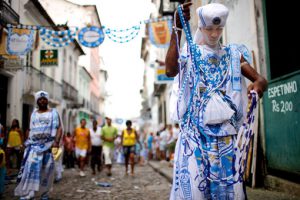
Chosen in November 2011 as the Afro-descendent capital of the Americas by leaders of the Encontro Ibero-Americano do Ano Internacional dos Afrodescendentes, Salvador is also the capital of Brazil’s northern Bahia state. Also once the seat of national government after independence, Bahia delights tourists with its historical sites, music, architecture, beaches, cultural diversity, and the renowned hospitality of Baianos.
1. Stroll Through Historic Downtown. Salvador’s historic Pelourinho district is recognized by UNESCO as a World Heritage Site for its architecture and unique preservation of the history of resistance by African slaves in Brazil. Walk on the famous Rua Chile to the Municipal Square and Rio Branco Palace, one of the country’s oldest palaces.
2. Hit the Beach. The beaches north of Salvador, located in the Linha Verde zone, are among the best in Brazil. Imbassaí beach, which means “Path of the River” in the Indigenous Tupy language, is 63 kilometers (39 miles) from Salvador. Take a bus at the central bus station directly to Imbassaí ($5).
3. Dance Samba. Brazilian samba was born in Bahia. Don’t miss the chance to hear authentic beats at the St. George Pub in the Rio Vermelho neighborhood. Afterwards, try the homemade codfish specialty and a world-class Cachaça-based caipirinha. Rua Borges Reis, 60.
4. Ride the Elevator. Salvador is divided into upper town and lower town; the traditional way of exploring the two levels is to take the Lacerda Elevator in the historic center of town. Built in 1873, the elevator has two towers reaching 236 feet (72 meters) high, and carries more than 900,000 people per month. From the top you have a panoramic view of Baía de Todos os Santos. The nominal 80-cent fee is for maintenance.
5. Shop at Mercado Model. At Mercado Modelo, founded in 1912, you’ll find typical Salvadoran arts and crafts: paintings, dolls, musical instruments like drums and berimbau, necklaces, and other ornaments. The market is across from the Lacerda Elevator in Praça Visconde de Cayru.
6. Hit an Afro-Brazilian Bar. Sankofa Café and Bar on St. Michael Hill Road has become one of the most cosmopolitan places in Salvador. The space, created by DJ Sankofa Ghana, is filled with references to African heritage and the diaspora, from food to music.
7. Sample Baiana Food. Aconchego Zuzu restaurant specializes in rich traditional dishes of Bahia. Decorated with scenes of African blocos (local Carnaval music rehearsal venues), the restaurant operates within a small residential village. Hear live music Thursday through Sunday, 8:30–midnight. Rua Quintino Bocaiúva, 18.
8. Enjoy Art. The Museum of Modern Art of Bahia, located in a 17th- century mansion, receives about 200,000 visitors a year to its exhibitions of contemporary Brazilian and Afro-Brazilian art. Inside are works of famous artists like Tarsila do Amaral, Portinari, Di Cavalcanti and Carybé. Open Tuesday to Sunday from 1:00–7:00 p.m., free.
9. Check Out Brazil's Harlem. Brazil’s version of New York’s Harlem, Liberdade, is one of the largest black-majority neighborhoods in Latin America. It’s also home to the headquarters of Brazil’s oldest Carnaval bloco. Musicians rehearse at Afro Ilê Aiyê ballroom every Saturday of the summer, starting at 10:00 p.m., Ladeira do Curuzu in Liberdade.
10. Retreat for a Day. For a break from Salvador’s bustling cultural life, visit Chapada Diamantina, an oasis in the nearby mountains, where spiritual leaders and backpackers from around the world go to marvel at trippy rock formations and the mystical atmosphere. The Morro do Pai Inácio, at 312 feet (400 meters) high, is one of Brazil’s most spectacular and accessible waterfalls. Buses from Salvador are $30 each way for the five-hour trip.
There are trophies for actors, athletes, writers, and musicians, but reelection is the only recognition politicians earn for a job well done. Bogotá-based Colombia Líder is working to promote good governance by presenting awards to the best Colombian mayors and regional governors of every four-year election cycle.
Launched in 2006, Colombia Líder evaluates elected officials in areas such as fiscal management, poverty alleviation, public services expansion, and gender equality.
“Poor governance and lack of respect for the rule of law is an endemic problem in Colombia,” says Colombia Líder coordinator Karem Labrador Araujo. “But some leaders are doing a good job and no one talks about them.”
Last November, Colombia Líder chose Carlos Alberto Contreras, mayor of Barrancabermeja, and Horacio Serpa, governor of Santander state, as the best mayor and governor for the 2008–2011 period. In a city of 44,000 displaced citizens, the panel noted, Contreras made a “titanic” effort to link more than 11,000 families to the federal poverty eradication program. Serpa also constructed more than 124 miles (200 kilometers) of new highways.
Colombia Líder not only evaluates the country’s 1,002 mayors and 35 governors; it also maintains a database of best practices that politicians elsewhere can tap.
The project has the backing of private companies, NGOs and foundations. Although only in its second year, Colombia Líder has been invited to replicate its system in Mexico and Paraguay.
When you think of the world’s top ski destinations, your mind jumps to the European Alps and the American Rockies. But over the past decade, Andean resorts like Cerro Castor in southern Argentina and Chile’s Valle Nevado have begun attracting world-class skiers to train and compete.
The Fédération Internationale de Ski (FIS)—skiing and snowboarding’s global organizing body—is largely responsible for South America’s growing reputation in winter sports. Since 1989, FIS has organized the South American Alpine Skiing Cup, the largest ski competition in the region. The Cup runs from August to September and consists of downhill races (slalom, giant slalom, downhill, Super G, and super-combined) in Argentina and Chile.
The rest of the skiing world is taking notice. “Top European ski teams are traveling to South America to compete in the Cup and maintain their fitness for other international competitions, such as the FIS World Cup,” says FIS Coordinator Markus Waldner. Predictable snowfall, excellent ski conditions and affordable accommodations compared to Europe and North America help account for the area’s growing popularity.
Though the competition is open to individuals, regardless of nationality, the Cup is dominated not only by local talent but by the same gene pool. The Simari Birkner siblings from San Carlos de Bariloche have claimed the majority of South American Cup titles over the past half-decade. Cristian Javier Simari Birkner, 31, has won the men’s division for the past six years running. On the women’s side, his sisters Maria Belén, 39, and Macarena, 27, have both finished in the top four over the past 11 years.
The Cup is also opening doors for South American skiers to participate in international competitions. Cristian represented Argentina in the 2002 and 2006 Winter Olympic Games, and was the country’s flag bearer in 2010.
Alpine skiing is still a fringe sport in South America, but the arrival of top European talent to the South American Cup could spark more interest among local fans—and give home-grown teams like the Simari Birkners the experience and commercial attention they need to compete with the best in South America and abroad.
A new report from the Center for Democracy in the Americas on economic reforms in Cuba argues that the Cuban government has accepted that market forces can play a role in economic policy and that economic growth must be the central criterion for judging economic success. Cuba’s New Resolve: Economic Reform and Its Implications for U.S. Policy goes on to argue that existing U.S. policy should be updated to reflect ongoing change in Cuba, and offers a series of policy recommendations to U.S. policymakers.
The role of women as drivers of development in Latin America and the Caribbean is the focus of the new World Bank report, Work & Family: Latin American and Caribbean Women in Search of a New Balance. It finds that women’s impact on the creation of wealth, reduction of poverty and improvement of opportunities for children is greater now than at any time in history. The report offers concrete recommendations to optimize development outcomes through effective, gender-sensitive public policy decisions.
A recent study released by the German Bertelsmann Foundation, titled Social Justice in the OECD — How Do the Member States Compare?, illustrates how social inequality has risen in recent years in many OECD countries and the rapidly growing social divide in the United States. The study ranks countries according to an index that measures their successes in poverty prevention, access to education, labor market inclusion, social cohesion and nondiscrimination, health, and intergenerational justice. Within the Americas, Canada ranked the highest, followed by the U.S. and Chile. Mexico achieved a score close to Turkey.
AQ's coverage and post-trip analysis of the President's May 2-4 visit.