

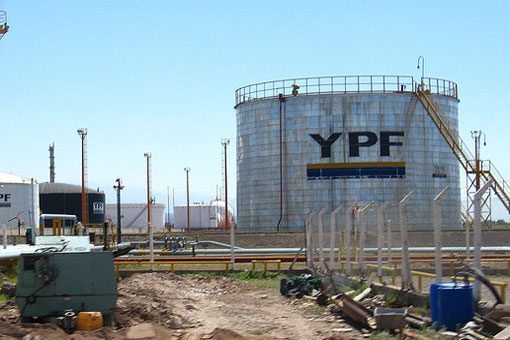

The boom in shale gas—natural gas trapped in shale deposits—is no longer a North American phenomenon. Argentina, with 774 trillion cubic feet (Tcf) of recoverable shale gas resources, holds the world’s third-largest reserves—placing it behind only China (1,275 Tcf) and the United States (862 Tcf).
With nearly 12 percent of global shale gas resources, is Argentina poised to become a global energy player? With the right policies and investments, Argentina could experience a shale gas (and, to a lesser extent, oil) boom similar to that of the U.S., where from 2000 to 2010 shale gas went from 1 percent to 23 percent of U.S. total gas supply.
The Neuquén Basin in Argentina’s southwest (the location of the Vaca Muerta oil field) shows the greatest potential for unconventional gas development. Yacimientos Petrolíferos Fiscales (YPF) found 4.5 Tcf of tight gas (natural gas stuck in unusually impermeable rock) in 2010, and 927 million barrels of shale oil in November 2011. Other oil companies—such as ExxonMobil, Petrobras, EOG Resources, Pan American Energy, Total, and Apache—are focusing on the basin as well. They will spend approximately $4.5 billion in explorations in 2012.
But the transition from discovery to production depends on more than resources and available technology. Foreign companies must have confidence in Argentina’s economic, regulatory and political situation before they invest, given the industry’s high sunken costs, extensive production periods and complex environmental challenges.
In this scenario, the decision of the Argentine government to declare the exploration and production of hydrocarbons to be of “national public interest” and expropriate 51 percent of YPF (exclusively from Repsol, which until April 16, 2012, owned 57.4 percent of the company) raises major concerns about its intentions and the future development of the sector.
While YPF had pursued an aggressive dividend policy that led to decreasing investment and production (which, in turn, heavily affected the current account), it is not clear how government control of the company will reverse this in the short run. The administration does not have the financial resources to explore and exploit some of the most profitable fields and will have to seek investors willing to invest in an uncertain climate. Vaca Muerta, for example, might require $20 billion in investments in the next three years. Still, the government did announce that the company will be professionally managed, will keep its legal status as a private corporation listed in the NYSE and will seek joint ventures with local and foreign private companies.
While the decision will certainly have an impact on the general business climate, it is less clear how it will affect the oil and gas sector itself. In fact, several companies (including Sinopec, ExxonMobil and Total) have shown interest in taking the risk and joining forces with the new YPF.
However, other concerns remain even if the expropriation yields minimal impact in terms of investments in the sector (particularly shale resources). A top issue is the price environment. Since 2002, the government has kept natural gas prices frozen. This forces producers to charge customers below-average prices: approximately $1.00 per million British thermal units (Btu) for consumer use; $2.50 per million Btu for power generation companies and $3.00 per million Btu for industrial use. The average global price was $4.00 per million Btu in 2011.
Cheap gas led to a boom in consumption. But it also led to a drop in investments, which resulted in stagnating production and a 43-percent decrease in natural gas reserves from 2003 to 2009. The lag between price and production costs reached about $7 billion in 2011 (which was covered by subsidies). Meanwhile, imports from Bolivia and other countries increased to nearly 30 percent of consumption.
In 2008, the government responded to the investment falloff with the Gas Plus program, which allows producers to charge higher prices for natural gas coming from new investments. Shale gas discoveries fall under this category. Prices must be negotiated on a case-by case basis, but they hover between $4.50 and $7.00 per million Btu—a price that makes several shale gas projects economically feasible.
Gas Plus has yielded positive, though modest, results. Natural gas under this scheme accounts for less than 10 percent of total production; of that, only 40 percent is charged above $5.00 per million Btu. Large industries still prefer the cheap gas, even though gas produced under Gas Plus is guaranteed to be the last to be cut by the government during frequent winter shortages. The largest buyer, Compañía Administradora del Mercado Mayorista Eléctrico Sociedad Anónima, is a 20-percent state-owned company that administers the electric market.
Beyond efforts like Gas Plus, recent macroeconomic developments could help stabilize the price environment for shale gas investments. In 2011, Argentina’s balance of payments recorded a deficit of 1.6 percent of GDP and the fiscal deficit reached 1.7 percent of GDP. This trend is expected to worsen in 2012. Without access to global credit markets, greater emphasis will likely be placed on promoting exports and investments in sectors like energy.
Government efforts to simplify the subsidies system—by cutting subsidies for high-income citizens and various industrial sectors—led to a rise in gas prices last January. So far, however, the measures only entail government savings and do not increase producer profits or provide an incentive for investment.
While they signal an important change in strategy and a willingness to raise tariffs, there is more to be done. The government is attempting to improve the country’s external position through import restrictions, establishing barriers to dividend repatriation and implementing a requirement that energy companies cash in export revenues through the Central Bank.
President Cristina Fernández de Kirchner has blamed oil companies (especially Repsol-YPF) for the lack of energy investment and the energy trade deficit, which reached almost $3 billion in 2011.
Environmental issues are another concern. To extract shale gas, millions of gallons of water and chemicals must be injected into wells. Critics say this process, known as fracking, produces groundwater contamination and seismic risks. While geological factors and better technologies reduce the chances of contamination in Argentina, water usage in arid areas is a concern.
Shale gas development is an opportunity too great to dismiss. It could solve Argentina’s energy trade deficit and reduce gas dependence on Bolivia. Its potential for improving the overall trade balance should convince the administration to offer further production incentives, even after the partial expropriation of YPF. This is the only way to assure protection of assets and attract the private investments needed for releasing the country’s shale gas potential.
Brazil is a major participant in the global growth in e-commerce. In 2011, 32 million Brazilians made an online purchase—a 39-percent jump from a year earlier, accounting for approximately $19 billion in online sales and elevating it to seventh place in worldwide online sales.
By 2015, Brazil is projected to rise to fourth place, following only China, the U.S. and Japan.
The demographics of Brazil’s online purchasers explain why this is not surprising. Internet access is on the rise, with 77.8 million Brazilians online in the second quarter of 2011—a 20-percent jump in just two years. Among those who are active online and over 15 years old, 86 percent access shopping websites on their home or business computer. The global average is 72 percent.
But these figures tell only part of the story. As in many sectors across Brazil, much of the consumption growth is fueled by a larger middle class. In the first half of 2011, middle-class customers accounted for 61 percent of new online shoppers.
The rise also stems from Brazil’s credit boom. Middle-class consumers can now use credit cards to make online purchases.
The rapid growth in e-commerce, particularly among first-time, middle-class consumers is also leading to a rise in complaints against online retailers, which spiked by nearly 200 percent from 2010 to 2011 in the state of Rio de Janeiro alone. The most common grievance is that the product either does not arrive or is delivered with defects.
This raises regulatory issues around how to protect consumers against abusive practices. One of the top concerns is ensuring that only the person engaging in a transaction and the seller of the product or service have access to information shared during the purchase.
The Brazilian congress is trying to keep pace with the rise in e-commerce. Bills pending in congress would provide greater certainty for e-commerce and update the landmark Consumer Protection Code (CDC) established in 1991. They include: establishing mechanisms for consumer e-commerce protection; regulating electronic sales of products and services; establishing criteria for the operation of web operating companies; and requiring businesses to display their corporate name, address and taxpayer identification number online.
Beyond pending legislation, the Brazilian Ministry of Justice in July 2010 established guidelines for e-commerce transactions. Among them is a requirement to ensure transparency in e-commerce by guaranteeing the same level of protection as would be found in a traditional transaction. This includes prohibiting misleading or unclear advertisements and ensuring consumer access to the general terms of a contract prior to the transaction.
Still, the top priority is updating the CDC, which was developed before the age of e-commerce.
One issue that must be resolved is the gap in technological knowledge between the consumer and supplier. This is often significant, with the consumer being more vulnerable to fraud in an online transaction than an in-person purchase.
A Commission of Jurists established in 2010 to update the CDC is helping to cut through this thicket of regulation and law to create new e-standards. There are over 500 bills addressing consumer issues pending in congress, with 214 of these bills proposing revisions to the CDC. One of the Commission’s charges is to establish regulatory changes that will allow consumers to legally cancel transactions.
Now that e-commerce has propelled it to the top ranks of the global industry, Brazil is focusing on the next step: becoming a world leader in e-commerce protection.