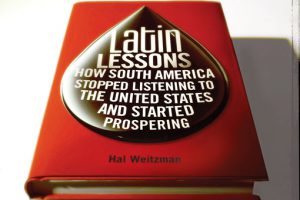

South America has been one of the rare pleasant surprises on the global economic scene in recent years. While developed countries struggle with debt and recession, much of the region maintains stability and impressive economic growth. Income is largely on the rise, and unemployment and poverty are on the decline. This is quite a change for a region that used to catch pneumonia whenever the developed countries caught a cold.
In Latin Lessons: How South America Stopped Listening to the United States and Started Prospering, Hal Weitzman, former Andes correspondent for the Financial Times, explores recent political and economic trends—mainly in the Andean countries—to analyze the developments that shaped present-day Bolivia, Ecuador, Venezuela, and, to a lesser extent, Peru. His highly readable book begins with a good review of South America’s long and often sad history as a commodity-producing region.
The author’s central argument is more nuanced than the title suggests. Much of South America is prospering, including the countries that are politically closer to the United States. The region has evolved to the point where it is increasingly shaping its own destiny and pursuing its own blend of economic policies and a foreign policy that is less centered on the United States.
Weitzman provides a concise summary of the momentous changes in Bolivia, Ecuador and Venezuela, where the radical Left came to power and implemented policies very different from the market-oriented economic approach of the Washington Consensus. As he shows, the rise of charismatic leftist leaders, such as Hugo Chávez in Venezuela, Evo Morales in Bolivia and Rafael Correa in Ecuador, was no accident. Their success reflects the failure of previous leaders and previous economic policies to meet public expectations. The ground for radical change (including steps to politically incorporate marginalized communities) was set before these three leaders took power.
The nationalism that led Andean leaders to expel or restrict the role of foreign and private firms in the natural resources sector reflects local experience as well as changing global trends. The persistence of abject poverty in places with a long history of mineral or oil production contributed, rightly or wrongly, to public support for nationalizations. “As the value of their [resource] exports rose dramatically, the people of the region naturally became impatient to experience the benefits,” Weitzman writes.
At the same time, the rise of China—a massive consumer of South American commodities and source of external government funding—has boosted fiscal coffers. This, according to Weitzman, has made it easier for leftist governments to adopt a more hostile posture toward Washington, as well as toward the private sector. The collapse of the U.S. financial system in 2008 and the global recession further undermined the prestige of market-based growth models in the eyes of many Latin Americans.
Weitzman is careful to point out that the radical Left’s success in the Andes is due to more than just charismatic leadership. The governments of Venezuela, Bolivia and Ecuador have reduced poverty and expanded the reach of government services to previously excluded segments of society. This includes delivering health care, food, education, or subsidies to their political bases. However, recent improvements rest on two weak pillars.
First, public institutions remain weak and often corrupt. Hugo Chávez’ policy of using the national energy company, Petróleos de Venezuela, S.A (PDVSA), to fund and deliver social services to the poor reflects the weak state of government institutions. Leaders like Chávez may have expanded the role of the government, but they have not made government institutions more effective or less corrupt. Naturally, this raises doubts about the sustainability of current social policies, Weitzman observes.
Second, the Andean countries are all enjoying a commodity bonanza, thanks to high export prices and to policies that shift a greater share of commodity revenues into the public sector, through either high taxation or nationalization. As Weitzman writes, “The resource nationalism of Chávez, Morales and Correa sought to use oil and gas to pay for the massive redistribution of wealth; but in doing so, they made it likely that the money would run out soon and tied their economies more closely to the notoriously volatile international commodity markets. Their natural resources were their salvation and their likely damnation.”
What is the longevity of the new Andean regimes? Morales, Chávez and Correa have changed the rules of the political and economic game in their countries. Can the Bolivarian revolution in Venezuela survive Chávez? Can Ecuador’s new political and economic order persist after Correa?
Weitzman injects some skepticism by reminding the reader that “Neither nationalization nor shock therapy solved the essential Latin American problems of inequality, poverty, weak political institutions and corruption, so when one failed to work, the pendulum had a habit of swinging back in the opposite direction.”
The new order may be more durable in Bolivia, where the shift in political power to the Indigenous population appears to be structural and permanent.
Beyond economics, Weitzman calls into question the effectiveness of the “war on drugs.” He provides a valuable account of how locals view the policy and its consequences for the region, including on its politics. The rise of Evo Morales, once a leader of Bolivia’s cocaleros, is inextricably bound with Washington’s efforts to eradicate a crop that Indigenous people historicaly grow for customary use.
Latin Lessons outlines the many factors that have led to the growing political distance between the U.S. and Latin America—even as economic and social links have deepened. As Weitzman documents, Latin America accounts for a growing share of U.S. exports (24 percent in 2010, compared with only 14 percent in 1990). The U.S. bought 42 percent of Latin America’s exports in 2010, and the region sells more oil to the U.S. than either Canada or the Middle East. At the same time, more Latin American immigrants live in the U.S. than ever before.
Despite these links, U.S. policy priorities (namely the war on drugs, the isolation of Cuba and free-trade agreements) are increasingly distant from regional priorities, and sometimes in conflict with them. Many in the region agree wih the description of U.S. policy as “a hodgepodge of remnants from previous initiatives that collectively form an incoherent, unsatisfying and unproductive muddle.”
The author advises the U.S. to develop an active presence in Latin America based on an updated understanding of events (rather than on old stereotypes) and a more sophisticated perception of the issues that bind it to the region. He calls for creative thinking, which would include setting a new agenda that avoids the extremes of grand plans and benign neglect. Such an agenda should, in his view, include new approaches to the drug problem and Cuba, as well as immigration, energy security and trade. It should also work to strengthen democracy and public institutions, supporting the rule of law.
Weitzman describes a region that is neither an eternal victim asking for rescue nor a strong, autonomous global player that can ignore American policies and views. He strikes a balance between seeing events in the region as being driven by an all-powerful U.S. and viewing Latin Americans as the full authors of their fate.
Still, his analysis would have been strengthened by enlarging his scope to briefly discuss the moderate Left governments in Brazil and Uruguay. The Brazilian Left rejects the Washington Consensus, but differs from the Andean Left in its views on the role of markets, trade, foreign direct investment, and foreign companies in the economy. The commitment of the Uruguayan Left to work within an institutional framework contrasts sharply with the populist approach of leftist leaders elsewhere.
Similarly, readers would have benefitted from a broader analysis of Peru that goes beyond corruption and social exclusion to include its remarkable economic growth and the corresponding impact on poverty and politics. This would have helped the reader to understand why President Ollanta Humala shifted away from Chávez and identified with former Brazilian President Luiz Inácio Lula da Silva during the 2011 campaign.
Nevertheless, Latin Lessons provides an able synthesis of economic, political and social trends that is not only suitable for general readers and specialists, but can be useful for U.S. policymakers, particularly those working on issues such as drugs, immigration, trade, and energy policy.
Weitzman’s title raises intriguing questions. Did South America really stop listening to the U.S., or was the U.S. message just no longer relevant? While a few Andean countries rejected the economic ideas advocated by the U.S., others settled into a mix of market-oriented policies, openness to trade and foreign investment, along with a more vigorous state role in key economic sectors and in providing social services for the poor.
Perhaps this indicates greater policymaking maturity, reflecting a growing capacity to undertake a more nuanced approach to economic policy. If so, it augurs well for a region that shows more signs of promise.
In Brazil, most voters do not identify with a political party. In spite of this relatively low level of partisanship, Brazilian elections, at least at the presidential level, have settled down into contests between the Partido dos Trabalhadores (PT) and the Partido da Social Democracia Brasileira (PSDB). The PSDB, led by Fernando Henrique Cardoso, won the first two post-stabilization elections (1994 and 1998), but the PT, headed by Luiz Inácio Lula da Silva in 2002 and 2006 and Dilma Rousseff in 2010, has won the last three contests.
In the national legislature, by contrast, the party of victorious presidents has never held a majority of seats. Still presidents have been able to build coalitions that make effective governing majorities.
Scholarly debates about Brazilian parties and elections mostly focus on presidential elections and on the roles of partisanship and ideology, with retrospective assessments of the economy and administration. These debates are important, but they suffer from one problem: presidential elections are single events held in unique circumstances.
Como o eleitor escolhe seu prefeito: campanha e voto nas eleições municipais (How Voters Choose Mayors: Campaigning and Voting in Municipal Elections), a collection of 13 articles organized and edited by political scientists Antonio Lavareda and Helcimara Telles, changes the level of analysis in an important and very useful way. Lavareda, president of MCI Estratégia, and Telles, a professor at Universidade Federal de Minas Gerais, focus on the 2008 municipal elections in the capital cities of key states. The chapters analyze campaigns and the bases of electoral choice in the cities of São Paulo, Rio de Janeiro, Belo Horizonte, Salvador, Fortaleza, Curitiba, Recife, Porto Alegre, Manaus, Belém, Goiânia, and Florianópolis.
The introduction, written by Antonio Lavareda, establishes the economic background to the 2008 elections. During the four-year period leading up to the vote, including the election year, growth was high and inflation remained low. The importance of public satisfaction with Lula’s administration was not lost on local politicians. While few voters actually cast votes based on a local candidate’s ties to Lula, his popularity negated campaign attacks on the national administration. Candidates who could link themselves to the president tried to nationalize their local elections by focusing on economic growth and the expansion of social benefits through the family stipend program; candidates of the opposition tried to “municipalize” the contests by focusing on local issues.
Lavareda also stresses political continuity. Thanks to a constitutional amendment in 1997 allowing executive officeholders to run for a second term, mayoral reelection rates have climbed steadily, from 58 percent in all municipalities in 2000 and 2004 to 67 percent in 2008. In municipalities that are state capitals, reelection rates in 2010 reached 95 percent.
While partisanship may arguably be less of a factor in national contests, Lavareda argues, it matters at the local level. Party fragmentation, which appears very high in the national legislature, is more manageable locally.
Typically, three or four parties capture most of the municipal vote, and smaller parties ally with parties that at least are not ideologically distant. In many states, particularly those in which the capital city does not sit on a rich resource base in relation to the state as a whole, state governors control vital resources and play central roles in municipal elections.
Partisanship also matters organizationally. Brazil restricts private spending on political campaigns, but in the final months before an election, candidates are entitled to airtime during the Free Period of Electoral Advertising (Horário Gratuito de Propaganda Eleitoral—HGPE). The number of daily minutes each candidate receives is a function of the legislative seats held by the parties supporting that candidate. Not surprisingly, major parties form coalitions with smaller parties to augment their airtime.
The importance of the HGPE is documented in the chapter on São Paulo by Jairo Pimental Jr. of Universidade de São Paulo and Claudio Luis de Camargo Penteado of the Universidade Federal do ABC. The authors provide a nuanced account of how Gilberto Kassab, the mayoral candidate of the Democratas party, won re-election with skillfully constructed alliances that gave him more time on the HGPE and “greater visibility and space for his campaign.” The result: voter opinion of his administration changed from negative to positive.
In Rio de Janeiro, Fábio Vasconcellos and Marcus Figueiredo of the Universidade do Estado do Rio de Janeiro look at how the vote was age- and class-linked. Partido Verde candidate Fernando Gabeira won the votes of richer, younger and more educated people. His opponent, Eduardo Paes of the Partido do Movimento Democrático Brasileiro (PMDB), did well in the first round among voters who held a positive view of outgoing Mayor César Maia (then a member of the Democratas party), only to see those same voters opt for Gabeira in the second round. While Gabeira based his campaign on clean government, Paes promised he could do more for the poor.
Party affiliation was the key ingredient for success in Salvador, according to Cloves Luiz Pereira Oliveira of Universidade Federal da Bahia and co-authors Dalmir Francisco and Tiago Prata L. Storni of Universidade Federal de Minas Gerais. There, incumbent mayor João Henrique faced very low approval ratings a year before the election.
When he changed parties, dropping the Partido Democrático Trabalhista and joining the PMDB, he gained the support of a member of President Lula’s cabinet, Geddel Vieira Lima, who controlled public works resources and the party organization. As an evangelical, João Henrique also drew support from that community and was able to position himself as a champion of the poor.
Exceptions, of course, don’t prove rules. But the case of Manaus, the only municipality in which an incumbent lost, is instructive, as noted by Luciana Fernandes Veiga and Sandra Avi dos Santos of Universidade Federal do Paraná and Malco Braga Camargos of Pontifícia Universidade Católica de Minas Gerais.
Serafim Corrêa, seeking reelection from the PSB, lost the contest in the capital city of Amazonas to Amazonino Mendes of the Partido Trabalhista do Brasil. Corrêa had won in 2004 due to scandalous personal behavior by his opposition.
But in 2008 the “machine” of ex-Governor Gilberto Mestrinho and Amazonino Mendes, which had ruled Amazonas since the 1950s, retook the municipality and relied on clientelistic exchanges with poor neighborhoods to do so. Corrêa was constantly attacked by the opposition-controlled media and, as a result, he began the campaign with low approval ratings and lost in the second round.
The book’s final chapter, by Lavareda and Telles, looks at these cases, along with those from other cities, to construct an overall model of Brazilian mayoral elections. In some states, especially poorer ones where mayors are dependent on state largesse, the connection between the governor and the mayor is crucial. In other cases, like the cities of Belo Horizonte and São Paulo, national elections affect local politics: it’s PT versus anti-PT. Ideology seems to matter in some cities, especially in the more economically developed areas such as São Paulo, Belo Horizonte and Florianópolis.
Lavareda and Telles emphasize that party organization and partisanship matter, but their importance depends on historical factors rather than on a state’s level of economic development. In Recife, a poor city in a poor state, a candidate without political strength won election simply because he was affiliated with an electorally strong party. In São Paulo it worked the other way: anti-PT sentiments helped elect a conservative candidate.
In Brazil, where partisanship is weak, campaigns matter much more.
Overall, this book marries qualitative and quantitative methodologies in a thorough but never boring treatment of local electoral processes. It stands as a testament to the sophistication of Brazilian social science.
Its major weakness is the reliance on cross-sectional rather than longitudinal survey data. Why is this important? Partisanship is hard to study in Brazil because it changes over the course of a political campaign. People reporting no partisan affiliations at the beginning of a campaign come to like a candidate and share that candidate’s party preference.
Thus Brazilian partisanship, unlike U.S. partisanship, can be endogenous. To analyze partisanship more rigorously, scholars need to interview the same respondents at various points during the campaign, measuring their changing partisan identification, their responses to campaign messages and their evolving evaluations of political candidates.
These authors cannot be faulted for relying on the data available to them, but a complete analysis of partisanship will require better (and more costly) databases. Still, by emphasizing the variety of local and state political processes, and by systematically linking these subnational processes to broader themes of national-level politics and partisanship, Antonio Lavareda, Helcimara Telles and their colleagues have made a major contribution to our understanding of Brazilian politics.
AQ's coverage and post-trip analysis of the President's May 2-4 visit.