
Stay up-to-date with the latest trends and events from around the hemisphere with AQ's Panorama. Each issue, AQ packs its bags and offers readers travel tips on a new Americas destination.
Gastón Acurio wants to change the way you eat. One of Latin America’s most well-known celebrity chefs, the Peruvian is well on his way to putting his country’s cuisine on plates across the world.
Acurio, 41, has opened more than a dozen upscale eateries in nine countries throughout the hemisphere, including a recently opened cevicheria in San Francisco and a New York outpost scheduled to open next winter. “In Peru, everybody is a cook—we are so proud of our food,” he explains. “Our mission now is to take this cultural patrimony—our cuisine—and promote it throughout the world.” The mission is complemented by his weekly program on Peru’s Plus TV, Aventura Culinaria, which traces the stories behind different recipes and traditions.
Acurio, who abandoned his law studies in Madrid to enroll at the elite Le Cordon Bleu in Paris, hopes to make ceviche and anticuchos as commonplace as sushi and sashimi. At Cordon Bleu, he found himself part of a growing movement of chefs interested in Peruvian cooking, eschewing the strictly European cuisine served in Lima’s best restaurants. “Twenty years ago, the top restaurants in Lima were French; today they are all Peruvian,” Acurio recounts with pride.
Acurio, in fact, hopes to encourage a new generation of chefs who will make Peruvian food a global byword in gastronomy. In 2007, he created the Instituto de Cocina Pachacutec, a culinary school in one of Lima’s poorest districts, where talented young cooks study with the country’s best chefs over two years. Today, his school is one of more than 35 different cooking institutions in Lima—a city fast becoming a culinary hub. For Acurio, this is a transformation long overdue.
AQ Online Exclusive: Gastón Acurio's Ceviche Recipe
Ingredients:
Sea bass filet 600 gr.
Red hot chili pepper finely chopped 12 gr.
Finely chopped cilantro 8 gr.
Key lime juice 400 ml.
Sliced red onions 120 gr.
Lettuce 4 leaves
Boiled sweet potato 240 gr.
Corn kernels 160 gr.
Salt 12 gr.
Glutamate 4 gr.
Decoration:
Red hot chili pepper in slices 4 gr.
Sea weed 20 gr.
Preparation:
1. Cut raw sea bass in cubes of 2 cm approximately
2. Rub a stainless steel bowl with red hot chili pepper, place sea bass filet in the bowl, season with salt, chopped red hot chili pepper without seeds and veins, finely chopped cilantro, squeeze key lime gently to avoid any bitter taste, add 4 ice cubes and sliced red onions, mix well.
3. Serve in a cold plate, garnish it with lettuce, sliced sweet potato of 1.5 cm thickness approximately and corn kernels
4. Decorate with sea weed and sliced red hot chili pepper
Nestled in a valley approximately nine miles (15 kilometers) from the Caribbean, Caracas is one of Latin America’s most exciting destinations. Although Venezuela’s capital is not a typical tourist stop, this city of 4.5 million people offers unique rewards to the adventurous visitor.
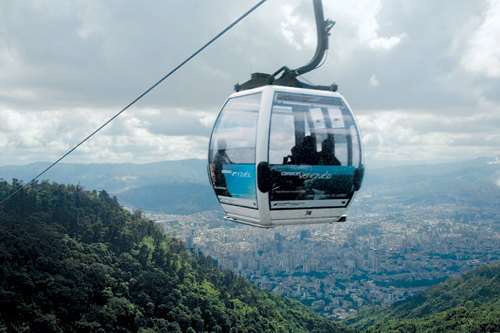
1. Start with a panoramic view. The Waraira Repano cable car ascends 3,608 feet (1,100 meters) to the top of Avila mountain, where visitors can cool off with a glass of traditional raspberry juice at the Hotel Humboldt. Other options at the top include ice skating and outdoor concerts.
2. Try some arepas. Locals, known as Caraqueños, commonly eat this flat cornmeal patty at breakfast or after a night out. Don’t miss two of the more popular varieties of this national food—the reina pepiada (chicken and avocado) and the peluda (beef and cheese).
3. Check out a UNESCO World Heritage Site. The campus of the Universidad Central de Venezuela (UCV) is known for its vast collection of noteworthy art, along with hidden gems like the Aula Magna—the university auditorium where Alexander Calder-designed disks hang from the ceiling.
4. Get an adrenaline rush on a mototaxi. Caracas is infamous for its traffic jams, so the best way to get around, especially during rush hour, is on one of the city’s mototaxis. Be warned: the ride is not for the faint of heart.
5. Catch a home run. Baseball is a favorite pastime, and the country’s professional league, referred to as la pelota caliente (the hot ball), runs from October to January. The Leones del Caracas hold the most championship titles (16); and they, along with the Tiburones de La Guaira, play their games at the Estadio Universitario.
6. Visit Simon Bolívar’s birthplace. The home of El Libertador (the liberator), built by his great-grandfather, is located in the El Silencio neighborhood and is one of the city’s best-preserved sites.
7. Combine art and mass transit. Hop on El Metro, ridden by over 1 million people daily, and head to the Bellas Artes stop—site of the Museum of Fine Arts and the National Art Gallery.
8. Enjoy a sneak peak at the Amazon. Located outside the north entrance of the UCV, Caracas’ botanical garden offers a rich sample of the country’s tropical flora. Spend the afternoon picnicking under Amazonian palm trees while still in the city.
9. Finish the day with a drink. Lounge Bar Ávila, the vintage-decorated rooftop bar at the Pestana Hotel on the Urbanización Santa Eduvigis, is one of the more hip spots to enjoy the sunset.
10. Dance salsa. At night, Centro San Ignacio in east Caracas transforms into one of the city’s hottest clubbing spots. The lower level is packed with multiple clubs and bars, bringing the concept of bar hopping to a new level.
Do you have additional travel tips? Post your ideas here.
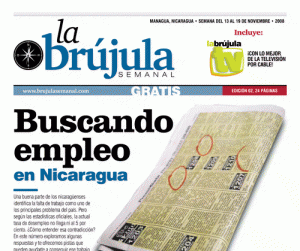
Just as the space for a free press has become limited in Nicaragua, the country’s youth now has its own source of unbiased, hard-hitting news. La brújula, a free weekly news magazine launched in November 2008, is aimed at 18–35-year-olds—a demographic that editor-in-chief Arturo Wallace claims has been ignored by the country’s media. Wallace, a media professor and former BBC journalist, and his three-person staff publish original reporting from Nicaragua and abroad, along with art and music coverage that appeals to an increasingly sophisticated younger audience. That target group is a crucial demographic—nearly 40 percent of the country’s population.
Despite Nicaragua’s increasingly politicized environment, la brújula has managed to avoid confrontation with the government. Its readership includes both those for and against President Daniel Ortega. “We’re not trying to change anything in the next year…we’re trying to create a generation of educated people,” says Wallace.
The magazine is available at universities across Nicaragua and online at www.labrujula.com.ni.
Share your thoughts on other new publications around the hemisphere.
Education is the key to getting ahead. That’s why Mexico’s Institute for Mexicans Abroad (IME) teamed up with the University of California to start a grants program aimed at providing educational opportunities for first-generation Hispanics in the United States.
Launched in 2005, the government-run IME awards $900,000 annually in education scholarships for immigrant students or in stipends for the tutors and advisors that teach literacy workshops and other basic education courses. Thirty percent of the IME funds can be allocated toward teaching materials. This is one way that Mexico is supporting the integration of its estimated 12.7 million immigrants currently living in the United States. Donations from U.S. corporations and individuals complement the IME awards. Last year, these donations totaled $154,000.
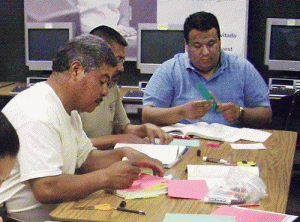
So far, more than 20,000 people have benefited from IME grants. One recent beneficiary is Alejandro Hernández Rojas, a 31-year-old immigrant who lives in Houston, Texas. After completing an IME-supported literacy program, Hernández can now help his daughter with her schoolwork. The result? “I know that she is proud of me,” he says. The life of another Houston resident, Feliciano Oliva Villanueva, 51, was changed by the basic education courses sponsored by the program. After 30 years as a temporary worker, Oliva now proudly declares, “I feel self-sufficient.” Like Hernández and Oliva, for many immigrants, basic education is an aspiration and a critical step toward their goals of contributing more to society. With IME, achieving this dream is now a greater possibility.
To find out more, visit www.imebecas.org.
Many of the hemisphere’s research institutions are focusing on the regional implications of the global economic crisis. The Inter-American Development Bank (IDB) produced two reports for its March 2009 meeting. Policy Trade-offs for Unprecedented Times, a macroeconomic study, argues that Latin America has withstood the crisis but cautions that the region is highly susceptible if the U.S. economy fails to recover quickly. A complementary report, Social and Labor Market Policies for Tumultuous Times, calls for more social coverage and fewer bottlenecks that affect growth.
The annual report of the Facultad Latinoamericano de Ciencias Sociales (FLACSO), a regional social science organization with members in 17 countries, explores how economics have affected the region’s trend toward integration. Integration in Latin America: Actions and Omissions; Conflicts and Cooperation, written by FLACSO General Secretary Francisco Rojas Aravena and published earlier this year, claims that integration can help countries achieve their political, economic, social, and cultural goals. It also emphasizes the role of government actors, civil society, entrepreneurs, and intellectuals in integrating the region.
On the topic of inequality, the Observatory on Racial Discrimination published Racial Discrimination and Human Rights in Colombia: A Report on the Situation of the Rights of Afro-Colombians in December 2008. The report reveals grim statistics—for example, 14 percent of Afro-Colombians did not eat at least one day per week in 2005—and offers ideas for promoting greater equality.
Access the Reports
English
Policy Trade-offs for Unprecedented Times
Social and Labor Market Policies for Tumultuous Times
Integration in Latin America: Actions and Omissions; Conflicts and Cooperation
Spanish
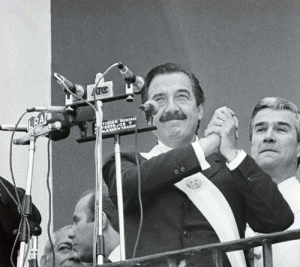
Former Argentine President Raúl Ricardo Alfonsín, who guided his country through the transition from dictatorship to civilian government, passed away in March after a battle with lung cancer. Alfonsín, 82, was a lawyer, a passionate politician and a powerful speaker who risked danger and arrest to speak out against military rule.
A co-founder of the Permanent Assembly for Human Rights, which represented political resistance to the country’s military dictatorship, he served as president from 1983 to 1989. During his tenure, Argentina made historic advances in the rule of law and civil liberties, capped by Alfonsín’s decision to investigate disappearances during the military junta (1976 to 1983) through the National Commission on Disappeared People (CONADEP). The commission report, Nunca Más (Never Again), eventually led to members of the military junta being put on trial. But social unrest also marked his time in office—a result of economic troubles and hyperinflation—and Alfonsín was forced to resign six months prior to the end of his term. Despite the memory of his final days in office, the late president’s passion for democracy lives on, serving as an example for other nations in the hemisphere who followed Argentina’s difficult path toward democracy.
AQ's coverage and post-trip analysis of the President's May 2-4 visit.