
Innovators/Innovations
Some of our hemisphere’s emerging leaders in politics, business, civil society, and the arts.

In this issue:
-
Civic Innovator: Un Techo Para Mi País, Regional
September 2010 marks the bicentennial of Chile’s independence from Spain (at the hands of the liberator Bernardo O’Higgins). If the group Un Techo Para Mi País (A Roof for My Country or Techo) achieves its goal it will also mark the liberation of millions of Chile’s poor from substandard living conditions. Created over a decade ago by Jesuit priest Felipe Berríos, Techo has set the ambitious goal of eliminating all of the substandard housing in Chile’s shantytowns by 2010.
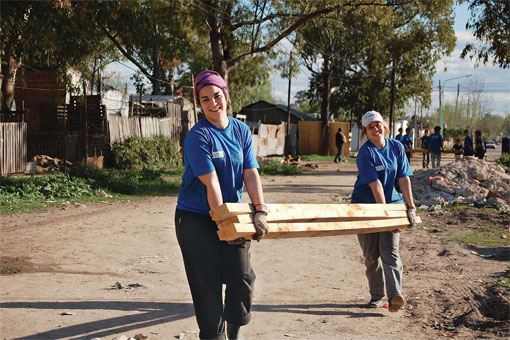
The plan? To mobilize university students throughout Chile to work together with residents of some of the country’s worst slums to improve housing. It also includes developing programs for health, education and job training and creation. “Living under a roof creates a sense of belonging to the community,” Berrios explains. “That allows residents to focus on creating a proper home by seeking education and better health conditions.”
Since it was founded in 1997 by Berríos and a small group of university students at La Universidad Católica in Santiago, the organization has built 42,000 homes, has recruited 200,000 volunteers and won the trust and participation of governments and multinational corporations throughout the hemisphere.
“We’ve gained a reputation for being well-organized and transparent in the eyes of governments and private companies, but also among the general population,” says Ignacio González, the group’s U.S. director for development and a former volunteer builder.
In 2001, the organization moved beyond Chile to open offices in Lima and San Salvador. Today, it operates in 15 Latin American countries.
Most of the volunteers are under 30, which Berríos credits for much of the organization’s driving energy and its transnational appeal. The young, often privileged volunteers that work side-by-side with marginalized populations “have stopped talking about ‘this country’ and have started talking about ‘my country’,” Berríos says. “They want to be protagonists of a better future.”
Techo has expanded its ambitious goal to eradicate substandard housing in all of Latin America. Plans are underway to build another 20,000 houses, and add another 50,000 volunteers throughout the region by the end of the year, where an estimated 15 million citizens live in substandard housing—or don’t have homes at all.In 2007, President Michelle Bachelet awarded the organization Chile’s Bicentenary Seal; and in 2008 the Peruvian Congress gave it special recognition for its assistance after an earthquake devastated much of the central coast region in August 2007.
Berríos credits the organization’s success and energy to the unique combination of the students who donate their time to effort and the beneficiaries they live and work with.
Recently, just after volunteers finished work on a new home in Curanilahue, 316 miles (509 kilometers) south of Santiago, Chile, the new owner rushed up to say thanks.
“This is the first time I won’t have to order my children to climb on their beds when it rains,” the woman, a mother of five, told the builders. “So they don’t get covered in mud.”
-
Business Innovator: Virginia Garretón, Chile
As Chile has become a growing presence in the international market, high quality wine and salmon exports have become integral to its global brand. So when Chilean salmon are found to have unhealthy amounts of antibiotics in their system or a Cabernet Sauvignon becomes bitter, it threatens to damage the market for some of the country’s most important exports.
Virginia Garretón, 40, a molecular biologist and CEO of Austral Biotech S.A., is at the vanguard of efforts in Chile’s emerging biotechnology industry to develop technology that will help to maintain the profitability and high quality of these products and other food commodities.
Garretón and her staff of nine researchers at Austral Biotech S.A., the Santiago-based biotech research firm she founded in 2005 with private equity capital amounting to about
$1 million, are developing cost-effective methods to test for antibiotic levels in salmon and for a chemical that causes red wine to become bitter. The quick and inexpensive tests (Garretón compares them to at-home pregnancy tests) will allow producers to maximize profit by decreasing the time spent harvesting the salmon and, in the case of high-end wine, maintaining its taste and aroma.The salmon kit, which uses small bio-magnets, helps farmers identify the optimum time to harvest their stock (when antibiotics in the fish are at an acceptably low level). Farmers are required to send samples of their stock to labs to be tested for antibiotics. Current methods cost around $56 per test and take two to five days of turn around. Austral Biotech’s salmon kit will cost around $16 per salmon and is used on-site.
Another kit in the works measures the quantity of the chemical 4-ethylphenol, which, in high quantities, makes red wine bitter.
“Identifying when the level is too high can make the difference between a $50 bottle of wine or a $10 one,” Garretón says. Austral Biotech is currently developing methods to eliminate excess amounts of the chemical detected by the tests.
Garretón’s innovations mirror other advances in Chile’s biotech sector, which has grown by 30 percent in the past three years, although she insists the sector is lagging behind. She hopes her company represents the beginning of a more robust biotechnology industry in the country.
“We need more companies in this field as well as advanced academic programs and professionals who can teach in them,” she says, “and I think we’re beginning to move toward that.”
With a PhD in molecular and cell biology from the Pontificia Universidad Católica in her native Santiago, Garretón founded Austral Biotech S.A. shortly after completing her post-doctorate studies at Rockefeller University in New York, where she researched plant molecular biology.
The company is off to a promising start. It is currently partnering with Universidad Santo Tomás on research and, in 2006, received $100,000 from Fundación COPEC, which funds research initiatives that maximize Chile’s natural resources. Last year, Garretón was one of five young entrepreneurs honored at the “How to Lead in the 21st Century Conference” organized by the Diario Financiero in Santiago.
But Garretón’s success has not prevented her from arguing that the Chilean biotech industry still requires a lot more investment and researchers to compete with Argentina, Brazil and Peru—all of which have more developed biotech sectors.
Garretón’s kits, expected to be available for sale in 2011, will help strengthen her argument. And so will her next major research product: developing similar early-warning kits for the swine and dairy industries.
-
Political Innovator: Adrián Pérez, Argentina
Adrián Pérez was only 12 when former Argentine President Raúl Alfonsín came to power in 1983. But Pérez remembers it as a moment of promise for his generation, a time when the country seemed prepared to finally turn the page on its near half century of fractured politics and military rule.
Pérez has not lost his faith in that promise. In fact, he has become a leading crusader for nonpartisan reform. Now 38, he represents the province of Buenos Aires as a national deputy in the lower house of Congress. Elected in 2003 with the Affirmation for an Egalitarian Republic Party (ARI), he is the president and co-founder of the center-left Coalición Cívica (Civic Coalition), which counts 18 members of Congress among its participants.
Pérez has led initiatives to establish live TV broadcasts of all sessions of Congress and to make the National Institute for Statistics and Census (INDEC) more independent from the executive office. “The INDEC has been completely distorted in the last couple years,” he says. “We’re working to restore its independence and strengthen other institutions.” The replacement of independent technocrats with staff loyal to the government has undermined confidence in economic statistics produced by the government, scaring off investors and creating insecurity over the actual rate of inflation.
A member of Red Acción Política, a Buenos Aires-based NGO that promotes dialogue across party lines, Pérez has exploited his contacts and alliances in Argentina’s polarized politics to promote the Fondo del Ingreso Ciudadano de la Niñez (INCINI), a law similar to other countries’ conditional-cash transfer programs. First presented in Congress in 1997, the legislation would provide indigent Argentine families monthly allowances of up to 200 Argentine pesos ($65) on the condition that their children remain in school. The bill was killed in the Senate in 2004. Last year, Pérez played a key role in courting colleagues in Congress to support the bill, which will be presented again in December 2009.
Perez’ cross-party activism has won him recognition at home and abroad. In 2008 he was one of five legislators to receive a “merit diploma” (an award only given every ten years) for outstanding public service from Fundación Konex, a Buenos Aires-based organization that awards public figures for their contributions to Argentine society. The year before, he was selected by his peers to win the Premio Parlamentario for his legislative work.
One of Pérez’ primary commitments is finding ways to mobilize a new generation in Argentina’s political life. He believes that many young Argentines are disengaged from politics because they perceive politics as “…corrupt and deceptive.”
“We can show young people that politics is a noble activity, “ he says, “And that it can change people’s lives. Young people need to see that politics can be done another way.”
-
Arts Innovator: Sofia Maldonado, Puerto Rico
For Sofia Maldonado, the world is a canvas. Literally. Her colorful designs embellish building facades, highways and even swimming pool floors. Her work has been showcased at New York’s PINTA art fair and the Havana Biennial, but her favorite pieces are some of her now-scuffed-up murals, skateboards and rinks in Cuba and in her native Puerto Rico.
The Brooklyn-based muralist, 25, has made a career of bringing art to skate parks and skate culture. While her art also includes more gallery-friendly media, like paint on canvas, she prefers large outdoor spaces. “I don’t limit my work to museums and galleries,” she says. “I like to put my artwork in the eyes of people who don’t often go to art shows.”
Maldonado began painting as a high school student in San Juan, Puerto Rico. “Our generation was part of a boom of graffiti artists in San Juan,” she says, adding that she and her friends took advantage of dilapidated buildings and unused public space in the city. But unlike her peers she used brushes and acrylic paint instead of spray cans. “It was cheaper,” she explains.
In 2006 she began studying art at the prestigious Pratt Institute in New York. A year later, she had her first solo show, Tropic Storm, at Magnan Galleries. The three-part exhibition featured skate bags (which she designed), paintings on broken skateboards and a video that documents Maldonado creating a skate bowl from an abandoned pool. In keeping with her ethos that art should be interactive, she painted and installed a small ramp in the gallery that was open for public use.
Maldonado, who describes herself as an amateur skater, traces her fascination with skate culture to her desire to create interactive, democratic art. She takes cues from skaters who are constantly spotting freestyle skating spots in the urban setting. Where they see a good place to skate, she sees a good place to paint.
Her skate-themed art eventually brought Maldonado’s focus to Cuba—her mother’s birthplace—and made her an unlikely diplomat. Last April, she participated in the Havana Biennial, where she launched Skate My Patria, an effort to connect the island’s isolated skate community with the rest of the world.
In addition to delivering 40 hand-painted skateboards and other equipment from the U.S. skaters to their counterparts, Maldonado and her cohorts painted a skate park, exchanged skate lessons with locals, and filmed a short documentary about the experience. Maldonado is presenting the documentary and other artifacts from Havana’s skate community at the Taller Puertoriqueño in Philadelphia this fall.
Outside of the skate bowl, Maldonado’s career is picking up. Last spring, she was commissioned to paint a three-story-high mural in Hartford, Connecticut. Maldonado is designing for Etnies shoes this fall, and in the winter, will enter the world of high fashion. She’s working on a clothing line that will hit the runway in February.


Great overview you wrote! Never actually thought about ...1
I found so many interesting topics on your blog. From the tons of ...1
A partnership is only good as long as both parties adhere to their ...1
More comments...