
![]() |
The Canadian government revealed this morning that Canadian fighter jets were scrambled to intercept two Russian bombers approaching Canadian airspace near its Northwest Territories on Tuesday. The Canadian jets returned to base without incident once the Russian planes turned around. The announcement comes on the eve of a visit by Prime Minister Stephen Harper to northern Canada to observe military exercises over the Arctic.
The Russian TU-95 Bear jet bombers flew within 30 miles (50 km.) of Canadian soil after having first been spotted nearly 120 nautical miles north of Inuvik, Northwest Territories. Canada has linked the Russian flights over the arctic and near Canadian airspace to competition between Canada, the United States, Russia, and others to secure arctic resources as polar ice caps melt and reveal new potential sources of oil, natural gas and minerals resources.
A similar incident involving Russian bombers occurred last month off Canada’s east coast and again in February 2009. In both cases, Canadian fighter jets were scrambled to intercept the Russian aircraft. Russian officials have repeatedly claimed that their planes never encroached on Canadian airspace.
![]() |
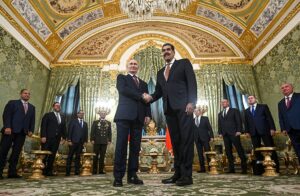
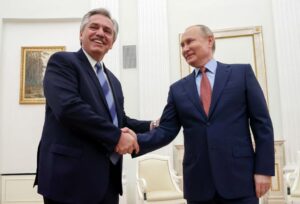
Russian Prime Minister Vladimir Putin is expected to arrive today for the first time to Caracas, where he has scheduled meetings with Venezuelan President Hugo Chávez and Bolivian President Evo Morales. The agenda will focus on furthering their cooperation on energy, finance and defense, among other areas.
According to Venezuelan Vice President Elías Jaua the new agreements will “take integration with Russia to a whole new level.” Putin’s visit just days after the terrorist bombings appears to be a clear signal of the importance Moscow has assigned to its relations with Venezuela.
Venezuela recently became Russia’s main arms purchaser in Latin America, signing contracts for more than $4.4 billion worth of equipment since 2005. Reports indicate that Chávez will announce the launch of a new joint venture between Petroleos de Venezuela (PDVSA) and a Russia energy consortium comprised of Rosneft, Lukoil, TNK-BP, Gazprom and Surgutneftegas.
Putin’s visit also comes less than two weeks after President Álvaro Colom became the first Guatemalan president to visit Russia.
![]() |
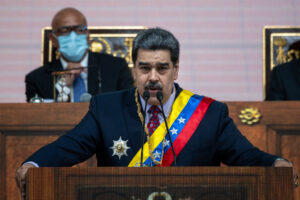
Venezuelan President Hugo Chávez repeated yesterday his intention to jumpstart a nuclear energy program and announced the creation of an atomic energy commission between Venezuela and Russia. Chávez attempted to dismiss concerns over the possible future militarization of the proposed program: “We’re not going to make an atomic bomb, so don’t bother us like with Iran.”
The pronouncement follows news of a $2.2 billion loan from Russia that Venezuela will use to finance arms purchases, including 92 Soviet-era T-72 tanks, short-range missiles and anti-aircraft weapons systems. U.S. Secretary of State Hillary Clinton addressed the issue saying Venezuelan arms purchases “outpace all other countries in South America and certainly raise the question as to whether there is going to be an arms race in the region.” Venezuela has already bought more than $4 billion worth of Russian arms since 2005.
Earlier this month, President Chávez met with Iranian President Mahmoud Ahmadinejad to discuss a possible nuclear partnership. Talk of nuclear energy development, coupled with news of major conventional arms purchases has fueled fears in the United States that Chávez’ actions pose “a serious challenge to stability in the Western Hemisphere,” according to State Department spokesman Ian Kelly.
![]() |
Thirty some-odd years after Moscow and Managua traded diplomatic missions, the one-time Cold War allies appear to be growing closer than ever.
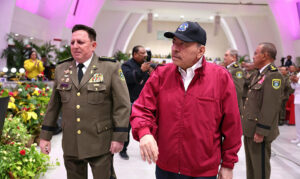
Russia’s deputy prime minister, Igor Sechin, met with Nicaraguan President Daniel Ortega at the end of last month—reportedly the third official Russian trip to Nicaragua in a year—signing several deals meant to make ties even tighter.
Sechin came in the company of high government officials from Russia’s energy and fisheries departments, and signed agreements aimed at boosting bilateral cooperation in both these areas. Sechin has said Russia that is particularly interested in the potential for crude oil exploration in Nicaragua.
Sechin and Ortega also agreed to introduce visa-free travel for their citizens, which according to Nicaraguan Vice President Jaime Morales, will help promote tourism between the two countries.
The deals are part of a broader regional charm offensive. Observers are now referring to Latin America’s revival in Russian relations, years after Moscow’s military reach faded at the end of the Soviet era. Many Nicaraguans, for example, remember the Soviet armaments the Sandinistas used against the U.S.-backed Contras.
Back in government again, Ortega set the stage last year for bilateral coziness when he surprisingly recognized the statehood of the former Georgian republics of South Ossetia and Abkhazia. It was a lonely endorsement: Nicaragua was the lone country to join Russia in supporting the two regions’ Moscow-backed breakaway.
Russia’s thanks: a gift of 130 buses to ease Nicaragua’s public transport ailments.
Deepening ties with the Kremlin seems to be coming at just the right time for Nicaragua, which fears an aid vacuum. In addition to European cuts, Washington’s Millennium Challenge Corporation clipped millions in development money over concerns that Ortega’s Sandinista party rigged the November 2008 municipal elections.
But Ortega shrugged off the announced cuts saying Russia and Venezuela would come to Nicaragua’s aid. Venezuelan President Hugo Chávez promises to come through with the support of his aid and trade bloc, the Bolivarian Alternative for the Americas, or ALBA. For Russia, no visa requirements are an interesting development but let’s see what may come next, the real test of Moscow’s renewed interest.
Alex Leff is acontributing blogger to americasquarterly.org based in San José, Costa Rica, and is the online editor for The Tico Times, Central America's leading English-language newspaper.
![]() |
From the Americas Society/Council of the Americas. AS/COA Online's news brief examines the major—as well as some of the overlooked—events and stories occurring across the Americas. Check back every Wednesday for the weekly roundup.
Sign up to receive the Weekly Roundup via email.
Political Fallout in Peru after Bloody Clash
Indigenous protesters and police forces clashed in Peru’s northern Amazon region over the weekend in a violent clash that claimed dozens of lives on both sides. The unrest followed months of demonstrations against a set of decrees that protesters said violated their ancestral claims on land and resources in the region. The Minister for Women and Social Development Carmen Vildoso resigned as a result of the controversy over the government’s handling of the clashes. Indigenous leader and head of the Inter-ethnic Association for the Development of the Peruvian Jungle Alberto Pizango was granted political asylum by the Nicaraguan government on June 8, after the government accused him of inciting violence against the police on June 5.
![]() |
From the Americas Society/Council of the Americas. AS/COA Online's news brief examines the major—as well as some of the overlooked—events and stories occurring across the Americas. Check back every Wednesday for the weekly roundup.
Sign up to receive the Weekly Roundup via email.
White House Chooses First Hispanic for SCOTUS
On Tuesday, President Barack Obama announced his choice for a Supreme Court justice to replace David Souter, picking the first Hispanic judge in history to be selected for the highest court in the United States. Sotomayor, whose credentials include three decades in the field of law and 16 years as a federal appeals judge, is from the South Bronx and of Puerto Rican descent. Pundits suggest that her ethnic background could serve as an obstacle for Republicans fighting her confirmation. Read AS/COA analysis about the nomination.
The Houston Chronicle’s Immigration Chronicles blog points out that several media outlets made the mistake of saying Sotomayor was born to immigrant parents. Puerto Ricans have been U.S. citizens since 1917.
AS/COA’s Christopher Sabatini joined PBS’ Worldfocus to talk about the historic nature of Sotomayor’s appointment, as well as how Latin America is receiving her nomination.
AQ's coverage and post-trip analysis of the President's May 2-4 visit.