

![]() |
Top stories this week are likely to include: debate continues on IACHR reforms; U.S. Supreme Court considers gay marriage; Bolivia takes Chile to court; Argentina wants UN discussion on Falklands/Malvinas; Indigenous groups protest World Cup construction.
Debate over IACHR Reforms to Continue: In a marathon extraordinary session on Friday, the General Assembly of the OAS resolved to continue discussing reforms to the Inter-American Commission on Human Rights (IACHR) that were proposed two years ago by Ecuador, Venezuela, Bolivia, and Nicaragua. Though external funding for the IACHR will be allowed to continue in the meantime, the reforms could mean eventually eliminating external funding for the regional human rights body and restricting the circumstances in which the commission can issue precautionary measures to protect victims.
U.S. Supreme Court Considers California's Prop 8 and DOMA: The U.S. Supreme Court will consider two high-profile cases on same-sex marriage this week. The court will convene Tuesday to consider the constitutionality of California's Proposition 8, a law banning same-sex marriage after California state courts had recognized gay marriage earlier in 2008. On Wednesday, the court will also consider the federal Defense of Marriage Act, which was signed into law in 1996 to deny federal benefits to gay and lesbian couples. The court’s decisions could overturn gay-marriage bans in 29 U.S. states.
Bolivia and Chile Dispute Escalates: Bolivian President Evo Morales said Saturday that Bolivia would take Chile to the International Court of Justice in the Hague in "coming days" to sue over Bolivia's lost access to the sea. Bolivia has been landlocked since the 1879-1884 War of the Pacific, but the issue has remained important in modern Bolivian politics. In a radio interview Sunday, Morales said that as long as Sebastián Piñera is president of Chile, he doesn't anticipate holding any further dialogue with Chile to negotiate a solution to the dispute.
Argentina to discuss the Falklands/Malvinas with the UN: Argentine Foreign Minister Héctor Timerman is expected to meet with UN General Secretary Ban Ki-Moon in New York early this week to request that the UN organize a dialogue with the United Kingdom over the political status of the disputed Falklands/Malvinas Islands. Argentina and more than 20 neighboring countries have said that the referendum held by islanders on March 10 and 11 is invalid. Voters overwhelmingly declared the islands a British Overseas Territory.
Brazilian Indigenous Groups Protest World Cup Displacement: Rio de Janeiro police in riot gear stormed a former museum occupied by Indigenous protesters on Friday, firing tear gas and pepper spray after an hours-long negotiation to convince protesters to abandon the building, which had been marked for demolition for the 2014 World Cup. The Indian Museum has been an important refuge for Indigenous Brazilians even after the museum was closed in 1977. On Friday, protesters were reportedly in the process of abandoning the building when the police entered, but the police say that the protesters started a fire inside. Human rights activists and public officials have denounced the police response.
![]() |
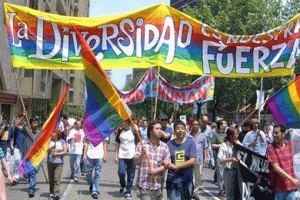
The Chilean Movement for Sexual Minorities (Movimiento de Integración y Liberación Homosexual—Movilh) filed a lawsuit against the Chilean State to the Inter-American Court of Human Rights (IACHR) on Monday. The action followed the Supreme Court’s rejection of a protection claim presented by three gay couples that were denied the possibility to get married. The Chilean Congress is the only organ that can modify the law, which currently authorizes heterosexual unions only.
Rolando Jiménez, head of Movilh, claims that Chile violates at least five articles in the American Convention of Human Rights by prohibiting same sex marriages in the country. Aiming to pressure for legalization, this is the first lawsuit of its kind to be presented to the regional body. The action was filed by renowned lawyers Ciro Colombara and Branislav Marelic, along with Hunter T. Carter, same-sex marriage activist in the United States.
The debate on gay rights in Chile is not new. Recent acts of violence and international pressure have revealed the pressing need for lawmaking in support of LGBT rights in Chile. A recent study by Radio Cooperativa showed that 54.9 percent of Chileans support same-sex marriage, and in 2011 President Sebastián Piñera sent a proposal to Congress seeking to legalize same-sex civil unions.
Despite these and other achievements in countries like Mexico and Argentina, discrimination towards gay populations still exists in the Americas, particularly in the political arena. Watch an AQ and Efecto Naim joint report on LGBT rights in the region.
![]() |
From Americas Society/Council of the Americas. AS/COA Online's news brief examines the major—as well as some of the overlooked—events and stories occurring across the Americas. Check back every Wednesday for the weekly roundup.
New President to Take the Reins in Peru
Peruvian President Alan García thanked his cabinet for its work at their last meeting today, as the country prepares for the July 28 presidential inauguration of Ollanta Humala. The former leftwing firebrand finished revealing a cabinet that Reuters characterizes as more conservative than that of former president of Brazil, Luiz Inácio "Lula” da Silva, to whom the media often compare Humala. The cabinet is anchored by Central Bank head Julio Velarde and Finance Minister Luis Miguel Castilla, both U.S.-trained economists who Humala will carry over from the outgoing García administration. (Velarde will remain at his position, while Castilla moves up from the position of deputy finance minister.) The 12-country South American regional bloc UNASUR will also meet tomorrow in Lima, where they will discuss ways to advance regional integration and poverty reduction. All 12 heads of state plan to attend Humala’s inauguration and the UNASUR meeting, except for Hugo Chávez of Venezuela, who is undergoing cancer treatment.
Read an AS/COA Online News Analysis about Humala’s cabinet picks.
Humala Appoints First Afro-Peruvian Minister in Country’s History
President-elect Ollanta Humala announced that singer Susana Baca will serve as culture minister in his cabinet. A 2002 winner of a Latin Grammy, the singer will be the first Afro-Peruvian to hold a cabinet post in the Andean country.
Puerto Maldonado Shows Another Side of Peru’s Economic Development
In a dispatch for the Summer 2011 issue of Americas Quarterly, Caroline Stauffer profiles the town of Puerto Maldonado in the Peruvian Amazon—an impoverished area where the rapid economic growth of recent years has yet to trickle down. Puerto Maldonado is one of the many places where the local population's perception that development had passed them by contributed to the rise of center-left Ollanta Humala in this year’s presidential elections.
The next issue of Americas Quarterly, focusing on sports in the Western Hemisphere, hits newsstands August 10.
Colombia’s Congress Tasked with Debating Gay Marriage
Colombia’s Constitutional Court told Congress last night to take up the issue of gay marriage in order to resolve a legal vacuum surrounding same-sex partnerships. The issue remains controversial in Colombia, whre the Constitution specifies that marriage can only exist between a man and a woman. Congress has declined to change the law, despite considering proposals to legalize gay unions six times in recent years.
![]() |
From the Americas Society/Council of the Americas. AS/COA Online's news brief examines the major—as well as some of the overlooked—events and stories occurring across the Americas. Check back every Wednesday for the weekly roundup.
Sign up to receive the Weekly Roundup via email.
Uribe out, Santos in, Chávez Back
Speaking before his country, outgoing-Colombian President Álvaro Uribe bid farewell after eight years in office, apologizing for his administration’s mistakes and urging Colombians to defend their freedoms and support incoming President Juan Manuel Santos. Upon assuming office on August 7, Santos began efforts to restore ties with Venezuela, sent into a tail spin after the Uribe administration accused Caracas of harboring FARC rebel camps within its territory. Meeting with Venezuelan President Hugo Chávez three days into his presidency, Santos and his counterpart agreed to restore bilateral ties, improve military patrols along the border, and initiate a joint security commission to help monitor terrorist groups.
![]() |
Seventy judges in the Federal District of Mexico underwent sensitivity training today at the Instituto Mexicano de Sexología in preparation for this Thursday, when same-sex marriage becomes legal in the district. According to the Judicial and Legal Services Council the workshops are intended to ensure that ceremonies are performed without “discrimination”.
Leticia Bonifaz, the councilor of the district, has said that two separate large-group ceremonies are planned for March 13 and 21. The Federal District passed a bill legalizing same-sex marriage and adoptions by same-sex couples on December 21, 2009. It is the first municipality after Buenos Aires to legalize gay marriage in Latin America.
![]() |
Buenos Aires-based civil court judge Marta Gómez Alsina effectively blocked Latin America’s first gay marriage yesterday when she filed an injunction to stop today’s marriage of Alex Freyre and Jose Maria di Bello until the case could be reviewed by the Supreme Court.
The couple, whose initial marriage license application was denied in April, won the right to marry when a judge ruled on November 10 that that laws limiting marriage to a man and a woman violated their constitutional right to equality under the law. Local reactions to the November decisions were mixed as Buenos Aires Mayor Mauricio Macri announced that he would not appeal the judge's decision, while Catholic Archbishop Jorge Bergoglio released a statement expressing his disapproval.
Argentina’s capital has been at the forefront of gay-rights issues since 2002 when it became the first major city in Latin America to approve civil unions for gay couples. However, while Buenos Aires' civil-union law was considered a victory for gay and lesbian rights, it did not allow gay couples to adopt children in the name of both parents, to enable a partner to gain citizenship and to inherit wealth or to be included in insurance policies. The couple, both of whom are gay-rights activists, has vowed to press forward with the ceremony despite the ruling.
AQ's coverage and post-trip analysis of the President's May 2-4 visit.

