

![]() |
Speaking to the Chilean and Latin American public from the La Moneda presidential palace in Chile, President Obama signaled the start of a new era in U.S.-Latin America relations—one whose focus will be on enhancing security in the region, promoting inclusive development, strengthening democratic institutions, and securing sustainable energy resources. On the eve of the 50th anniversary of President Kennedy’s creation of the Alliance for Progress and amid political turmoil and regime change in the Middle East and North Africa, President Obama’s speech to the Latin American public was both symbolic and significant.
It is no secret that the U.S. administration supported—and even lent assistance—to the forces that overthrew Chilean president Salvador Allende’s democratically elected government in 1973 and installed a military regime with General Augusto Pinochet at its head. This is a part of Chile’s history with which the country continues to come to terms, serving justice to the victims of the regime’s human rights abuses.
In a joint press conference with President Piñera, Obama was asked by a reporter about the U.S.’ past role in Chilean affairs. He answered without missing a beat: “It is important for us to understand our history, and to learn from our history,” he said, but “we are not trapped by our history.”
![]() |
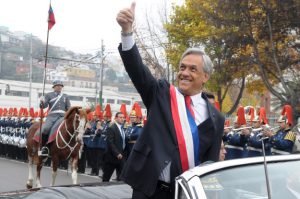
President Obama’s visit to Chile coincides with President Piñera’s completion of the first year of his four-year term. Although his administration has been highly effective at rebuilding the massive damage of the 2010 earthquake and tsunami, Piñera’s approval ratings are at their lowest level yet. Almost immediately after being sworn in, Piñera took a hit in the polls.
The unnecessary delay in selling two of his most emblematic companies (a television station, CHV, and LAN Airlines) sparked debate on potential conflicts of interest. Although he was able to regain some support after the successful rescue of the trapped miners, a popular revolt triggered by the decision to raise natural gas prices in the south sent approval ratings in a downward trajectory.
Though Piñera later sold his companies (or provisionally signed them over to non-profit organizations) and promptly announced that gas prices would only marginally increase, several other minor unforced and unpopular decisions have underscored his first year in office. Some of these errors can be attributed to the difficulties of running a country ruled by the opposition for the past 20 years. But others should be understood as part of Piñera’s natural entrepreneurial character, which naturally entails a certain amount of risk-taking.
![]() |
Chile’s new president-elect, Sebastián Piñera, will announce his first cabinet picks on Tuesday, February 9, after what has been a rather complicated process.
During the campaign, Piñera and his closest advisors had committed to a technocratic approach to cabinet selection, however since the election the largest political party in the winning coalition, Unión Demócrata Independiente (UDI) has been pushing to include close political allies in key cabinet assignments. Tension rose this morning when the leader of Renovación Nacional, Piñera’s party, made statements about the political nature of the ministries saying, ”consultants are able to provide technical knowledge but they do not deliver political efficiency.”
These early tensions are being called significant since they may influence Chilean politics and policymaking for the next four years. Observers note that the president-elect has a managerial style that is more technical than political in nature. But a more politicized cabinet would have more power to include a social agenda in the executive’s policy proposals. Balancing these forces will not be easy; UDI is the country’s biggest party and controls 30 percent of Congress.