
btn_subscribe-top
btn_give-a-gift
btn_login
btn_signup
btn_rss
  • The Fourth of July and Cuban Women

    July 2, 2010

    by Frank Calzon

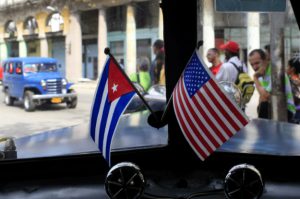
    On the eve of this 4th of July, I think about our servicemen and women whose lives are at risk defending U.S. interests and the cause of freedom around the world. I also think about Cuba, so close to the United States, where a despotic regime continues to misrule; and about the Ladies in White, a group of women—mothers, daughters, sisters, and wives of Cuban political prisoners, punished for desiring the same freedoms that Americans will celebrate this weekend.

    Again, this Sunday the Ladies in White will walk together to mass, all dressed in white, calling attention to the plight of their loved ones and the lack of freedom in Cuba.  The women have been harassed, spat upon and insulted by mobs organized by the regime. Their mistreatment, detention and abuse by Cuban police has earned the condemnation of  world leaders, including the First Lady of France, former Czech President Vaclav Havel and President Barack Obama.

    Read More

    Tags: Barack Obama, Cuban, Ladies in White, Ladies of Havana, United States, United States Naval Institute, Vaclav Havel

  • The United States’ Limited View of the War on Drugs

    April 6, 2010

    by Arjan Shahani

    It took the deaths of two American citizens and the husband of a diplomatic employee—all tied to the U.S. Consulate in Ciudad Juarez—for the Obama administration to apparently take notice of Mexico’s drug problem. Still, it seems that even the rhetoric from Washington will limit itself as much as it can to address this crisis as long as the bloodshed continues to hit outside of U.S. national borders.

    On March 14 all the headlines focused on the targeting of U.S. Consulate employees in the border town of Ciudad Juarez, which has become one of the main stages for drug-related violence in the recent years. Secretary of State Hillary Rodham Clinton was quick to respond to these attacks in an unusual address on a topic that had been left off the agenda until recently.

    It seems that as long as the victims of drug-related violence did not carry U.S. passports, the Obama administration only cared enough to issue petty warnings to American tourists not to visit our country. Yet when Enriquez, Redelffs and Salcido were gunned down President Barack Obama told the world he was outraged and promised a quick response to the issue. Clinton said that “this is a responsibility we must shoulder together" and subsequently made an official visit to Mexico 10 days later. There, she met with key officials in Calderón’s administration to work on a joint solution to the problem.

    Read More

    Tags: Barack Obama, Ciudad Juárez, Felipe Calderon, Hillary Rodham Clinton, Porfirio Díaz

  • Massachusetts Senate Election has Implications for Latin America

    January 20, 2010

    by Eric Farnsworth

    Yesterday’s election in Massachusetts to fill Ted Kennedy’s U.S. Senate seat had little to do with Latin America, but the implications of Scott Brown’s victory over Martha Coakley will nonetheless resonate across the region. That’s because the victory of the Republican candidate breaks the Democrats’ super majority of 60 votes in the Senate, and will likely require renewed negotiation and accommodation in order to pass the massive health care bill that has been the top priority of the White House and Congressional leaders since early 2009. Further delay on health care means that other agenda items will have to wait even longer for the political attention required to address them, and the mood on Capitol Hill could well become still more partisan and sour.

    That’s doubly true for controversial legislation, particularly as we move further into 2010, which is a midterm election year. Since President Obama was inaugurated one year ago today, three out of the four special elections have been won by Republicans (the Massachusetts Senate seat and the Governorships of Virginia and New Jersey). Only an upstate New York Congressional seat was won by the Democratic candidate, and that was after the Republican vote split over two candidates. Looking ahead to the elections in November, many observers predict that Democratic losses will mount, which means the White House and Congressional leadership will do whatever they can to improve the midterm prospects by juicing the economy, creating jobs and strengthening the support of the Democratic base, particularly organized labor.

    Read More

    Tags: Barack Obama, Free Trade, Health care, Immigration, Scott Brown

  • Public Support for Obama High in Latin America, Poll Says

    December 10, 2009

    by AQ Online

    President Barack Obama has a 61 percent approval rating in Latin America, a December Gallup Poll finds. The poll, reflecting public opinion in 17 countries between July and September 2009, also showed that support for U.S. Leadership in Latin America increased from 39 percent in 2008 to 51 percent this year.   Meanwhile, Obama’s domestic approval rating dropped to 47 percent on Dec. 9. 

    Support for Obama was strongest in Chile, where 72 percent of respondents had a favorable image of the U.S. President, and in Colombia (68 percent) and Uruguay (64 percent).  Obama’s approval rating was lowest in Paraguay (40 percent), Nicaragua (42 percent), Bolivia (46 percent), and Venezuela (48 percent).

    The poll is released as Latin American leaders, notably Brazilian President Luiz Inácio Lula da Silva, have stepped up criticism for U.S. policy in the hemisphere.  Obama has been criticized for recognizing the election of Porfirio Lobo in Honduras, failing to quickly close the Guantanamo Bay detention center and moving forward with plans to expand U.S. presence in military bases in Colombia. 

    Tags: Barack Obama, Brazil. President Lula da Silva, chil

  • Obama's Visit to New Orleans

    October 19, 2009

    by Emilie Bahr

    President Barack Obama appeared in New Orleans last week for his first visit since taking office in January. For locals, it was an event that spoke to both the hope and frustration that are inextricably linked to life in the city since Hurricane Katrina.

    Obama’s four-hour visit, in which he toured a charter school in the city's devastated Lower 9th Ward and later spoke across town in another heavily damaged section of the city at the University of New Orleans, was both highly anticipated and heavily criticized.

    New Orleanians overwhelmingly support a president who says the right thing when it comes to the city, even though he has yet to stray markedly from his predecessor in terms of making New Orleans' priorities national ones.

    Others have shown consternation at the timing of the president's visit, wondering why it took him so long to touch down in the city and why, when he finally did, the visit was so brief. Many thought he should have been here on August 29 to commemorate the fourth anniversary of Katrina.

    That said, this is a city that revels in a chance at the spotlight, an opportunity to tell its story. Most were excited by the president's visit and the prospect of winning the national media's focus for the day. Those hopes were largely dashed, however, by the saga of a six-year-old Colorado boy thought to have floated away in a balloon and, later, by reports of a Louisiana justice of the peace had denied an interracial couple a marriage license on the grounds that children of such couples face societal socrn.

    Read More

    Tags: Barack Obama, Bobby Jindal, Hurricane Katrina, New Orleans, Ray Nagin

  • Stephen Harper Visits the White House

    September 16, 2009

    by Nicole Spencer

    President Barack Obama receives his first visit from Canadian Prime Minister Stephen Harper at the White House today. As a testament to the strength of the U.S.-Canada relationship, this will be the seventh time Obama and Harper have met since the new President took office. Health care is not likely to make the agenda, but trade, energy and the environment, Afghanistan, and border management are expected to be discussed.

    Americans might not know much about these issues, but maybe they should. For example, Canada is a top trading partner of the United States, with nearly $750 billion in two-way trade in 2008. The U.S. economy is not only fueled by Canadian trade, but also, literally, by Canadian energy. Canada has the world’s second-largest proven oil reserves, after Saudi Arabia, and is consistently one of the top three suppliers of oil to the United States. Along with the need for coordinated environmental management along the 5,500 mile (8,900 kilometer) U.S.-Canadian border, the United States and Canada recently began a Clean Energy Dialogue to help speed the transition to greater use of clean energy sources in both countries. Canada has been a partner in the fight against terrorism and currently has 2,500 troops on the ground in Afghanistan. Our ability to increase security along the northern border since September 11, 2001, has also depended on Canadian cooperation.

    Read More

    Tags: Barack Obama, energy, Stephen Harper, trade, U.S.-Canada relations

  • A Reflection on Brazil's Gift to Obama

    July 10, 2009

    by Eric Farnsworth

    What is it about South American leaders and public gifts to President Obama? In April, we were treated to the spectacle of Venezuelan President Hugo Chávez giving a copy of Eduardo Galeano’s Open Veins to the U.S. President at the Summit of the Americas in Trinidad—a disingenuous publicity stunt that backfired and stole the headlines from other, more substantive and important issues. And now we have Brazilian President Luiz Inácio Lula da Silva at the G8 summit in Italy giving Obama a soccer jersey signed by all the members of the Brazilian national soccer team.

    Now, as a soccer head myself, I can think of no better gift to receive from the Brazilian President than a signed jersey. I certainly hope that it is displayed properly in the White House, and even though there is no record of the First Family having any particular interest in or affinity to soccer, nonetheless this is quite a cool gift. No complaints there. Except one. It was barely a week ago that the United States and Brazil played the championship game of the Confederations Cup in South Africa, the 2010 World Cup host. This was the first time in history that the United States men’s soccer team made it to the final of an extra-regional international soccer tournament. For Brazil, this was old hat, a big yawn, which paled in comparison to their five (yes, five) World Cup Championships. But for the upstart Americans, this was a big deal.

    Read More

    Tags: Barack Obama, Hugo Chavez, Luiz Inácio Lula da Silva, Soccer

  • Que Importa Honduras! – Obama Administration Strikes the Right Tone

    July 2, 2009

    by Liz Harper

    Honduras, que importa, right? Does this tiny Central American country warrant all this debate, discussion and media coverage?! Yes, it does, and the Obama administration is right to be defending democracy.

    Due attention must be given to the dramatic developments there—not only for the historic regional implications of dealing with a twenty-first century military coup, but for the test of how the U.S. will now conduct its relations in the hemisphere.

    Besides being a striking, unsettling reminder of the fragility of our region’s democratic institutions, the event brought to the fore how different the Obama administration’s approach to Latin America is from that of the Bush administration.  

    Read More

    Tags: Barack Obama, Honduras, Manuel Zelaya

  • Latin America Comes Calling - Uribe and Bachelet Visit Washington

    June 29, 2009

    by Eric Farnsworth

    President Álvaro Uribe of Colombia comes back to Washington today—his 13th time here since being elected in 2002—to meet with President Obama following their face-to-face meeting at the April Summit of the Americas in Trinidad and Tobago. It’s an opportunity to set an agenda looking ahead across the broad range of issues confronting both nations. The pending trade agreement will be discussed, but with Uribe already planning a return trip to Washington in September specifically to lobby, the agenda for the meeting today will be broader, including, no doubt, a joint statement on Honduras.

    That’s important, because Colombia has been willfully misrepresented by trade opponents and their allies in Washington as a human rights wasteland. On top of that, for the past several years U.S. policy has been characterized as one dimensional and as supporting a president who his opponents claim is a quasi-autocrat with caudillo, or strong-armed, tendencies, and who, for good measure, was too close to an unpopular U.S. president. The meeting today, together with their discussions in April, will show again that the Colombian president is a serious, thoughtful leader. It will also emphasize that the bilateral agenda with Colombia goes well beyond passage of one agreement, as important as that is, and that the U.S.-Colombia relationship is strong and enduring. 

    Read More

    Tags: Alvaro Uribe, Barack Obama, Free-trade agreement, Michelle Bachelet, Washington DC


Subscribe

Web Exclusives

Loading...


Loading...

Subscribe!