
![]() |
Top stories this week are likely to include: the World Bank presidency goes to a vote; Secretary Clinton in Brazil; Repsol proposes talks with CFK; Chávez authorized for 90-day leave; and the possibility of progress in drug-related violence.
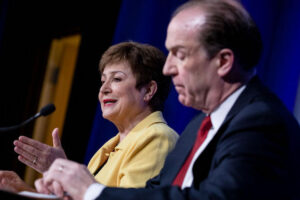
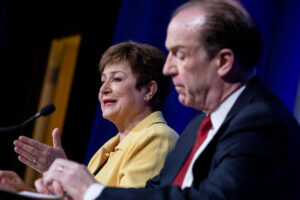
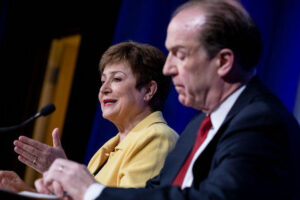
World Bank Presidency: With Colombia’s José Antonio Ocampo withdrawing his candidacy over the weekend, the contest for the next president of the World Bank is a two-person race. A vote is scheduled for today to decide between the two remaining candidates: the United States’ Jim Yong Kim and Nigeria’s Ngozi Okonjo-Iweala. Despite Brazil’s call recently for the BRICS nations to rally behind one candidate, pay attention to which candidate the developing economies will cast their vote. AQ Editor-in-Chief Christopher Sabatini says, “The ability of developing countries to really force a change in the international financial institutions depends on their ability to ally. They split over the IMF presidency last year, and despite their narrowing to two candidates for the World Bank, it’s difficult to imagine them rallying over the Nigerian candidate.”
Secretary Clinton in Brazil: After yesterday’s conclusion of the Sixth Summit of the Americas in Colombia, U.S. Secretary of State Hillary Clinton will be in Brasilia, Brazil, today and tomorrow for meetings on the Global Partnership Dialogue and the Open Government Partnership (OGP). She and Brazilian President Dilma Rousseff will “welcome 42 new countries into the [OGP] as they announce concrete commitments to prevent corruption, promote transparency, and harness new technologies to empower citizens,” according to a State Department press release. AQ Senior Editor Jason Marczak notes that “with last weekend’s summit not signaling any kernel of hemispheric unity, this week’s meetings are an important opportunity for the Americas’ two largest economies to show that one of the most important relationships in the hemisphere continues to strengthen.”
Repsol Proposes Talks with Argentina: Reports surfaced last week that the Argentine government was mulling a takeover of the majority of shares of YPF SA, the country’s largest oil company. Those reports sparked an international backlash especially in Spain, where YPF’s parent company Repsol is based. Spain’s minister of industry warned on Friday that Argentina would become an “international pariah” if it went ahead with the takeover—and Argentina has since delayed the project rather than abandon it. The head of Repsol is currently in Argentina and is urging talks between his company and the Argentine government. Look out for developments this week.
Chávez in Cuba for Extended Stay: Although he planned to attend last weekend’s Summit of the Americas, Venezuelan President Hugo Chávez instead departed for further medical treatment in Havana after doctors advised him on Saturday not to travel to Cartagena. On the same day, the Venezuelan legislature legally authorized Chávez to leave the country for up to 90 days. Pay attention to how Venezuelans react to the possibility of a prolonged absence of the president—especially the opposition eager to unseat him.
Progress in Drug-Related Violence?: Last weekend’s Summit “served as a good forum for discussion over drugs—and that was about it,” according to Sabatini. But while no final declaration was made on this longstanding problem, there was one glimmer of hope on Saturday. El Salvador, one of the Northern Triangle countries embattled by the bitter gang violence surrounding narcotics trade, experienced its first homicide-free day since President Mauricio Funes took office in June 2009. Whether this is a one-off success or the beginning of a pattern remains to be seen.
![]() |
Lending by the Chinese Development Bank (CDB) and Export-Import Bank of China (China Ex-Im) to Latin America is larger, newer, and growing faster than its Western counterparts. According to our research, since 2005, China has provided $75 billion in loans and credit lines to Latin American countries. In 2010, Chinese funding exceeded the region’s combined financing from the World Bank, Inter-American Development Bank (IDB), and U.S. Export-Import Bank. In fact, China overtook the World Bank and IDB even as those banks doubled lending to the region from 2006 to 2010.
China’s emerging role as a major lender to Latin America has raised concerns regarding the competitiveness of loans from World Bank and Western export credit agencies and implications on governance and environmental initiatives. In an article for The Washington Post, journalist John Pomfret further outlined these concerns stating that “China is a master at low-ball financing, fashioning loans of billions of dollars at tiny interest rates that can stretch beyond 20 years… This has become a headache for Western competitors, especially members of the 32-nation Organization for Economic Cooperation and Development (OECD), which long ago agreed not to use financing as a competitive tool.” Others argue that Chinese financing provides an alternative source of financing without the restrictive policy conditionalities imposed by the World Bank. Deborah Bräutigam, a professor at American University, believes that in Africa, China is filling an unmet need for energy, mining, infrastructure, transportation, and housing lending, which was all but abandoned by the World Bank decades ago.
In the midst of these debates, our report "The New Banks in Town: Chinese Finance in Latin America" released by the Inter-American Dialogue examines the volume, composition, and characteristics of Chinese lending to Latin America and the Caribbean. Our report found that lending by the CDB and China Ex-Im to the region is newer, larger, and complements lending by their Western counterparts.
Lending by Chinese banks are recent additions to the region with annual lending never exceeding $1 billion prior to 2008. Since then, Chinese lending has skyrocketed. Over 90 percent of Chinese funding is packaged as loans of $1 billion or more in comparison to 22 percent of the World Bank’s loans. Despite concerns about emerging competition between Chinese banks and their Western counterparts, China’s lending complements rather than competes by lending at commercial rates to different countries and sectors.
Venezuela and Ecuador received 61 percent of China’s total loans to the region, filling a gap left by sovereign debt markets. Chinese loans also concentrate in different sectors than their Western counterparts. An estimated 87 percent of Chinese loans are focused in the energy, mining, infrastructure, transportation, and housing sectors rather than the health, environment, and public administration sectors dominated by the World Bank.
![]() |

Last week marked the two-year anniversary of the January 2010 earthquake in Haiti, one of the most devastating in history. It magnified global attention to the Western Hemisphere’s poorest nation, especially as the hardest-hit neighborhoods in Port-au-Prince were 25 kilometers from the tremor’s epicenter.
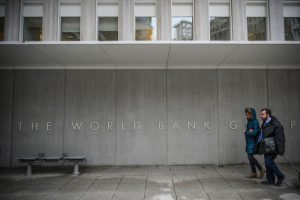
In order to prevent these areas in Haiti from sliding into indigence, the World Bank is proactively funding initiatives to empower Haiti’s government and civil society to become more prepared against future natural disasters. Learn about how financing and training from the World Bank is helping the poorest communities of Haiti better determine risk through infrastructure and urban planning as the country continues to rebuild.
![]() |
Latin America and the Caribbean are likely to grow 5.7 percent this year—twice the expected recovery for the United States—say the World Bank and International Monetary Fund in a report released this week. Regional output of goods and services is expected to continue to grow in 2011, although at the slower rate of 4 percent.
Brazil, Peru and Uruguay are expected to grow 7.5, 8.3 and 8.5 percent, respectively. The report highlighted Brazil as an emerging economic behemoth, thanks to credit growth and increased exports of iron ore, beef, soy, and sugar on the international scene, combined with strong consumption and poverty reduction at home.
Experts attribute the better-than-expected pace of Latin American growth—despite the global financial crisis—to a decade of good fiscal and debt management, strong commodity prices, growing foreign investment, and increased trade links with Asia.
The World Bank and IMF report cautioned against complacency, urging commodity-exporting countries in particular not to waste huge capital inflows on domestic financial excess, but instead set up windfall savings funds for emergencies. In addition, Luis Alberto Moreno, president of the Inter-American Development Bank, warned U.S. businesses not to miss out on the opportunity to develop ties to fast-growing economies. He said that for years, free trade in the U.S. has inaccurately been synonymous with loss of jobs. He also pointed out that, as a result of strong macroeconomic performance in the region and various free trade agreements, U.S. exports to Latin America increased 82 percent between 1998 and 2009.
AQ's coverage and post-trip analysis of the President's May 2-4 visit.