

btn_subscribe-top
btn_give-a-gift
btn_login
btn_signup
btn_rss

Fresh Look Reviews

Fresh, unique perspectives on recent books from across the hemisphere originally published in English, Spanish and Portuguese.
In this issue:
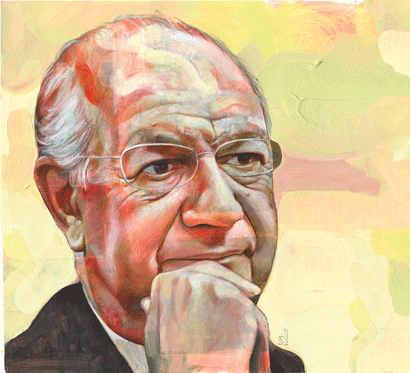
Read Robert L. Funk's review of <i>The Southern Tiger: Chile's Fight for a Democratic and Prosperous Future</i>. Portrait of Ricardo Lagos by Scott Laumann.

The Southern Tiger: Chile’s Fight for a Democratic and Prosperous Future by Ricardo Lagos

Robert L. Funk

Ricardo Lagos has been a central figure in creating the Chile we know today—a prosperous democracy and a model for much of the region. Whether as an academic, an activist in the struggle for democracy, a minister of education (1990–1992) and of public works (1994–1998), a president (2000–2006), or once again, a major figure in the opposition, Lagos has been almost omnipresent in the country’s major policy decisions.

By any measure, he has had an extraordinary career in public service.

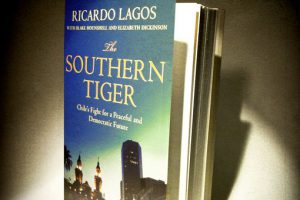
In The Southern Tiger: Chile’s Fight for a Democratic and Prosperous Future—written with Foreign Policy magazine managing editors Blake Hounshell and Elizabeth Dickinson—Lagos retraces some of those steps and reflects on the impact of his policies both at the time and today. The former president makes it clear that he too views himself as a central player in Chile’s democratic and economic transition.

Two themes emerge in The Southern Tiger. The first, now a cliché in studies of Chilean politics, is that of continuity and change; the second is Ricardo Lagos standing up to authority.

On the first theme, Chile is a very different country from the one that Lagos’ coalition, the Concertación, inherited from the regime of General Augusto Pinochet in 1990. Although the foundations of today’s economic model were laid by the dictatorship, the Concertación opened up the economy, reinserted Chile into the international community, instilled and expanded basic social services in areas such as health care, and expanded access to primary, secondary and postsecondary education. By almost any measure—GDP, household income, poverty, education, health, government spending, infrastructure, connectivity, international trade, or corruption—Chile has made great progress in the last 20 years.

Lagos’ recollection of the turbulent past recounts episodes of cacerolazos (pot-banging demonstrations, mostly by the middle class), guanacos (water cannon–bearing trucks used to break up street protests), and fights and divisions among opposition parties as they vied for frontrunner status in electoral battles. For a Chilean reader in 2012, a time when social movements have swept the country, the Chile of yesterday seems very similar to the Chile of today.

But other longstanding debates would also resonate: the appropriate economic model for Chile; the need for infrastructure; and how to overcome interest groups and other obstacles to improve the education system.

In these areas and others, Lagos is quite candid about the unfinished tasks at the end of his term in office. He expresses frustration at the imperfect Transantiago public transportation system, the inability to have a bridge built to the island of Chiloé, the lack of reform to a binomial electoral system that offers some minority parties overrepresentation in congress, and the centralization of Chile’s political system, among others.

For several of these, he seems to be pointing the finger at his successor, Michelle Bachelet: “After I left office […] the project stalled.”

Another sign of how little Chile’s elitism has changed is in Lagos’ retelling of more personal episodes. Naming colleagues and adversaries from the 1960s onwards, for example, he mentions many people—from Heraldo Muñoz, the current head of the UN Development Programme’s Bureau for Latin America and the Caribbean, to Organization of American States Secretary General José Miguel Insulza to José Tohá, former President Salvador Allende’s minister of the interior and minister of defense—who continue to be active, or whose children are active, in the public sphere (Lagos’ own son is a senator).

The lack of renovation among political (and other) elites stems from longstanding cultural traditions, but also from political institutions—principally, the political parties and the electoral system—that do not encourage the emergence of new actors. These institutions were barely touched during the Concertación’s time in office, which, together with the lack of new political leadership, are at the root of much of the discontent in Chile today.

The fact that public policy challenges remain similar despite so much progress does not mean—as many young Chileans argue today—that little has been accomplished. Rather, it underscores the magnitude of the challenges faced in 1990. One of Lagos’ objectives in the book seems to be to remind readers, especially youth, that the first steps in improving social policy, democratizing the political system and modernizing the economy and infrastructure were accomplished amid tremendous political and ideological opposition.

At the same time, there is an underlying story in The Southern Tiger of Lagos’ own development. The description of the economic debates of the 1960s and 1970s recall a time when the state still had a predominant role in encouraging development. While Lagos would later preside over one of the world’s most neoliberal economies, it is not difficult to identify the origins of his enthusiasm for grand infrastructure projects rooted in the old, developmentalist model.

With an income of roughly $15,000 per capita, Chile is approaching middle-income status. But in Chile and elsewhere citizens demand more than economic well-being. The challenges may be grounded in economic policy—who spends what on education, for example—but as Lagos implicitly recognizes, the obstacles to resolving these challenges are political as well as economic.

He notes that a country’s success rests on three pillars: democracy, economic growth and social equality. Lagos writes that countries that lose sight of this equilibrium quickly lose their way. For him, Chile’s success is a result of constant, even if slow, progress on all three fronts.

But today’s instability indicates that perhaps all three pillars did not develop in unison. Chile’s political system remains very much based on the rules and limitations imposed by Pinochet’s 1980 constitution. For young voters born in a democratic Chile, it makes little sense to continue operating under rules originating in the Cold War. Lagos recognized that, and no postauthoritarian president did more to move beyond these democratic handicaps than he did. In 2005, he spearheaded a set of constitutional amendments that eliminated provisions such as designated and lifetime senators and reimposed civilian control over the armed forces.

Here, the former president underlines the second theme of the book: Ricardo Lagos standing up to authority. The narrative is full of anecdotes of a lifetime of assertiveness, including standing up to Pinochet, to the Chicago Boys, and to the police officers who came to arrest him in 1986. (“‘Sir,!’ I said sharply, offended by the bad cop’s presumption of informality. ‘Who authorized you to address yourself to me like this, using the ‘tu’?’.”) Lagos also recounts standing up to skeptics who did not believe the 1988 plebiscite could be won and, as president, standing up to military generals when they showed insubordination, and to U.S. President George W. Bush over the invasion of Iraq: “Mr. President, friends are supposed to be frank.”

For those more familiar with the presidential Ricardo Lagos, famous for his stern rebukes and fatherly lectures, it is easy to forget his role during the dictatorship—a time when Lagos and others like him showed tremendous courage. Although many opposition leaders were not from the working class, they still were not afraid to demonstrate in the streets, participate in clandestine meetings, go to jail, and perhaps most famously in Lagos’ case, wave an accusatory finger at General Pinochet on television.

That moment on national television—“a cool night of April” in 1988—catapulted Lagos to the national stage, and not coincidentally, it is how he chooses to begin his book. He had come prepared to attack General Pinochet, asking the producer: “Of all these cameras […] which one will be facing me?” When Lagos saw an opening in the questioning, he faced the previously identified camera, and spoke directly to and pointed at Pinochet: “I told him his ambitions to power outstripped any past leader of Chile.” Lagos earned his stripes, and the book has several additional vignettes of how he did so.

But even with these personal accounts, it seems at times as though the book cannot decide if it wants to be a brief history of Chile’s democratic transition (of which there are many) or a memoir of a former president of Chile, of which there are few. The historic details provided should already be fairly well known to a reader interested enough in Chile to tackle a Lagos memoir. As a memoir, it is a bit general: at 258 pages, it is about a third the length of Tony Blair’s memoirs and about a quarter the size of Bill Clinton’s.

Lagos is not prone to public displays of emotion. Well-known episodes are usually recounted in terms of their policy impact rather than their impact on the man. The author does not delve deeper.

But from what Lagos has chosen to tell, and the way he tells it, there is little doubt that he sees himself as someone who stood up for what he believed, and that he is proud of the road he (and Chile) have taken. At a time when many Chileans are questioning that road, there is some value in looking back.


O novo Brasil: as conquistas políticas, econômicas, sociais e nas relações internacionais by Albert Fishlow

Paulo Vieira da Cunha

Few would disagree with the notion that Albert Fishlow is the right person to write the book on Brazil’s transformation over the past 30 years. He has followed the country since the early 1960s and contributed personally to its economic policy debates—both in Brazil and in the United States. He helped train a legendary cohort of Brazilian policy analysts and even helped establish one of Brazil’s most influential economic research institutes, the Instituto de Pesquisa Econômica Aplicada (IPEA).

Fishlow’s new book, O novo Brasil: as conquistas políticas, econômicas, sociais e nas relações internacionais (The New Brazil: Political, Economic, Social and International Relations Achievements), lives up to expectations. A detailed analysis of political, economic, social, and external change in the turbulent years of Brazil’s “New Republic,” it is also a painstakingly documented, factual and critical presentation of Brazil’s journey from the days of Tancredo Neves (elected president in 1985 but too sick to take the oath of office), through the administration of President Fernando Henrique Cardoso (1995–2003), to the meteoric rise of former President Luiz Inácio Lula da Silva (2003–2010). It takes as its starting point the Diretas Já—Direct [Elections] Now—movement in 1983, which began to bear fruit once military rule ended in 1985.

As Edmar Bacha—a member of the team who developed the Plano Real (Real Plan) in 1994 and a former Brazilian Development Bank (BNDES) president—observes in the preface, “Under the New Republic, Brazil experienced transformative changes. We missed an interpreter; someone with a solid formation, deep and detailed knowledge, critical detachment, and why not say it, a love for the country, to explain these transformations. We now have it.”

The book’s 10 chapters are divided into two parts. The first part focuses on the return to democracy and on the struggle to achieve inflation stabilization with the Plano Real; the second deals with the 15 years from 1995 to 2010: the Cardoso and Lula administrations. It documents the social achievements of both Lula administrations. But it also provides a commanding analysis of why and how the preconditions for Lula’s success were set in the Cardoso administrations.

Chapter seven, for instance, summarizes economic developments and policies over the course of the four administrations and concludes that “two presidents with different political perspectives and priorities produced consistent economic policies.” Despite the similarities, however, growth under Cardoso was mediocre, but it was explosive under Lula. Real per-capita income stagnated under Cardoso, but it boomed under Lula. On average, in the last four years of the Cardoso administration, the Brazilian economy created 668,000 jobs per year in the formal sector. In the last four years of Lula, it generated more than double that number: 1.7 million jobs per year. Total credit volumes and access to credit shot up under Lula and the percentage of the population living under the poverty line dropped from 28.1 percent in 2003 to 15.3 percent in 2009.

The achievements are remarkable. But what Fishlow makes clear is that the explanation for this success was not a divergence from past policy, but rather a policy continuum.

The continuum Fishlow refers to can be hard to see. Cardoso ruled under the shadow of the long period of structural adjustment in the 1990s. From 1995 to 2002 there were major negative shocks, including the aftermath of Mexico’s 1994 Tequila Crisis and the immediate post-9/11 economic slowdown in the United States.

Lula was luckier. He came to power just as China emerged on the global scene after joining the World Trade Organization. The 2001 recession in the U.S. and the aftermath of the September 11 attacks ushered in a period of unprecedented monetary easing with a combination of tax cuts and expenditure increases that ultimately destabilized the global economy.

But in the shorter run, these policies—along with the rise of China to worldwide economic prominence—produced a boom in commodity demand and prices that was extremely beneficial for Brazil. By the early 2000s, Brazil was prepared to fully and productively take advantage of positive external shocks, which propelled growth and help sustain it even today. It was this period that allowed Brazil to rapidly accumulate external reserves and go from being a net borrower to a net creditor—two factors that would prove critical during the 2008–2009 economic crisis.

As Fishlow points out, the biggest macroeconomic changes came in early 1999 with the introduction of a floating exchange rate, a commitment to stabilize and then decrease the debt-to-GDP ratio (the Fiscal Responsibility Law), and inflation targeting.

Fishlow’s contribution is to uncover how much went into creating the Fiscal Responsibility Law that passed in 2000—what he calls “financial restructuring” or the making of the modern Brazil. According to the author, the key was to pair privatization and debt restructuring to create a financial system that could for the first time extend credit to the private sector.

As part of this, discipline was injected into administering public finances at the sub-national level so that fiscal federalism could work, despite the vicissitudes of the political system. Privatization boosted productivity and investment, and it also helped finance the huge cost of private and public debt restructuring that Fishlow estimates at 14.1 percent of GDP. “Combined, these two processes—financial restructuring and privatization—contributed to the creation of a modern Brazil. Both served the country well, despite criticism.”

Even that was not enough, however. Part of the “new deal” post-1998 was the incessant increase in the tax burden, a historically unprecedented doubling of the tax burden from 17 percent of GDP in 1997–1998 to 34 percent of GDP by 2008 and nearly 37 percent of GDP today. The point here is that Cardoso built the fiscal space that future governments have used to fuel both growth and social programs.

This fiscal space came in handy when Lula fought the external crisis in 2009–2010 and went on a spending spree to bolster the election prospects of his successor.

Cardoso failed to build a leaner and more efficient state. But he did create the conditions for fiscal and financial stability. Lula wanted to create a larger and more activist state but resisted until 2009.

This is what we have today. The Brazilian private sector and the electorate at large endorse it wholeheartedly. Is it sustainable? Can public expenditures continue to grow at a faster rate than GDP, as they have done for 12 years since 1999? More importantly, is this in the long run a contribution to growth and welfare?

O novo Brasil does not answer these questions. But it frames the context for an informed, objective discussion. The larger contribution of Fishlow’s work is to have produced an accessible, well-written and pithy account of Brazilian economic, social and external policies in the past quarter of a century, set in their specific political contexts.

Its companion English language version, Starting Over: Brazil Since 1985, which came out after the Portuguese version—deals with much of the same material but is reconfigured. Both are excellent analyses of the changes and challenges that Brazil has faced since its transition to democracy.


El país de uno: Reflexiones para entender y cambiar a México by Denise Dresser

Eric L. Olson

Despite boasting the second largest economy in Latin America, a noteworthy record of fiscal and economic management in the midst of global turmoil, and envious commercial ties to the United States, Mexico has failed to take its rightful place as a global powerhouse. Many observers wonder why Mexico has not achieved its true potential. What, for instance, has prevented Mexico from joining the BRICS (Brazil, Russia, India, China, and—now—South Africa)?

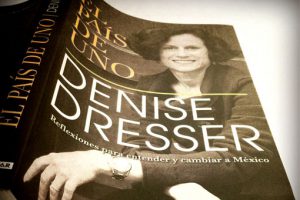
In El país de uno: Reflexiones para entender y cambiar a México (My Country: Insights to Understand and Change Mexico), Denise Dresser concludes that Mexico has no one to blame but itself for its lackluster performance. Dresser, a distinguished professor at the Instituto Tecnológico Autónomo de México, columnist at Proceso magazine and editorial writer at Reforma, offers a sharp, unflinching and penetrating analysis of today’s Mexico that traces much of the problem to the failure to live up to expectations raised by the 2000 electoral defeat of the single-party state led by the Partido Revolucionario Institucional (Institutional Revolutionary Party—PRI) for most of the previous century.

Dresser uses each chapter to slowly (and at times painfully) peel back the layers of self-deception, hypocrisy and even cynicism that have betrayed the hopes of Mexicans. Her book employs some of the razor-sharp cadence of her opinion columns—for which she received the 2010 National Journalism Award for a February 2009 article about Carlos Slim—to puncture Mexico’s pretentious and corrupt elite. Her precise one-liners embellish every paragraph. One tart example: “[Mexico] is a country of goats grazing through the hallways of power, devouring everything in their path.”

Dresser’s critique—some may call it a screed—spares neither the political nor the economic elite. “Party doesn’t matter; political affiliation doesn’t matter; and neither does ideological affinity,” she writes. “Whoever reaches power in Mexico—either PAN [Partido Acción Nacional], PRI, PRD [Partido de la Revolución Democrática], Green Party or PANAL [Partido Nueva Alianza]—they all seem to think the same way: how, when and for whom do we obtain something.”

Dresser traces the origins of such selfishness to the bad habits developed over decades of one-party rule. Her analysis of the old guard of the PRI—sometimes referred to as the “dinosaurs”—settles on the group of political operators who paved the way for one of Mexico’s most controversial modern presidents, Carlos Salinas de Gortari (1998–1994). Although a reformer and innovator in economic policy, Salinas failed to see the need for political reform to sustain his free-market agenda and build a transparent and accountable government. “[Salinas] was an enlightened despot, but a despot nonetheless,” writes Dresser in a section titled La Famiglia Salinas. Perhaps more disturbing is her suggestion that the architects of the Salinas era—and maybe Salinas himself—are now working behind the scenes in support of the frontrunner in the 2012 presidential election, former PRI Governor Enrique Peña Nieto. For what it’s worth, the governor has denied this repeatedly.

Her disappointment is especially apparent when she turns her scalpel on the PAN and PRD—opposition parties once viewed as the wedge that would pry open Mexico’s political system. Dresser believes they have done little to change the underlying forces that have rendered Mexico’s democracy weak and economic potential limited: “Party rotation in power does not combat corruption, it merely expands [corruption’s] ideological spectrum.”

Dresser finds the economic elite equally irresponsible, accusing them of undermining the nation’s potential and future for their own gain. She describes “buddy capitalism” (capitalism de cuates) in which the lines between the entrepreneurial and political class are blurred by favoritism and protectionism under the thinnest veneer of the market. Consumers, as a result, have been left vulnerable.

The plundering of the nation’s riches, the sacking of its resources and the hollowing out of institutions to serve personal interests have, according to Dresser, left Mexico a “slumbering,” “poorly educated,” “conformist,” and “corrupt” country where petro-riches have lulled politicians into making consistently bad decisions.

The final chapter turns to the challenges of rebuilding her country. “The only hope, given the diagnosis contained in this book, is found in those Mexicans—dedicated, brave, and combative—who refuse to participate in the moral collapse of their country,” she writes—and then proceeds to list a “citizenship agenda” that would restore citizens to their rightful place at the center of the democracy and bring about a more transparent and accountable government and economy.

The agenda would be aimed at developing an informed citizenry who can demand accountability from elected officials and the entrepreneurial class. Dresser believes this is a practical goal, involving fundamental changes in attitudes and outlooks that will lead to a truly democratic and more equitable society. The agenda lists 10 critical points, each beginning with the refrain, “beginning today....” For example, “Beginning today, I will understand that voting is an essential, crucial and fundamental right,” and that this right should be exercised with great forethought and responsibility.

This is not a book for those uninitiated in the intricacies of Mexican society and politics, nor for those who are defensive about Mexico and its place in the world. And it will disappoint those looking for a good news story to counterbalance the steady stream of bad news about crime and violence. But it is a message of hope, and as such it will be invaluable to those honestly wrestling with the complexities of Mexico and to those rooting for this great nation to succeed and take its rightful place on the global stage. There are no sugar-coated magic pills offered by Dr. Dresser; instead she offers the hard truths that must be confronted before any recovery program is possible.

The translation of the title (My Country) gives insight into Dresser’s deeper purpose in writing the book. She sees the citizen as critical for the future of the country; Mexicans must assume their civic responsibility and work to change current reality. While the book does not pull punches about the corruption and mediocrity of Mexican leadership, it takes ordinary citizens to task for allowing their country to be overrun by “kleptocrats.” Dresser believes Mexicans must take ownership of their country, and, through her 10-point roadmap, throw off the shackles that have held the country back.

Dresser outlines an important agenda that is post-partisan at its core and returns to the foundational notions of citizenship and responsibility as the source of strength in society—that same source of strength that inspired the change of power in 2000. It is a tough message, to be sure, but one that may just save Mexico from its own worst instincts.


Connect with AQ


Twitter YouTube Itunes App Store


WEB EXCLUSIVES

Most Popular

MOST POPULAR ON AQ ONLINE

  • Most Viewed
  • Past:
  • 1 day
  • 1 week
  • 1 month
  • 1 year

NOW ON AS/COA ONLINE

Loading...

AQ MEDIA PARTNER

Loading...