
btn_subscribe-top
btn_give-a-gift
btn_login
btn_signup
btn_rss

Las sorpresivas alianzas por la paz en Colombia

April 12, 2013

by Jenny Manrique

Desde que inició el proceso de paz del gobierno colombiano con las Fuerzas Armadas Revolucionarias de Colombia (FARC) en la Habana, es innegable que el tema de encontrar una salida política al conflicto ha hecho que muchos coincidan o discrepen sobre los posibles escenarios. Como todo en política.  

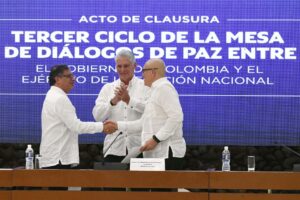
En la marcha del pasado martes fue inevitable que amigos y enemigos de la paz se sentaran en diversas orillas según sus nuevas apuestas. De un lado, el presidente Juan Manuel Santos, el alcalde de Bogotá Gustavo Petro, el movimiento Marcha Patriótica liderado por Piedad Córdoba e Iván Cepeda—quienes recientemente recibieron un reconocimiento en Copenhague—, indígenas, campesinos, afrocolombianos, policías, soldados y las mismas FARC desde la Habana, coincidieron en que es necesario que los colombianos blinden el esfuerzo de los negociadores en Cuba. Durante años, estos personajes tuvieron visiones aparentemente irreconciliables y se denunciaron unos a otros sin tapujos sobre temas de alto calibre, tales como la responsabilidad del Estado en relación a los llamados falsos positivos.  

Del otro lado se encontraron quienes han hecho un ruido permanente en el proceso: los sectores más ultraconservadores encabezados por el ex presidente Álvaro Uribe y recientemente por el ex mandatario Andrés Pastrana—quien durante su gobierno no logró alcanzar los acuerdos pretendidos con la guerrilla—acompañados por el Polo Democrático Alternativo, uno de los partidos más antiuribistas de Colombia. A pesar de sus diferentes matices, a todos en este grupo les preocupa que la paz se convierta en una campaña por la reelección—un escenario absolutamente obvio para Santos en el contexto en que se juega todo su capital electoral.

Read More

Tags: Colombia, Colombia Peace Talks

Colombians March to Support Peace Process

April 10, 2013

by AQ Online

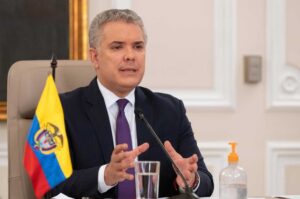
Colombian President Juan Manuel Santos joined hundreds of thousands of Colombians in a march through Bogotá on Tuesday to support the peace negotiations between the Fuerzas Armadas Revolucionarias de Colombia (Revolutionary Armed Forces of Colombia—FARC) and the Colombian government.

The march drew together an estimated 800,000 people across Colombia and 200,000 in Bogotá alone, making it the largest demonstration to take place in Colombia’s capital city. Similar demonstrations took place in Cali, Barranquilla, and Santander.  In an address to the crowd, President Santos urged unity and said that “All conditions are set…[for] an end to the conflict.”

Since peace talks began in Oslo in October, the Colombian government and representatives of the FARC have been negotiating a peace treaty that is expected to address agrarian reform, a top priority for the FARC. The president and his team have also addressed the demilitarization and disarmament of the rebels and explored ways to integrate the FARC’s leadership into the political system. In addition to agrarian reform and demobilization, social development—health, education, housing, and poverty eradication—have been a top priority for both sides.

However, Santos announced last week that the government would not negotiate a bilateral ceasefire with the FARC until the two sides reach a final agreement. Without ceasefire in place, some Colombians fear that there will be no end to the conflict which has killed at least 600,000 people and displaced another three million.

Political opponents of the current administration, including former Colombian President Álvaro Uribe, refused to participate in Tuesday’s march. Uribe and other politicians have argued that the march supports the FARC, rather than victims of violence and kidnappings.

Tags: FARC, Colombia, Colombia Peace Talks

Colombia Peace Talks Move Forward on Agrarian Reform

March 21, 2013

by AQ Online

Today concludes the seventh round of peace talks between the Fuerzas Armadas Revolucionarias de Colombia (Revolutionary Armed Forces of Colombia—FARC) and the Colombian government in Havana, Cuba, with news yesterday signaling there could be an agreement on one of the most important issues on the agenda: agrarian reform.   

The issue of land reform is an important part of the negotiations for both sides, yet progress has been slow.  In the past, the FARC has declared that to solve agrarian problems, there must be a “democratization,” which means distribution of land held by large landowners.   The FARC’s proposal for land reform includes a demand for a redistribution of land and the improvement of property conditions.

By the end of today, there will likely be a press conference detailing the solutions reached in this latest round of dialogues with negotiations resuming again on April 2. 

The Colombian peace process began ceremoniously in Oslo, Norway, in October 2012 with negotiations commencing in Havana, Cuba, in November 2012. Lead negotiators include former  Vice President Humberto De La Calle on behalf of the Colombian government and  Ivan Márquez on behalf of the FARC.

Tags: FARC, Colombia Peace Talks

Negotiating Peace for Displaced Persons in Colombia

February 14, 2013

by Stephanie Leutert

Peace talks between the Revolutionary Armed Forces of Colombia (FARC) and the Colombian government are slowly progressing in Havana, Cuba, despite renewed violence and generally low expectations. Land reform continues to be a contentious area and just last month the FARC unveiled a 10-point communiqué outlining its requests. While the plan failed to explicitly mention the 4 to 5 million citizens currently displaced due to the conflict, successful peace talks could create new opportunities for these Colombians to return to their land.

The multiple perpetrators in Colombia’s armed conflict mean that a peace treaty with only one group (the FARC in this case) will not provide a complete solution. The FARC and the paramilitaries (the largest and most organized adversaries for much of the conflict) each displaced millions of civilians from some 7 million total hectares of land. Although estimates vary, by all counts the paramilitaries displaced as many individuals as the FARC and perhaps even twice the amount. Drug traffickers and organized criminal groups like the new bandas criminales (BACRIM) have also followed suit, ousting a good portion of 2011’s estimated 200,000 displaced persons, according to the Consultoría para los Derechos Humanos y el Desplazamiento (CODHES).

The first step to reversing the displacement is providing basic security, particularly in the areas most affected by the conflict (Caqueta, Putamayo, Valle del Cauca, among others). Here the FARC peace agreement would begin this process, but comprehensive disarmament, demobilization and reintegration is critical.

Read More

Tags: Colombia Peace Talks, FARC, Colombia

Monday Memo: Obama’s State of the Union Speech – Ecuadorian Elections – Venezuelan Currency Devaluation – and more

February 11, 2013

by AQ Online

Top stories this week are likely to include: President Obama discusses immigration reform in the State of the Union; Ecuador prepares for presidential and congressional elections; Colombia and FARC make progress in peace negotiations, Venezuela’s currency devaluation goes into effect; and Mexican farmers begin to release suspected criminals in negotiations with Guerrero state.

President Obama to Discuss Immigration, Guns in State of the Union Address: U.S. President Barack Obama is expected to renew his demand for comprehensive immigration reform, gun control and climate change in this Tuesday’s State of the Union speech, according to senior officials. Obama has called for a pathway to citizenship for the 11 million undocumented immigrants living in the U.S. and told House Democrats that immigration reform will be a “top priority and an early priority” of his second term. Meanwhile, Republican Senator Marco Rubio of Florida, a Cuban American and one of eight U.S. Senators in a bipartisan effort to overhaul the U.S. immigration system, will deliver the Republican response—a signal that the GOP is seeking to overcome its poor standing with Latino voters in the last election. “The president and Senate negotiators have laid out two different visions with respect to a path to authorized status for undocumented immigrants. The principles to be laid out in Tuesday’s speech will set a marker of just how much the president is willing to negotiate,” said AQ Senior Editor Jason Marczak. Tuesday’s speech will be the 100th State of the Union address.

Ecuador Prepares for Elections Next Sunday: Ecuador's presidential race will enter its final week as voters at home and abroad prepare to elect the country's next president and members of the national assembly on February 17. President Rafael Correa is heavily favored to win re-election to a third term. A survey last week by polling agency Perfiles de Opinion showed that 62 percent of expected voters support Correa, while only 9 percent of voters say they support his nearest rival, Guillermo Lasso. Correa has held office since 2007, and if he wins Sunday’s elections, he will serve a four-year term that will end in 2017.

Colombia and FARC say they are Nearing an Agreement on Land Reform: The Colombian government and FARC leaders said Sunday that they are making progress in the latest round of peace negotiations in Havana, which included an "exhaustive analysis" of land reform. During a press conference on Sunday, the FARC said that they are prepared to free two police officers and one soldier captured by the rebel group in January, fulfilling demands by the Colombian government to release the hostages at once. FARC negotiator Rodrigo Granda said Sunday that the negotiations were on track and advancing at “the speed of a bullet train.” The sixth round of peace talks between the Colombian government and the FARC will start on February 18.

Venezuelan Currency Devaluation Takes Effect Wednesday: The Venezuelan government's long-expected currency devaluation, announced last Friday, will officially go into effect on Wednesday. The official exchange rate will change from 4.3 bolivars to the dollar to 6.3 bolivars to the dollar, the fifth time the country’s currency has been devalued in a decade. Venezuelan Vice-President Nicolás Maduro, currently leading the country in the absence of the ailing President Hugo Chávez, said that the devaluation was needed to fund the country’s social programs, and was also a response to attacks on the bolivar by capitalist “speculators.” The impending devaluation has already caused a rush of panicked last-minute shoppers to buy domestic appliances and other goods over Carnival weekend.

Mexican Farmers Begin Turning over Hostages: Mexican farmers in the township of Ayutla who detained 53 suspected criminals in January released 11 of their hostages last Friday after negotiations with the Guerrero state government. The farmers, fed up with recent drug-related violence and kidnappings in their community, have formed so-called “self-defense” forces to set up checkpoints, capture and imprison suspected criminals before trying them before an ad-hoc town assembly. The vigilante justice has been criticized by human rights groups, but the farmers say they are acting to protect themselves in the absence of the state, which has so far tolerated the movement. The Guerrero state government said the farmers agreed to turn over "the first 20" detainees, though it's not clear whether more will be released. The farmers have said they will not back down until the government proves it is capable of protecting them and establishing peace in the region.

Tags: Barack Obama, Rafael Correa, Colombia Peace Talks

Colombian Rebel Groups Compromise Ongoing Peace Process

February 5, 2013

by AQ Online

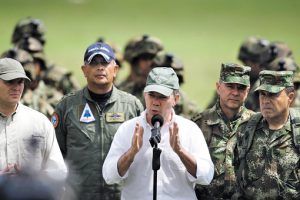
Colombian President Juan Manuel Santos announced today that six members of the Fuerzas Armadas Revolucionarias de Colombia (Revolutionary Armed Forces of Colombia—FARC) and two policemen were killed in an attack near the Venezuelan border. The announcement comes only days after the president requested that the Ejército de Liberación Nacional (National Liberation Army—ELN) set free two German citizens who were seized last week in the northern Catatumbo region. These events have raised concern about the viability of the peace talks in Havana, but both the government and the FARC remain optimistic about progress.

Iván Márquez, head of the FARC’s negotiating team, believes there are many reasons for his side to be optimistic about the peace process. “Destroying the road towards peace over claims of armed conflict would be unreasonable,” he stated. But since the group’s two-month ceasefire came to an end on January 20, kidnappings and violence have resumed in the country.

Smaller but more politically motivated than the FARC, the ELN has also expressed its interest in engaging in peace talks with the government, but the group refuses to stop its attacks on civilian and military targets as a precondition to begin the negotiations. The peace-building process held in Cuba recently concluded its third phase, with no major progress made toward ending the longstanding conflict.  Land reform is currently the main focus of the negotiations.

Tags: Colombia, Juan Manuel Santos, FARC, ELN, Colombia Peace Talks

Monday Memo: Immigration Reform Plans Announced – CELAC Summit Concludes – Argentina and Iran Plan Truth Commission – and more

January 28, 2013

by AQ Online

Top stories this week are likely to include: Cuba takes over the chairmanship of CELAC on Monday as the summit wraps up in Santiago; a bipartisan group of U.S. senators release a plan for comprehensive immigration reform a day before Obama lays out his proposals; violence in Colombia increases following the end to the FARC’s unilateral ceasefire; Argentina and Iran seek approval for an international truth commission to investigate the 1994 AMIA bombing in Buenos Aires; mining protesters blockade a highway in Peru.

Bipartisan Senate Group, Obama Release Plans for Immigration Reform

A bipartisan group of eight U.S. senators will announce at 2:30pm (EST) a plan for comprehensive immigration reform, which includes providing a path to citizenship for undocumented immigrants that is contingent upon first ensuring that new border security measures and an exit system are in place. The agreement comes a day before U.S. President Barack Obama is expected to announce his proposals for comprehensive immigration reform. The bipartisan group includes Senators Charles E. Schumer (D-NY), John McCain (R-AZ), Lindsey Graham (R-SC), Robert Menendez (D-NJ), Richard Durbin (D-IL), Michael Bennet (D-CO), Jeff Flake (R-AZ). Senator Marco Rubio (R-FL) joined the discussions more recently.  They met over the weekend to finalize the draft of a principles agreement that also outlines a path to citizenship for undocumented youth, known as DREAMers, and other principles for reforming the immigration system. “Today’s release of bipartisan principles for immigration reform legislation will put down a marker of what will be possible in a potential comprehensive package this spring. This, combined with the president’s speech in Las Vegas tomorrow and the significant weight that is expected to be placed on reform in the State of the Union on February 12, illustrates that if reform is to happen now is the year,” notes AQ Senior Editor Jason Marczak.  

Cuba takes over Chairmanship of CELAC as Summit Concludes

The two-day Comunidad de Estados Latinoamericanos y Caribeños (Community of Latin American and Caribbean StatesCELAC) summit  concludes today in Santiago, as Cuba formally assumes chairmanship of the regional body today. CELAC—which includes 33 Latin American and Caribbean nations and excludes the U.S. and Canada—hosted leaders from the European Union, who pledged to deepen ties with Latin America while meeting with regional trade blocs like Mercosur and the Pacific Alliance for trade discussions. As the summit wraps up today, Venezuelan Vice-President Nicolás Maduro is expected to deliver a message from Venezuelan President Hugo Chávez—still in Cuba recovering from surgery—who was noticeably absent from the summit. Also absent were Paraguayan President Federico Franco (Paraguay was not invited), Ecuadorian President Rafael Correa, and Brazilian President Dilma Rousseff, who left early to deal with the aftermath of the nightclub fire that killed over 230 people in Rio Grande do Sul.

Violent Attacks Increase in Colombia After Ceasefire

In the first week since the Fuerzas Armadas Revolucionarias de Colombia (Revolutionary Armed Forces of Colombia—FARC) ended a unilateral ceasefire it had announced in November, the guerrillas have reportedly carried out 32 violent attacks between January 20 and 26, surpassing the number of attacks before the peace talks were announced. The Colombian government warned that the increased violence, including the FARC’s kidnapping of two policemen last Friday, could undermine the rebels’ peace talks with the government in Havana. The third round of talks concluded last Thursday, with no major progress toward ending the conflict between the rebels and the government.

Argentina and Iran Agree to Create a Commission to Investigate Bombing

The foreign ministers of Argentina and Iran agreed Sunday to create an international truth commission that would investigate the 1994 car bombing of a Jewish center in Buenos Aires that killed 85 people. Argentine prosecutors have said that the attack was orchestrated by Iran’s current defense minister and carried out by Hezbollah. Formation of the truth commission will require legislative approval in both Iran and Argentina to move forward, and would consist of five independent judges from other countries that would analyze documentation investigating the attack. Jewish groups in Argentina have said the agreement will strengthen Argentine-Iranian ties at the expense of the victims of the attack, and expressed doubt that any suspects would be brought to trial.

Hundreds of Protestors Protest Mining Project in Peru

Hundreds of protestors in northern Peru are continuing a week-long highway blockade near Cañaris after 31 people were injured Friday in a confrontation with police over the nearby Cañarico Norte copper project. The protesters say that Canadian mining company Candente Copper Corp. will divert water that locals rely on for farming, but Peru’s vice-minister of energy and mines says that the protesters have been misinformed about the project’s environmental risks. Despite the protests, a roundtable meeting will go forward as scheduled on February 2 to discuss the project. Meanwhile, Peru's Ministry of the Environment will publish a guide to reducing social conflict through "ecological and economical zoning."

Read More

Tags: Colombia Peace Talks, CELAC, Comprehensive Immigration Reform

FARC Requests Dialogue on Agrarian Reform

January 16, 2013

by AQ Online

With the fate of peace talks between the Fuerzas Armadas Revolucionarias de Colombia (Revolutionary Armed Forces of Colombia—FARC) and the Colombian government hanging in the balance, the FARC requested yesterday that Colombian Agriculture Minister Juan Camilo Restrepo participate in the negotiations in Havana, Cuba, to address the guerrilla group’s demand for agrarian reform.

The FARC’s proposal, presented on Monday, calls for a complete rural agrarian reform that includes property redistribution and the improvement of property conditions, among other elements. (See this document for more details.) Hours after the FARC’s request, Restrepo praised the group’s intentions but said that the proposal should be discussed by the members of the peace negotiation team, to which he does not belong. Besides land reform, the agenda for the peace talks includes the end of armed conflict, guarantees for the exercise of political opposition, drug trafficking and the rights of victims of the conflict.

On Monday, the FARC’s chief negotiator, Iván Márquez, said that the two-month ceasefire would come to an end on January 20. The rebel group’s intention to resume military operations—as well as the FARC’s allegedly increasing weapons acquisitions in Ecuador—may endanger the peace process that began in October.

The government’s chief negotiator, Humberto de la Calle, stressed that Colombia is willing to extend guarantees to the rebels as long as the FARC agrees to end the fighting. Talks in this third phase of negotiation will go on for 11 days, followed by a three-day break. The deadline for the negotiations is set in November.

Tags: Colombia, Colombia Peace Talks, FARC

Controversy Surrounds FARC Ceasefire

November 27, 2012

by AQ Online

The Fuerzas Armadas Revolucionarias de Colombia (Revolutionary Armed Forces of Colombia—FARC) was criticized on Monday for violating the two-month, unilateral ceasefire that the rebel group announced in Cuba last week. In an interview with El Tiempo, Colombian Defense Minister Juan Carlos Pinzón accused the FARC of targeting energy infrastructure and the local police in the department of Antioquia despite the ceasefire having been in effect since midnight on November 20. The FARC denied intentionally violating the ceasefire and responded by saying that their forces on the ground had not received the order in time, blaming the media for not disseminating the news properly.

The Colombian government has resisted pressure to respond to the ceasefire. “Those who have an obligation to demonstrate credibility and commitment [to the peace process] are the FARC, who have historically lied to Colombia,” said Minister Pinzón referring to the 1987 ceasefire that the rebel group violated and the demilitarized zone that the FARC used to rebuild its numbers and capability during the last attempted peace negotiation (1999-2002). Instead, President Juan Manuel Santos and his negotiating team are focusing on long-term peace and the integration of the rebels’ leadership into the political system. Minister Pinzón emphasized the government’s hope that the negotiations succeed and that the FARC “once and for all declare a ceasefire for the rest of time.”

Despite the controversy surrounding the ceasefire, the Colombian government and the FARC will continue to negotiate the end of the 50-year conflict behind closed doors. The talks are being mediated by Norway and Cuba, while Chile and Venezuela—seen as sympathetic to the Colombian government and the FARC, respectively—provide diplomatic support.

Tags: Colombia, FARC, Colombia Peace Talks, Ceasefire

Colombia: Negociar en Medio del Fuego (o sin él)

November 20, 2012

by Jenny Manrique

El anuncio unilateral de las FARC, justo en el día en que se iniciaba la segunda fase de las conversaciones de paz con el gobierno en La Habana, tomó por sorpresa al país: habrá una tregua navideña entre el 20 de noviembre y el 20 de enero, tiempo durante el que el grupo guerrillero promete no realizar ninguna clase de “operaciones militares ofensivas contra las fuerzas públicas” o “actos de sabotaje contra la infraestructura pública o privada”. Este anuncio significa en la práctica que las FARC pararán la escalada de ataques que venían realizando en Chocó, Valle y Cauca—paro armado, cilindros bomba y explosión en fiesta de Halloween incluidos, con un saldo de 47 muertos y 83 heridos—poblaciones donde es un eufemismo seguir llamando daños colaterales a las múltiples víctimas civiles que dejan los enfrentamientos entre ilegales y fuerzas armadas en contextos donde nadie respeta el Derecho Internacional Humanitario. También significa que disminuirán el asedio a poblaciones como Arauca y Norte de Santander donde los trabajadores de los oleoductos tienen cada vez menos libertades de movimiento por temor a ser secuestrados.

Probará además si la cadena de mando que hoy tiene a los máximos representantes de las FARC en la Habana—Iván Márquez a la cabeza—es capaz de controlar a sus cerca de 8 mil hombres distribuidos en cinco bloques y dos comandos conjuntos en todo el país, y si cuentan con suficientes métodos de verificación para probar el éxito de la tregua que como anuncio le sienta muy bien el país, y deja a las FARC con una ventaja política importante en las negociaciones. Aunque sorpresivo, el comunicado de Iván Márquez también recuerda que entre los negociadores guerrilleros hay una fuerte presencia de “estrategas” políticos, al punto de que varios de ellos hacían trabajo militante de base, no tenían un bloque al mando, o incluso no estaban en el país combatiendo como es el caso de Marcos León Calarcá que encabeza la Comisión Internacional de las FARC desde la década de los 80.

Read More

Tags: Colombia, FARC, Peace Talks, Colombia Peace Talks

Pages


Connect with AQ


Twitter YouTube Itunes App Store


Issues in Depth: President Obama's travel to Mexico, Costa Rica

AQ's coverage and post-trip analysis of the President's May 2-4 visit.

» Read more.


WEB EXCLUSIVES

Most Popular

MOST POPULAR ON AQ ONLINE

  • Most Viewed
  • Past:
  • 1 day
  • 1 week
  • 1 month
  • 1 year

NOW ON AS/COA ONLINE

Loading...

AQ MEDIA PARTNER

Loading...