
btn_subscribe-top
btn_give-a-gift
btn_login
btn_signup
btn_rss

La cruzada de la oposición venezolana en su gira por el Mercosur

May 10, 2013

by Jenny Manrique

Al tiempo que el presidente Nicolás Maduro se reunía con sus pares en Uruguay, Argentina y Brasil, la oposición venezolana preparó una gira paralela, en cuya parada en Buenos Aires sus miembros fueron recibidos por legisladores opositores al gobierno de Cristina Kirchner.  

“No hay manera de ocultarle al mundo que somos mayoría, durante años el chavismo dijo que Venezuela era una lucha entre ricos y pobres, y hoy la mitad votó por nosotros y claramente la mitad de los venezolanos no son ricos. No vamos a retroceder”, resumió el líder opositor y ex alcalde del municipio Chacao, Leopoldo López, para definir la cruzada que emprendió la oposición con el ánimo de contar la realidad de esa otra Venezuela que impugnó las elecciones.

Confiados en que sí hay un acompañamiento internacional a sus denuncias, estas prosperarán y se podrán repetir las elecciones, López y los asambleístas venezolanos Nora Bracho y Freddy Guevara estuvieron esta semana en la Cámara de Diputados en Buenos Aires.

"La mejor manera de definir las elecciones que pasaron [el 14 de abril] es una pelea de David contra Goliat", disparó López en momentos en que Maduro, a quien llaman "El ilegítimo" se encontraba a pocas cuadras en la Casa Rosada con su homóloga Cristina Kirchner.

 Ese Goliat representado por la estatal petrolera PDVSA, ministerios, gobernaciones, alcaldías y la Fuerza Armada nacional fue el aparato que, según López, dedicó todo su poder a “contaminar el proceso electoral entero”, razón por la cual la impugnación que interpuso Henrique Capriles esta semana no se debe sólo a los resultados.

 “Nuestra queja comienza sobre la mancha anticonstitucional y manipuladora que ocurrió el 9 de enero cuando permitieron la continuidad del gobierno de Chávez [en su ausencia], sólo para que quien iba a ser candidato del chavismo, pudiera ser presidente mientras era candidato”, expresó López.

Con cifras en la mano, López relató todas sus quejas: en 10 días de campaña, el oficialismo tuvo 65 horas de cadena nacional, versus los 23 minutos de publicidad a los que tuvo derecho Henrique Capriles; se reportaron en total 230 violaciones a leyes electorales, y 5.623 irregularidades ocurrieron en las mesas de votación.

Read More

Tags: Nicolás Maduro, Mercosur, Cristina Fernandez de Kirchner

Francisco, el político

March 19, 2013

by Jenny Manrique

En total, 31 jefes de Estado, 11 jefes de gobierno, 132 delegaciones de todo el mundo y de diferentes congregaciones religiosas, asistieron este martes al comienzo oficial del pontificado del papa Francisco, el primer latinoamericano en llegar a la cabeza de la Iglesia Católica que congrega a 1.200 millones de fieles, la mitad de ellos en la región. Todo fue histórico en este día en el Vaticano: desde la presencia del presidente de Taiwan, Ma Ying-jeou  hasta la del líder de la Iglesia Ortodoxa, Bartolomé, pasando por el celebrado hecho de que la curia romana haya escogido a un arzobispo no europeo, jesuita, (que no figuraba en el sonajero de los papables) para reemplazar a un pontífice, Benedicto XVI, quien también por primera vez en la historia renuncia.

Y en medio de todo ese simbolismo hay algo todavía más relevante: el significado para la Argentina de tamaña decisión en momentos en que la curia y el oficialismo están más enfrentados que nunca. Este lunes cuando Francisco recibió a la mandataria de Argentina Cristina Kirchner, en ese escenario cálido en el que intercambiaron regalos y bromearon ante las cámaras, en realidad estaban sentadas en el Vaticano, frente a frente, dos visiones de país.

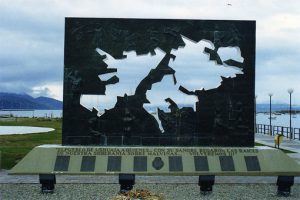
La presidente le pidió al Pontífice que intercediera ante Gran Bretaña por el reclamo de soberanía de las Islas Malvinas, recordando la labor que ejerció Juan Pablo II cuando intermedió en el conflicto entre Chile y Argentina por el canal de Beagle que amenazaba con desestabilizar el Cono Sur en 1978. Pero aunque Francisco también cree que las Malvinas son argentinas, -lo que, dicho sea de paso, no lo califica como un mediador neutral- el epicentro del asunto es que Roma tiene su propio conflicto con la Iglesia Anglicana hace 500 años, que reconoce a la reina de Inglaterra como la exclusiva jefe de su iglesia.

Read More

Tags: Argentina, Cristina Fernandez de Kirchner, Pope Francis

Monday Memo: Cuba Loosens Travels Restrictions – Chávez’ Visitors in Havana – CFK in Asia – Obama’s Inauguration

January 14, 2013

by AQ Online

Top stories this week are likely to include: Cubans apply for foreign visas; Nicolás Maduro, Diosdado Cabello and Latin American leaders visit Chávez in Havana; Cristina Fernández de Kirchner travels to Asia; and Barack Obama begins his second presidential term.

Cuba Loosens Travel Restrictions: The directive announced last October to relax regulations on Cuban travel overseas goes into effect today. The measure eliminates the requirement for Cubans to have a government permit and an invitation letter from abroad when applying for a passport. However, the Cuban government still reserves the right to refuse passports “to those deemed risky to public security, national defense or for other reasons, and limit travel by professionals considered ‘vital’ to Cuba,” according to MercoPress. The Associated Press is reporting long lines forming outside travel agencies, migration offices and the U.S. Interests Section in Havana today in response to the policy.

Chávez Remains in Havana: Venezuelan President Hugo Chávez’ health remains uncertain following his December 2012 surgery in Havana on an unspecified form of cancer—causing him to miss his own inauguration last week. Now that Venezuela’s Supreme Tribunal of Justice has delayed Chávez’ swearing-in until an indefinite, ambiguous date when Chávez recovers, many Venezuelans are questioning who is in charge. Over the weekend, Vice President Nicolás Maduro and National Assembly President Diosdado Cabello traveled to Havana to meet with Cuban President Raúl Castro. Former Vice President Elías Jaua has said that Chávez is “fighting for his life” while Information Minister Ernesto Villegas asserts that the Venezuelan leader is responding to treatment. Pay attention this week to see if more information is revealed about the state of Chávez’ health.

CFK in Asia: Argentine President Cristina Fernández de Kirchner departed Cuba yesterday, where she was meeting with Raúl and Fidel Castro, and continued to the Middle East and Asia for a three-country tour through next Monday. She arrived in Abu Dhabi, United Arab Emirates, yesterday to speak at the World Future Energy Summit and will leave tomorrow for Jakarta, Indonesia, for a visit that will focus on advancing bilateral cooperation with the world’s fourth most populous country. Fernández de Kirchner will depart Jakarta on Friday for Vietnam, where she will visit Ho Chi Minh and Hanoi. The president’s visit follows a trade mission last October led by Secretary for International Trade Beatriz Paglieri.

Obama’s Inauguration: U.S. President Barack Obama begins his second term on Sunday. However, since the January 20 date falls on a Sunday, the public ceremony on the National Mall in Washington DC will be pushed back one day to Monday, January 21. Obama will be sworn in on Sunday at a small, private gathering.

Tags: Cristina Fernandez de Kirchner, Hugo Chavez, Nicolás Maduro, Diosdado Cabello, Barack Obama

La guerra política detrás de la Ley de Medios

January 7, 2013

by Jenny Manrique

Desde hace más de un año, la población argentina asiste a una batalla jurídica y mediática que se libra en los estrados, en las calles y, cómo no, en los medios, por la aplicación de la Ley de Servicios de Comunicación Audiovisual, promulgada en el 2009, en la que la presidenta Cristina Fernández de Kirchner se viene jugando todo su capital político.

La llamada Ley de Medios, que derogó una antigua legislación que databa de la dictadura, ha sido destacada por sus simpatizantes dada su construcción democrática, ya que para la redacción de sus 166 artículos se realizaron 23 foros y 80 conferencias con integrantes de la sociedad civil.

“Es un proceso inédito porque el proyecto de ley se discutió horizontalmente, trabajamos por consenso y logramos que 21 puntos que debatimos en el seno de nuestra organización fueran incluidos en la ley”, asegura a Noticias Aliadas, Néstor Piccone, miembro de la Coalición por una Comunicación Democrática, que agrupa a 300 entidades desde sindicatos hasta organizaciones de la sociedad civil, pasando por radios comunitarias, pequeñas y medianas empresas, pueblos originarios, cooperativas de servicios, universidades, y grupos de género y de personas con discapacidad, a lo largo y ancho del país.

Los detractores de la ley están principalmente en aquellos grupos mediáticos afectados por las medidas de desmonopolización, que en síntesis buscan que nadie concentre el uso de licencias, es decir, que un mismo concesionario pueda ser dueño como máximo de una señal satelital, hasta 10 señales sonoras, de televisión abierta o cable, y hasta 24 licencias de radiodifusión por suscripción.

Read More

Tags: Argentina, Ley de Medios, Clarín, Cristina Fernandez de Kirchner

Argentine Anti-Government Protests

November 14, 2012

by Simon van Woerden

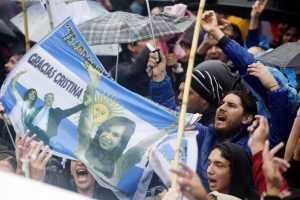
Tens of thousands of Argentines took to the streets nationwide and in smaller groups around the globe last Thursday to protest the government of Argentine President Cristina Fernández de Kirchner. In the last several months, demonstrations like this have become increasingly common: a similar protest in September drew around 200,000 angry Buenos Aires residents out of their homes, armed with pots and pans in a so-called cacerolazo, clamoring and banging their utensils to express their dissatisfaction with the current administration.

Although Fernández de Kirchner was elected with 54 percent of the vote just a year ago, her approval ratings have since fallen to little over 31 percent. The issues moving people into the squares are numerous. The public’s concern over insecurity, inflation, government corruption, and rumors of constitutional reform to facilitate a third term for the president in 2015 are some of the most important grievances.

"We don't want a Chávez who is in power for thirty years. Cristina needs to respect the constitution," says German Levisman, a 29-year-old pharmacist who is worried about the prospect of a third term for Fernández de Kirchner and angered by the government’s policies. "Something that's worth five pesos will increase in price by one peso in a few months. I can't possibly save any money for a house of my own. Meanwhile, government officials buy themselves luxury apartments in the business district. And they have the audacity to call hardworking people 'oligarchs' and 'bad persons?' They are the real bad guys!"

The president has refrained from a direct response to Thursday’s mass protest, which was mobilized mostly via social networks. Fernández de Kirchner did allude to the protest indirectly, referring to participants as "provocative people" who “want to return to the ultra-conservative regime".

Read More

Tags: Argentine anti-government protests, Cristina Fernandez de Kirchner

Argentina Lowers Voting Age to 16 After Measure Clears Last Hurdle

November 2, 2012

by AQ Online

Argentina’s Chamber of Deputies, or lower house, approved a bill Wednesday night that lowers the national voting age from 18 to 16 years old, having broad implications for next year’s congressional elections according to many analysts.  The law passed by a large majority in Argentina’s Senate in mid-October as detailed by an earlier AQ Daily Focus, and was once again passed by a 131-2 majority in the lower house, making it law.

The vote was boycotted by lawmakers from the Unión Cívica Radical and Partido Socialista, and 28 opposition senators signed a statement vowing to vote against modifications to Argentina’s constitution in the future.

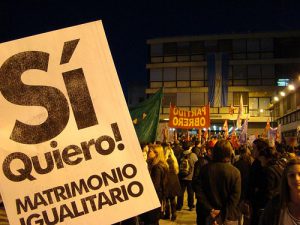
Opponents still contend that the additional 1.4 million voters would add momentum to President Cristina Fernández de Kirchner’s ruling Frente para la Victoria coalition in the 2013 legislative elections. This could lead to the ruling party gaining a two-thirds majority in both houses and allow for a change to the constitution that would grant the President the chance to run for a third term.  President Fernández de Kirchner does not support these claims, and says it expands democratic liberties in the same way her government promoted legislation to allow same-sex marriages.

The President’s approval rating was at an all time low in September, at 24.3 percent, and it remains to be seen whether this will boost her approval.

Tags: Argentina, Cristina Fernandez de Kirchner, voting age

Argentine Government gives Clarín Deadline to Divest Holdings

October 25, 2012

by AQ Online

The Argentine government said Wednesday that it would move to break up Grupo Clarín, the country’s largest media conglomerate, by December 7 if it does not comply with a 2009 anti-monopoly law requiring large media groups to divest some of their holdings.

Martín Sabbatella, the president of the Autoridad Federal de Servicios de Comunicación Audiovisual (Federal Audiovisual Communication Services Authority—AFSCA), said that Grupo Clarín has refused to comply with a requirement that at least 20 other media groups affected by the law have said they would obey. According to the government, Grupo Clarín has 240 cable systems, one FM radio and nine AM and stations, and four open-signal television channels. The law requires companies to limit their number of cable licenses to 24. In 2009, President Cristina Fernández de Kirchner said that Grupo Clarín held 73 percent of Argentina’s radio, television and cable licenses.

Grupo Clarín’s media outlets, widely opposed to the Fernández administration, have challenged the controversial article 161 of the 2009 media law as a violation of press freedoms. The article limits the number of media outlets that companies can own and called for large media groups to sell some of their media assets. Grupo Clarín immediately challenged article 161 in court, saying that it would give the Argentine government too much control over the press.

Argentina’s courts have yet to settle the question of article 161’s constitutionality, but a Supreme Court ruling in May said that a temporary suspension of article 161 would only be valid until December 7, a deadline that Grupo Clarín has said it will request to extend.

For the last several years, the Fernández administration and Grupo Clarín have been feuding on multiple fronts, including the government’s cancellation of Grupo Clarín ISP Fibertel’s license and a 2010 government lawsuit accusing the owners of Grupo Clarín and La Nación of acquiring newsprint producer Papel Prensa with the backing of Argentina’s military government in 1976. Press freedoms groups like the Committee to Protect Journalists say that the escalating dispute has led to a dramatic polarization of the Argentine press.

“This is not about enemies,” said Sabbatella, who will auction off Grupo Clarín’s broadcast licenses if it does not come into compliance with the law before December 7. “The government is not coming to expropriate, to nationalize or confiscate any media group. We are coming to apply the law.”


Tags: Argentina, Cristina Fernandez de Kirchner, Grupo Clarin

Argentina Lowers the Voting Age to 16

October 18, 2012

by AQ Online

The Argentine Senate overwhelmingly passed a bill late Wednesday night that lowers Argentina’s national voting age from 18 to 16 years old. With 52 votes in favor of the bill—and just 3 senators opposing the measure and two abstentions— Argentina joins Austria, Nicaragua, Brazil, and Ecuador in allowing 16-year-olds to participate in elections. At least six laws must now be modified so that electoral system can full embrace the new voters.

Passage of the bill means an additional 1.4 million new voters in a country where 23 million people voted last year. Argentine voters are obligated to vote in general elections.

Critics say the move is a calculated attempt by Argentine President Cristina Fernández de Kirchner to position herself for re-election in 2015, suggesting that the law would allow Fernández to cash in on her popularity among young Argentines. If younger voters support Fernández’ party in large numbers in the October 2013 legislative elections, it’s possible they could push through a constitutional reform that would permit her to run for president for a third term.

But the bill’s co-author, Senator Elena Corregido, says those charges are absurd. “They always say it’s not the right time or that there’s political speculation, but in reality, this deepens the democratic process we’re experiencing.”

Political analysts say the law may not have much of an impact overall: “We’re talking about a fairly small percentage and they’re not all going to vote for Cristina Fernández,” said political analyst Graciela Romer. “In the last elections, her youth vote was above average, but it wasn’t an avalanche, either.”

Recently, Argentina has also mulled over other changes to voting law, including allowing foreign residents of Argentina to vote. Buenos Aires is already asking foreign non-citizens to vote in local elections. But it remains to be seen whether voters—foreign, teenage or otherwise—will want their presidents to run for three terms.

Tags: Argentina, Cristina Fernandez de Kirchner, voting age

Monday Memo: AQ’s Top Expected Stories for the Week of June 11

June 11, 2012

by AQ Online

Top stories this week are likely to include: the Mexican presidential election pushes forward after last night’s debate; Chávez to file presidential candidacy today; Fernández de Kirchner to visit UN on Thursday; new UNASUR Secretary-General takes over; Brazil responds to lowered GDP projections; and B-20 business summit in Los Cabos.

Mexican Presidential Election: After last night’s second and final debate between the top four contenders for the Mexican presidency, the final weeks of the campaign are likely to see continued discussion over the candidates’ positions on how to fight nacrotrafficking and insecurity. Each candidate sought to spell out how their approach would differ from President Felipe Calderón’s heavy reliance on the military. According to the New York Times, the candidates, “while vowing to continue to fight drug trafficking, say they intend to eventually withdraw the Mexican Army from the fight,” pledge “to devote more attention to programs that address the social inequality that leads young people to join criminal groups.” In polling, PRI candidate Enrique Peña Nieto continues to hold a steady lead while PRD challenger Andrés Manuel López Obrador (AMLO) has moved into second. On AMLO, AQ Editor-in-Chief Christopher Sabatini notes that “despite his recent rise in polls, credible surveys still put him a very distant second and well outside the margin of error.”

Chávez to File Today: Venezuelan President Hugo Chávez will register his presidential candidacy in person today for re-election to a third term in the October 7 contest. Henrique Capriles Radonski, opposition challenger, filed his candidacy yesterday after a 6.2-mile (10 kilometer) march through Caracas flocked with tens of thousands of supporters. Chávez’ debilitating health after nearly a year of cancer treatment raises a constant red-flag. Notes Sabatini, “Capriles Radonski’s march through the city was intended to be a demonstration of strength, a counterpoint to Chávez’ absence and the mystery of his health. But will it work? Many of the old wedge issues remain, irrespective of perceptions of Chávez’ health: What will happen in a post-Chávez scenario both in terms of political turmoil and the still-popular misiones?”

Brazil Reacts to Lower GDP Projections: Economic forecasters have lowered Brazil’s projected 2012 GDP growth from 2.72 percent to 2.53 percent, according to Reuters. The revised figures are due to problems in the manufacturing sector and the European debt crisis, according to a poll from Brazil’s central bank. “While Europe and a slowing in Chinese demand are adversely affecting Brazilian manufacturing, the long-term challenge is to reduce the ‘Brazil cost’ of excessive bureaucracy, inadequate infrastructure and other manufacturing hurdles that companies face,”  according to AQ Senior Editor Jason Marczak.

CFK at the UN on Thursday: Argentine President Cristina Fernández de Kirchner (CFK) will attend the UN Special Committee on Decolonization meeting, known as the Committee of 24, this Thursday. According to Argentine Cabinet Chief Juan Manuel Abal Medina, CFK “expects a strong definition in terms of advancing in the path of dialogue and reaching an agreement to recover our Malvinas Islands.”

New UNASUR Secretary-General: Today, the Union of South American Nations (UNASUR) secretariat shifts from Colombia to Venezuela. All chancellors of UNASUR countries are currently in Bogotá for a ministerial-level meeting at the Casa de Nariño, where María Emma Mejía, former Colombian foreign minister and current UNASUR secretary-general, will hand over the secretariat to Venezuelan businessman Alí Rodríguez Araque, who was formerly the Organization of Petroleum Exporting Countries (OPEC) secretary-general and president of Petróleos de Venezuela S.A. (PDVSA), Venezuela’s state-owned oil company.

B-20 Summit to Precede G-20: The B-20 business summit will convene on Sunday and Monday in Los Cabos, Mexico, as an antecedent to the G-20 next week. The B-20’s objective, according to its website, is to promote dialogue between governmental and business leaders, enrich the discussions of the G-20 and facilitate the G-20’s objectives such as economic growth and social development. A sample of working groups in this year’s B-20 will include food security, green growth, employment, anti-corruption, and trade and investment.

Tags: Mexico, Colombia, Venezuela, Argentina, Felipe Calderon, Hugo Chavez, Cristina Fernandez de Kirchner, UNASUR, Enrique Peña Nieto, Henrique Capriles Radonski

Continued Fallout over YPF Expropriation

May 8, 2012

by AQ Online

European Union Trade Commissioner Karel De Gucht yesterday announced that Argentina may face retaliatory measures following the nationalization of Spanish energy giant Repsol’s majority stake in YPF, Argentina’s largest oil and gas company. De Gucht’s comments were delivered during a seminar in Brussels, Belgium, on “Strategic Challenges in the EU–Brazil Relationship.”

 “We will soon be moving forward with a response to Argentina's action in the Repsol case,” said De Gucht, adding, “There has for many years been a debate about open markets in the region[…] In recent weeks, we have seen that debate heat up again with Argentina's move against a Spanish company's stake in YPF.”  Although De Gucht did not specify what actions the EU is considering, any moves would presumably be in addition to the European Community’s plans to file a WTO complaint over Argentina’s alleged use of protectionist policies, such as the use of non-automatic import licensing for commonly traded goods.

On Friday, President Cristina Fernández de Kirchner signed into law the expropriation measure and named Miguel Galuccio as its chief executive. He promises to have a five-year plan ready within 100 days.

Tags: Cristina Fernandez de Kirchner, Repsol YPF, European Union Trade Commissioner

Pages


Connect with AQ


Twitter YouTube Itunes App Store


Issues in Depth: President Obama's travel to Mexico, Costa Rica

AQ's coverage and post-trip analysis of the President's May 2-4 visit.

» Read more.


WEB EXCLUSIVES

Most Popular

MOST POPULAR ON AQ ONLINE

  • Most Viewed
  • Past:
  • 1 day
  • 1 week
  • 1 month
  • 1 year

NOW ON AS/COA ONLINE

Loading...

AQ MEDIA PARTNER

Loading...