
btn_subscribe-top
btn_give-a-gift
btn_login
btn_signup
btn_rss

The Importance of Civic Engagement

May 21, 2013

by John Parisella

With a full-blown scandal over the expenses of some senators engulfing the Canadian Senate, an ongoing inquiry into corruption in Québec’s construction industry, and the daily whirl of allegations from the Republican leadership toward the Obama administration on Benghazi, the IRS, and Associated Press reporters, it is not surprising that young people may be questioning themselves these days about the value of civic and political engagement. 

Rarely a day passes without a media story about a scandal, unearthed by the diligent work of an investigative reporter, reaching the mainstream networks.  It is no small wonder that cynicism and skepticism are growing about the workings of the body politic or civil society, and whether getting involved and making a difference is still as relevant in today’s world as it was in more recent times.

The temptation to sit on the sidelines and criticize from afar those who are betraying the public trust is becoming more comfortable than joining the fray, fighting for one’s beliefs or a noble cause, and trying to bring about change to a social or political condition.  Some actually believe that today’s younger generation—closely wedded to technological innovation—will be more susceptible to growing doubts about the value of civic engagement.

While the current setting in many Western democracies may lead some to pessimism and disengagement, I remain an optimist about the future and why it is more important than ever to get involved.

Read More

Tags: Canada, civic engagement

Is Canada’s International Role in Decline?

May 6, 2013

by John Parisella

It’s been said that Canada has usually “punched above its weight” on the international stage.  Whether we refer to the world wars of the twentieth century, the creation of the United Nations, the bipolar era of the Cold War, the conflict in Korea, or the reaction to Afghanistan after 9-11, Canada’s contribution in blood, sweat and tears is well documented.  In addition, we have constantly played a role in peacekeeping and economic liberalization that is a model to the developed world.

Our close alliance with our neighbor to the south, the United States, has usually kept us in the loop on the major currents in world politics.  However, the recent announcement by Foreign Minister John Baird that Canada would not seek a seat at the UN Security Council was met with criticism from many long term adherents of Canada’s traditional foreign policy and with derision by the growing chorus of critics who oppose the values associated with the Harper government’s foreign policy and its ideological stance on international cooperation.  Rightly or wrongly, it was interpreted as one more step toward Canada’s declining reputation in foreign policy matters.

Withdrawing from Kyoto, opposing international NGOs  that provide abortion services, actively supporting Israel’s right wing coalition government and its approach to the Palestinian issue, and withdrawing from some UN projects have led proponents of traditional Canadian foreign policy to question whether Canada’s international reputation is now so damaged that Baird’s announcement was more an admission of certain defeat for the Security Council seat rather than a point of principle. Some veteran observers of UN politics interpreted Canada’s defeat two years ago for that very seat as a vote against this new orientation under the Conservative government of  Stephen Harper. 

To be fair, the world today is far different from the glory days of Lester B. Pearson and his Nobel Peace Prize in the Suez Crisis of 1956. Under Pearson’s influence and that of his successors, Canada’s international profile was built on multilateral cooperation, active engagement and above all, a strong diplomatic corps. However, events today are less predictable and ideologies less certain.  We no longer live in the more predictable bipolar world of the Cold War.

Read More

Tags: Canada

A Changing Political Landscape in Canada

April 18, 2013

by John Parisella

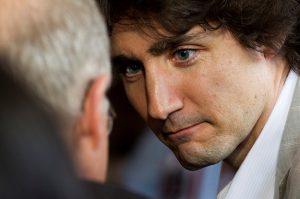
As the Harper majority government ends its second year in office, the Liberal party, with its third party status, has just chosen a new leader.  Normally, the choice made by the third party in the House of Commons would barely make waves.  However, the overwhelming victory of Justin Trudeau—the son of former Canadian Prime Minister Pierre Trudeau—at the end of a six-month campaign has already begun to change the political landscape in Canada.

Public opinion polls preceding and following Trudeau’s selection have demonstrated that the 41-year-old Trudeau is beginning to have an impact on how Canadians see their current government, what they are looking for in a prime minister  and how important the theme of real change could be in the next election.  Just prior to choosing Trudeau as leader, Liberals had either narrowed the gap in public approval with the governing Conservative party and the opposition New Democratic Party (NDP), or taken the lead. A poll recently published in the National Post showed Trudeau actually widening his lead in approval ratings.

With the elections more than two years away, these polls should be taken with a grain of salt. But it is clear that the Liberals have gained a new energy that makes them, once again, a potential major player in the next electoral cycle.  How Trudeau fares in the coming weeks could very well determine the outcome of the 2015 election.  If he loses traction, he may quickly become a passing fad.  Should he display aplomb and growth in his new role, he could become the prime minister-in-waiting.

Read More

Tags: Justin Trudeau, Canada

Has Canada Undergone a Big Shift to the Right?

April 9, 2013

by John Parisella

It is often stated as conventional wisdom that the United States is a right-of-center country and Canada, with its state-supported healthcare system and greater state-run operations, is left-of-center. In real life, it is far more complex—as we saw when U.S. President Barack Obama handily won reelection last November while the right-wing Conservative Party of Prime Minister Stephen Harper has won the last three general elections in Canada.

Occasionally, a book surfaces about a new political paradigm, leading many to question existing conventional wisdom. One such book has just hit the newsstands in Canada.  It is called The Big Shift, co-authored by the CEO of Ipsos Public Affairs, Darrell Bricker, and the respected Globe and Mail newspaper columnist John Ibbitson. I happen to personally know both authors and can attest to their impeccable professional credentials. Their book covers new ground, challenges existing conventions and offers a highly provocative treatise about the new politics in Canada.

The book’s basic thesis deals with an emerging new coalition of voters—anchored in resource-rich western Canada and in suburban Toronto—who share more conservative values and views about the role of government, the economy and law and order.  Using recent census data, they point to a fluid demography where many new immigrants are arriving in Ontario and western Canada from East Asia and South Asia. Ibbitson and Bricker speak of an immigration inflow that is equivalent to the size of Canada’s largest city, Toronto, every ten years. The result is a new, more Pacific-oriented Canada that is more polarized along the conservative-progressive divide than ever in its recent history.

Read More

Tags: Canada, Canadian politics

Saying “No” to Bush on Iraq: A Defining Moment for Canada

March 26, 2013

by John Parisella

With March 20, 2013 representing the 10th anniversary of the U.S. invasion of Iraq, historians and journalists in both Canada and the United States have been assessing the wisdom of this historic decision.  The Iraq War, due to its enormous costs in human, financial and material terms, has long fallen out of favor with the American people and the political class.  Even the Republican Party has taken some distance from the major architects of the war—former President George W. Bush and former Vice President Dick Cheney.  Neither has addressed a Republican National Convention since 2004.

In Canada last week, former Prime Minister Jean Chrétien made all the media rounds and was strongly commended for refusing to go along with the so-called “Coalition of the Willing” in 2003 after the UN Security Council refused to sanction the U.S.-led invasion.  It was the first time that Canada said “no” to a U.S. president about to enter a war. It was a defining moment because Canada was a faithful U.S. ally in World War II, in the 1990-91 Persian Gulf War, the 1950-53 Korean War, and throughout the Cold War. Moreover, Canada was very supportive of the invasion of Afghanistan after September 11, 2001.

The decision to go to war in Iraq was never popular in Canada, despite the initial support of the opposition Conservative party leader, Stephen Harper.  The case for weapons of mass destruction and the links between Iraq’s dictator, Saddam Hussein, and Al Qaeda were never convincing to the general population.  The Canadian government of the day, led by Prime Minister Chrétien, had large-scale support for saying “no,” and this support was especially vocal in Chrétien’s home province of Québec. Even Conservative leader and current Canadian Prime Minister Stephen Harper later recanted, saying the war was a mistake.

Read More

Tags: Canada, Iraq War, U.S.-Canada relations

Can Canada's Papal Candidate be an Agent of Change?

March 8, 2013

by John Parisella

As Cardinals gather for the conclave in Rome to choose the next Pope, there is growing speculation about Marc Ouellet, a potential Canadian candidate from Québec. The former Archbishop of Québec and current papal legate to Latin America is seen as a serious contender to replace Pope Benedict XVI. A conservative intellectual from the Québec village of La Motte, who spent 11 years in Colombia, he is considered a potential compromise choice between the traditional European contingency of front-runners and possible candidates from the Southern Hemisphere.

Cardinal Ouellet, often described as a favorite of Rome and the departing Pope, is known for his outspoken views and has over the years developed a number of detractors in his own home province of Québec. Undoubtedly a brilliant and respected scholar, his outspoken conservative positions on abortion and gay marriage have made him a target of harsh criticism from politicians and media in Québec. Once a bastion of the Catholic hierarchy and influence, Québec has become increasingly secularized and can now be characterized as Canada’s most socially liberal province. When Ouellet condemned abortion even in the case of rape, the negative reaction was swift and virulent.

This being said, it will not be the population of Québec or liberal columnists who will select the next Pope. Ouellet and other conservative Cardinals will be facing a far greater opponent in the days ahead—the thirst and desire for change among Catholics. If the Cardinals gathered in Rome reflect the mood of Catholics around the world, the next Pope will have to be a change agent. 

There are over 1.2 billion Catholics in the world and while the growth of the Church may be in decline in the Northern Hemisphere, it is expanding in Africa and Latin America. This trend has led to some speculation this time around that a Pope could come from the Southern Hemisphere. But change is needed and desired there as well.

Read More

Tags: Canada, Pope, Marc Ouellet

The Health of Canadian Finance Minister Jim Flaherty

March 4, 2013

by Huguette Young

OTTAWA- Jim Flaherty, Canada’s finance minister, stunned Canadians when he revealed in an interview about a month ago that he had a serious skin condition but that he was still up to his high-powered job.

For months, the minister had tip-toed around questions about his health. But his changing appearance gave it away. His face was puffy and red, he looked very tired, and wasn’t his pleasant self. At times, he appeared flustered at news conferences and during the daily Question Period in the House of Commons.

As it turned out, Flaherty is suffering from a “non-life threatening but serious” skin condition called Bullous Pemphigoid, his office eventually released in a statement. He was prescribed prednisone, a powerful steroid that causes “bloating, weight gain, redness in the face and bouts of sleeplessness,” the statement said, adding his condition “was clearing up.”

Flaherty has had this condition for nearly a year and by his own account, was very reluctant to talk about it openly. In an interview at the end of January with the The Globe and Mail, the minister said it was difficult for him to share his ailment with the public.

“I don’t like talking about this,” he admitted. “But it’s necessary because I am in public office. I don’t want people to think there’s something significantly wrong with my health that affects my ability to do my job.”

Should he have been forthcoming with his dermatological condition?

There’s no clear-cut answer to that question. In Canada, there’s no legal requirement for a minister of the Crown or for the prime minister, for that matter, to reveal the nature of his sickness. Public officials have a right to privacy when it comes to health issues. But to what degree?

Read More

Tags: Jim Flaherty, Canada, Right to privacy

Québec and the Workings of Canadian Federalism

February 25, 2013

by John Parisella

With the election of a pro-sovereignty party in Québec last September, the questions about Québec’s future within the Canadian federation have once again surfaced.  While there is no referendum about Québec’s future on the horizon—in part because the ruling Parti Québécois made only a vague commitment in last year’s election campaign to conduct such an exercise, and in part because the Parti Québécois forms a minority government in the National Assembly—it is appropriate to look at the workings of Canadian federalism and see how Québec has accommodated itself within the system.

It is useful to remember that all three countries in North America are federations: Canada, the U.S. and Mexico.  All three federalist systems operate differently.  There is not a “one size fits all” brand of federalism.  In the last 50 years, all three federations have had their challenges.  Regional tensions, jurisdictional battles and the aspirations of federated states like Québec have contributed to changes in how these federations operate.  Of the three North American federations, Canada is the most decentralized—in fact, it is one of the most decentralized countries in the world.

Canada’s federation has a defined distribution of powers, some exclusive to each order of government—either federal or provincial—and some shared between the two.  Economics, culture, immigration, and the environment are shared jurisdictions.  All powers not enumerated in Canada’s federal constitution are relegated to the central government through what is called the residual clause. 

Despite this more decentralized federation, disputes have periodically surfaced within Canada when central government policies affect provincial jurisdictions through federal spending power or the development of new programs.  Since Canada’s creation as a federation in 1867, we have undergone periods of centralizing federal policies as well as periods of greater provincial autonomy. In Canada as in other federations, the Supreme Court has often been called to adjudicate these disputes.  The federated state of Québec has been at the center of these conflicts more than any other, always arguing to protect existing powers or add new jurisdictions.

Read More

Tags: Canada, Quebec, John Parisella

Obama, Jackie Robinson and Black History Month

February 20, 2013

by John Parisella

Every February in both Canada and the United States, we celebrate Black History Month.  Originally a one-week affair in the second week of February to celebrate the birthdays of President Abraham Lincoln and African American abolitionist Frederick Douglass, it is now a month-long series of festivities and activities to commemorate the contribution of African Americans and Black Canadians to North American society.  This year, the celebrations coincide with the 150th anniversary of the Emancipation Proclamation, and the 50th anniversary of Dr. Martin Luther King Jr.’s “I have a dream” speech.

While serious issues and problems affecting African American communities remain, Barack Obama has just been reelected for a second term as president of the United States—not a small accomplishment. For those of us who cringe at the subtle and not so subtle racial overtones in the attacks against Obama (the birther issue is an illustration), we should take comfort in the fact that Obama is the first president since 1956 to receive more than 51 percent of the popular vote twice, and his party received over 1 million more votes than the Republicans in the congressional elections.  Moreover, no one can deny the progress made in racial equality in the past few decades, especially since the passage of the Civil Rights Act in 1964.

Already, some historians are questioning whether the progress of African Americans remains fundamentally cosmetic with Obama in the White House.  After all, unemployment within black communities is way above the national average, poverty is at record levels, and gun violence is still at epidemic proportions.  Yet, Obama carried the vote among African Americans at the level of 94 percent.  Are African Americans just voting for one of their own and giving Obama a pass in terms of gains for their communities?

Read More

Tags: Black History Month, Canada

Will Canada’s Liberal Voice Rebound in 2013?

January 16, 2013

by John Parisella

The prevailing narrative since Barack Obama’s decisive re-election victory last November is that America is changing. His most reliable voting blocs included progressives, minorities, single women, and youths, and his campaign was supported by an impressive, technologically-inspired ground game. Even many Republican talking heads acknowledged America’s changing demographics in their post-election ruminations.

Canada may be on the verge of experiencing something similar in the coming months and years.

Back in the 1960s, and not long after John F. Kennedy’s presidential victory at the outset of the decade, the Canadian political class was transformed with the rise of a brilliant intellectual from Québec called Pierre Elliot Trudeau, then-leader of Canada’s Liberal Party.  Fluent in both French and English, coupled with an impressive life story, Trudeau brought Canadian politics into the new media age. Justin Trudeau, the late Pierre’s son and a current member of parliament representing a district in Québec, is a serious contender for the leadership of the federal Liberals and already seems to be bringing Obama’s style to his leadership campaign. Are we about to have a transformation in how we conduct our politics in Canada?

In recent years, Liberals have fallen on hard times. Once called Canada’s “natural governing party,” Liberals now have a third-party status behind the ruling Conservatives and the official opposition New Democratic Party (NDP). The federal Liberal party will choose its new leader in April in the hopes of reviving its fortunes and once again become the leading progressive voice in Canadian politics.

In the meantime, both the Ontario and Québec Liberal parties will also be welcoming a new leader at the provincial level in the first quarter of this year. Each of these parties has a different reality; the Ontario Liberals are in power in a minority parliament and the Québec Liberals are the opposition party in a minority parliament. Can change in existing Liberal parties translate into change in the country as a whole?

A look at Canadian history shows that Canada has benefited from an orderly transfer of power between moderate conservative parties and moderate progressive parties, the latter usually under a Liberal label. In the past four decades, however, Canada’s political landscape has seen the emergence of more ideologically bent parties.  To illustrate, the separatist Parti Québécois has been in office for 18 out of the last 36 years in Québec, and a more populist conservative movement—the incumbent Conservatives under Prime Minister Stephen Harper—has been a dominant force in federal politics since 1993. Liberals in the meantime have become instruments of power rather than advocates of progressive policy initiatives, leaving a greater left-right split in Canadian public discourse.

Canada’s parliament is dominated today by the Conservatives and the NDP, but new leadership among the Liberals could represent change in the political landscape.  But it will not be without risks if the electorate across Canada responds better to the clarity of the current left-right continuum.

The Liberals generally tend to be more centrist in their approach.  They believe in progressive social programs, which reduce the economic disparities in society and provide a safety net; they are not allergic to government-generated solutions; yet they have argued for fiscal restraint. It is fair to add that Liberals have never been closed to innovation and reforms to the status quo.

With the emerging debate regarding Canada’s First Nations peoples and their demands for reform, a sluggish economy with increasing pressures on the middle class, rising government debt, and the continuing presence of a separatist movement in Québec, Liberals under new leadership across the country could become a part of a changing Canada—and possibly lead the nation. But will there be a strong enough constituency in Canada to support it?

Tags: Canada, Canadian politics

Pages


Connect with AQ


Twitter YouTube Itunes App Store


Issues in Depth: President Obama's travel to Mexico, Costa Rica

AQ's coverage and post-trip analysis of the President's May 2-4 visit.

» Read more.


WEB EXCLUSIVES

Most Popular

MOST POPULAR ON AQ ONLINE

  • Most Viewed
  • Past:
  • 1 day
  • 1 week
  • 1 month
  • 1 year

NOW ON AS/COA ONLINE

Loading...

AQ MEDIA PARTNER

Loading...