
![]() |
Colombian President Juan Manuel Santos announced today that six members of the Fuerzas Armadas Revolucionarias de Colombia (Revolutionary Armed Forces of Colombia—FARC) and two policemen were killed in an attack near the Venezuelan border. The announcement comes only days after the president requested that the Ejército de Liberación Nacional (National Liberation Army—ELN) set free two German citizens who were seized last week in the northern Catatumbo region. These events have raised concern about the viability of the peace talks in Havana, but both the government and the FARC remain optimistic about progress.
Iván Márquez, head of the FARC’s negotiating team, believes there are many reasons for his side to be optimistic about the peace process. “Destroying the road towards peace over claims of armed conflict would be unreasonable,” he stated. But since the group’s two-month ceasefire came to an end on January 20, kidnappings and violence have resumed in the country.
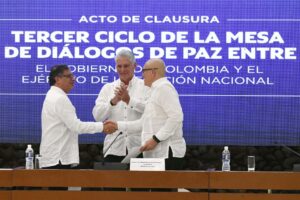
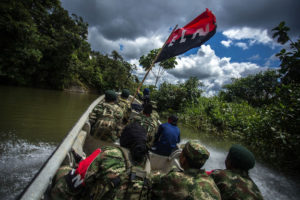
Smaller but more politically motivated than the FARC, the ELN has also expressed its interest in engaging in peace talks with the government, but the group refuses to stop its attacks on civilian and military targets as a precondition to begin the negotiations. The peace-building process held in Cuba recently concluded its third phase, with no major progress made toward ending the longstanding conflict. Land reform is currently the main focus of the negotiations.
![]() |
Last weekend, Colombia, headlines announce the worst in a series of military setbacks for the administration of President Juan Manuel Santos in its fight against the FARC.
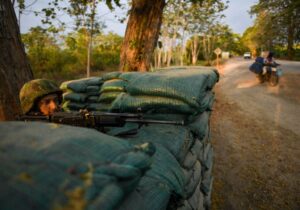
In a rural area of the department or Arauca, 10 soldiers and a corporal were killed when their unit was ambushed by the FARC. Arauca has remained a tough zone for the government to control: even during the heyday of former President Alvaro Uribe’s military offensive, the FARC maintained a considerable military power in Arauca. The ELN, a very weak group, has its only stronghold in that region.
Both groups have benefited from the fact that Arauca has a long border with Venezuela: a few years ago, when Venezuela had a policy of supporting Colombia’s guerilla groups, the FARC and the ELN established a sort of strategic rearguard beyond the border. Now that such policy is uncertain, they nonetheless take advantage of the border to escape the Army’s persecution, and to establish camps in Venezuelan territory.
How will this incident affect Santos’ policies?
“If you want peace, prepare for war” is a strategic maxim first written by Vegetius, a relatively unknown Roman author, who wrote treatises on military strategy and veterinary medicine. Such maxim can be interpreted in two ways. First, if you want your potential adversaries not to attack you, increase your military power so you will deter them. Second, if you are already involved in war, and you want to reach negotiated peace, you must build strength so that your enemy will conclude that talks are the best option to end the conflict; and you will have leverage at the negotiations.
AQ's coverage and post-trip analysis of the President's May 2-4 visit.