
btn_subscribe-top
btn_give-a-gift
btn_login
btn_signup
btn_rss

La cruzada de la oposición venezolana en su gira por el Mercosur

May 10, 2013

by Jenny Manrique

Al tiempo que el presidente Nicolás Maduro se reunía con sus pares en Uruguay, Argentina y Brasil, la oposición venezolana preparó una gira paralela, en cuya parada en Buenos Aires sus miembros fueron recibidos por legisladores opositores al gobierno de Cristina Kirchner.  

“No hay manera de ocultarle al mundo que somos mayoría, durante años el chavismo dijo que Venezuela era una lucha entre ricos y pobres, y hoy la mitad votó por nosotros y claramente la mitad de los venezolanos no son ricos. No vamos a retroceder”, resumió el líder opositor y ex alcalde del municipio Chacao, Leopoldo López, para definir la cruzada que emprendió la oposición con el ánimo de contar la realidad de esa otra Venezuela que impugnó las elecciones.

Confiados en que sí hay un acompañamiento internacional a sus denuncias, estas prosperarán y se podrán repetir las elecciones, López y los asambleístas venezolanos Nora Bracho y Freddy Guevara estuvieron esta semana en la Cámara de Diputados en Buenos Aires.

"La mejor manera de definir las elecciones que pasaron [el 14 de abril] es una pelea de David contra Goliat", disparó López en momentos en que Maduro, a quien llaman "El ilegítimo" se encontraba a pocas cuadras en la Casa Rosada con su homóloga Cristina Kirchner.

 Ese Goliat representado por la estatal petrolera PDVSA, ministerios, gobernaciones, alcaldías y la Fuerza Armada nacional fue el aparato que, según López, dedicó todo su poder a “contaminar el proceso electoral entero”, razón por la cual la impugnación que interpuso Henrique Capriles esta semana no se debe sólo a los resultados.

 “Nuestra queja comienza sobre la mancha anticonstitucional y manipuladora que ocurrió el 9 de enero cuando permitieron la continuidad del gobierno de Chávez [en su ausencia], sólo para que quien iba a ser candidato del chavismo, pudiera ser presidente mientras era candidato”, expresó López.

Con cifras en la mano, López relató todas sus quejas: en 10 días de campaña, el oficialismo tuvo 65 horas de cadena nacional, versus los 23 minutos de publicidad a los que tuvo derecho Henrique Capriles; se reportaron en total 230 violaciones a leyes electorales, y 5.623 irregularidades ocurrieron en las mesas de votación.

Read More

Tags: Nicolás Maduro, Mercosur, Cristina Fernandez de Kirchner

Maduro Begins South American Tour amid Venezuela Election Audit

May 7, 2013

by AQ Online

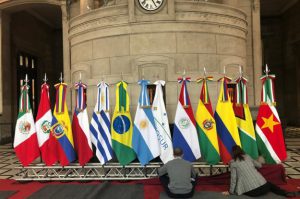
Venezuelan President Nicolás Maduro embarked today on a three-day tour of Argentina, Brazil and Uruguay, all members of Mercosur (The Common Market of the South). Following Paraguay’s suspension from the free-trade group, Venezuela joined Mercosur last year and will assume the bloc’s temporary presidency for the first time on June 28 during a summit in Montevideo.

During a ceremony on Sunday to commemorate the two-month anniversary of the death of Venezuelan President Hugo Chávez,  Maduro announced that he would visit the other Mercosur countries to “continue bringing forward a perfect equation of financial, energy, cultural and political integration.”

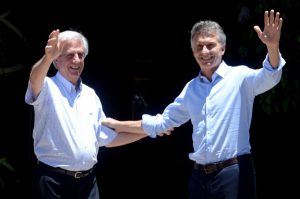
In Uruguay, Maduro will meet with Uruguayan President José Mujica, as well as former Uruguayan President Tabaré Vázquez, union leaders and the electrical transformer company Urutransfor.  Members of the Uruguayan opposition have criticized Maduro’s visit as “tactless and inconvenient” because of the current political tensions that exist in Venezuela. Later this week, Maduro will meet Argentine President Cristina Fernández de Kirchner in Buenos Aires and Brazilian President Dilma Rousseff in Brasilia to discuss the next steps for the regional bloc.

Read More

Tags: Venezuela, Nicolás Maduro, Mercosur, Uruguay, Brazil, Argentina

CELAC Summit Produces Mixed Results

February 20, 2013

by Olivia Crellin

The most controversial outcome of last month’s second CELAC (Community of Latin American and Caribbean States) summit in Santiago, following close on the heels of the first EU-CELAC meeting, was the decision in Santiago to appoint Cuban President Raúl Castro to the chairmanship of the 33-member regional body.

Castro, who will be splitting the two-year term with his Costa Rican counterpart, Laura Chinchilla, could not resist several pointed remarks aimed at the United States. He decried the presence of multinational companies in the region and the U.S.’ continued possession of Puerto Rico. The 81-year-old leader’s message was clear, however:

“We are building the ideal of a diverse Latin American and Caribbean region united in a common space of political independence and sovereignty over our enormous natural resources to advance toward sustainable development [and] regional integration,” Castro said.

Colombian President Juan Manuel Santos described Cuba’s leadership of CELAC as a “very significant political development with special symbolism.” Though absent from the summit, Venezuelan President Hugo Chávez wrote in a letter that the act told “the U.S., with a single voice, that all the attempts to isolate Cuba have failed and will fail.”  

Read More

Tags: CELAC, Mercosur, Pacific Alliance

Chávez Misses Mercosur Summit in Brasilia

December 7, 2012

by AQ Online

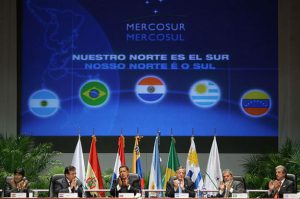
Heads of state of Mercosur member countries are meeting in the Brazilian capital today, marking the first time that Venezuela will participate as a full member in the South American trade bloc after Paraguay’s suspension in June paved the way for its membership. But health concerns are preventing Venezuelan President Hugo Chávez from joining his counterparts from Argentina, Brazil and Uruguay, with Minister of Petroleum and Mining Rafael Ramirez participating in his place.

The Venezuelan president arrived in Venezuela this morning after 10 days of medical treatment in Cuba. Chávez, 58, was diagnosed with cancer in mid-2011, and since then, has had three cancer surgeries on the island. His prolonged absences have triggered rumors around his health, and bonds have surged as a result of increased uncertainty over Venezuela’s future. When asked about his absence, Chávez explained that his departure from Cuba was delayed by a conversation with Fidel Castro, with whom he had been discussing poetry. He also asserted that Venezuela is “eight days away from the next victory,” referring to the upcoming regional elections that will take place on December 16.

Chávez has been absent from every regional meeting in the past year, including the Summit of the Americas held in Cartagena, Colombia, in April and the Ibero-American summit held in Cadiz, Spain, in November.

One of the central points on today’s agenda is Paraguay’s suspension from Mercosur, following the impeachment of former President Fernando Lugo in June. Paraguay’s suspension will likely continue after the meeting and will likely be extended until a newly-elected president takes office in August 2013.

Tags: Venezuela, President Hugo Chávez, Mercosur, Paraguay Impeachment

Monday Memo: Mercosur Considers Ecuador and Bolivia – Peña Nieto in the Presidency – Colombia, FARC Continue Talks – Peru, Chile at The Hague – and more

December 3, 2012

by AQ Online

Top stories this week are likely to include: Mercosur convenes; first week of Enrique Peña Nieto’s presidency; FARC peace negotiations resume; Peru, Chile dispute their border at The Hague; and Rousseff’s oil royalties veto makes waves in Brazil.

Mercosur Considers Ecuador and Bolivia: When Mercosur’s member nations convene on Friday in Brasilia, they will consider upgrading Bolivia and Ecuador—currently associate members—to full membership. Brazilian Foreign Minister Antonio Patriota cites a desire to deepen South American integration. AQ Editor-in-Chief Christopher Sabatini notes that “with each new addition to Mercosur the original intent of the customs union is becoming diluted. The additions may be economic benefits to Brazil and serve a broader political end, but with Venezuela and now potentially Bolivia and Ecuador the task of coordinating a common external tariff and ensuring that monetary policy doesn't interfere with internal trade is nearly impossible.”

Peña Nieto in the Presidency: After announcing his cabinet on Friday and transitioning into power the following day, Mexican President Enrique Peña Nieto undergoes his first full week in Mexico’s highest office. Yesterday, the main domestic political parties announced the Pacto por México (Pact for Mexico) that outlines desired political reforms for Peña Nieto’s term. The reforms center on three areas: strengthening the state; economic and political modernization; and expansion of social rights. As AQ Senior Editor Jason Marczak observes, “the show of unity with the joint signing of the Pacto por México is an important accomplishment for Peña Nieto but the specifics of how to implement these reforms will be the real challenge especially with PRD legislators already threatening to block them.”  

Peru, Chile at The Hague: Beginning today, the International Court of Justice will hear a lawsuit by Peru brought against Chile over an unclear maritime border. In the lead-up, however, both Chilean President Sebastián Piñera and his Peruvian counterpart Ollanta Humala have discouraged their respective citizens from being belligerently nationalistic. Piñera wrote against “exacerbated nationalism, which poisons the soul of the people,” while Humala urged for both countries to consider the outcome of the lawsuit as “the end point of a dispute between brother countries.”

Colombia, FARC Continue Talks: Both sides will resume peace negotiations in Havana on Wednesday. The Colombian government’s chief negotiator, Humberto de la Calle, has stressed “a stable and enduring peace” as the desired outcome of the talks; President Juan Manuel Santos recently announced that he has designated November 2013 as the deadline for an agreement. 

Impact of Dilma’s Partial Veto: Brazilian President Dilma Rousseff was absent at last Friday’s Unasur meeting in Lima due to “domestic engagements.” The issue in question was whether she would sign into law a controversial law on oil royalties, which would spread the nation’s resource wealth to non-producing states. According to Reuters, Dilma’s veto “changes the bill so that producer states continue to receive royalties on output from existing oil concessions. She signed most of the rest of the bill passed [in early November] by Congress, redistributing royalties from all future oil concessions so that non-producing states get a greater share.” The oil-producing states had threatened to take their case to the Supreme Court, which would have dragged out the case amid Brazil’s preparations for the 2014 and 2016 sporting mega-events. Pay attention this week to see further reactions within Brazil to Dilma’s partial veto.

Tags: Mercosur, The Hague, FARC, Enrique Peña Nieto, Juan Manuel Santos, Dilma Rousseff

From Caracas. Mercosur and The Venezuela Elections

October 5, 2012

by Juan Víctor Fajardo

The soon-to-close electoral race for the presidency of Venezuela between Venezuelan President Hugo Chávez and Henrique Capriles Radonski will certainly be remembered as one of the most fascinating campaign periods in this country’s recent political history.

On one hand, the race has been silently colored by the uncertainty that surrounds Chávez’ health. On the other, it has been marked by a series of unpredictable events that have intensified a complex and divisive political climate.

But in the midst of this bitterly-fought campaign, Chávez scored what should have been a major political victory for his administration: on July 31, he managed to secure Venezuela’s formal admission to Mercosur, the largest trading bloc in South America. Venezuela has already sent its first "Mercosur shipment" to Uruguay, but the bulk of future commerce will follow a set of rules that are currently being negotiated.

Despite its potential importance for Venezuela’s economic future, the electoral impact of Venezuela’s admission to Mercosur was surprisingly insignificant. The news was splashed across headlines and became the topic of opinion pieces and conversations. But Venezuela’s formal admission to Mercosur did not tangibly represent a major boost for Chávez’ candidacy. Why might this have been the case?

Read More

Tags: Mercosur, Venezuela, Venezuela elections

Monday Memo: AQ’s Top Expected Stories for the Week of September 17

September 17, 2012

by AQ Online

Top stories this week are likely to include: Enrique Peña Nieto tours Latin America; United Nations General Assembly gets underway; Venezuela’s presidential election intensifies; European Union continues free-trade talks with Canada; and Paraguay seeks reparations from Mercosur. 

Peña Nieto Visits Latin America: Mexican President-elect Enrique Peña Nieto departed yesterday evening for his six-country Latin America tour, which will take him to Guatemala, Colombia, Chile, Argentina, Brazil, and Peru this week. Eduardo Sánchez, spokesperson for Peña Nieto, says that the trip’s purpose is to strengthen “the position that Mexico has in the region and the possibilities that it has as a country to build itself as a facilitator” in Latin American relations. Issue topics that are expected to dominate the agenda include security, migration and trade. AQ Senior Editor Jason Marczak adds, “each visit will highlight how a Peña Nieto government will seek to elevate Mexico’s role in the region and in working with each country bilaterally. Strengthened cooperation with Guatemala is critical for improving security and migration flows, Colombia has important lessons learned in security, the Chile and Peru visits are linked to trade and the Trans-Pacific Partnership, and the Brazil visit will likely seek to set the two countries on a path toward trade collaboration rather than trade competition.” Peña Nieto told Brazil’s Época magazine that “free trade, far from protectionism, is the path that we should take to make Latin America a thriving actor in the global economy.” 

UNGA Gets Underway: The sixty-seventh session of the United Nations General Assembly opens debate tomorrow afternoon at 3:00p.m. in the New York secretariat. Access the agenda here. Heads of state are expected to arrive next week, where they will make their plenary addresses. 

Venezuela's Presidential Election: In the lead-up to Venezuela’s October 7 presidential contest, it was revealed over the weekend that incumbent President Hugo Chávez would not select a running mate in spite of his widely speculated deteriorating health. Chávez’ challenger, Henrique Capriles, has not selected a likely vice presidential candidate either. Further, Venezuelan polling firm Consultores21 released a poll over the weekend putting Capriles Radonski two percentage points ahead of Chávez – 48 percent to 46 percent.

RelatedAmericas Society and Council of the Americas will host a discussion on September 18, titled “The Road to Venezuela’s Elections: A Look at the Media, Public Opinion, and the Economy.” The president of Consultores21 will speak on the panel.

EU - Canada Trade Talks Continue: Officials from the European Union will arrive in Ottawa this week for the penultimate round of negotiations with Canada on a free-trade pact. An agreement is farther behind schedule. As Americas Quarterly reported in early 2011, the Comprehensive Economic and Trade Agreement was anticipated to be signed in the middle of last year. 

Paraguay to Demand Reparations from Mercosur: The Paraguayan foreign ministry filed grievances with the Argentine, Brazilian and Uruguayan embassies in Asunción a few days ago on the charge of “grave arbitrariness” since its suspension from Mercosur following the ouster of former President Fernando Lugo. In a separate release, the foreign ministry noted that “Paraguay has the right to demand moral reparation for the offences infringed upon the dignity of the Republic, as a State and as a member of the international community, as well as claim compensation for the economic losses and damages suffered.” President Federico Franco has charged Mercosur as an “ideological club of friends,” and is intensifying his rhetoric against the South American trade bloc that does not recognize his presidency as legitimate. Expect Argentine, Brazilian and Uruguayan responses from the grievances this week. 

ExtraToday begins the first full week of National Hispanic Heritage Month in the U.S., which lasts from September 15 to October 15. 

Read More

Tags: Canada, Enrique Peña Nieto, European Union, Federico Franco, Fernando Lugo, Free Trade, Mercosur, Mexico, Paraguay

Venezuela to Formally Enter Mercosur

July 31, 2012

by AQ Online

The presidents of Argentina, Brazil and Uruguay will meet Venezuelan President Hugo Chávez in Brasilia today to formalize Venezuela’s full admission into Mercosur, the largest trade bloc in South America.

Venezuela’s entry was approved in 2006 and recognized in subsequent years by the parliaments of Argentina, Uruguay and Brazil, but failed to materialize due to opposition by the Paraguayan Congress. Paraguay’s suspension from Mercosur after Fernando Lugo’s impeachment on June 22, 2012 opened the door for Venezuela to formally join.

Paraguayan President Federico Franco—who was not permitted to attend the meeting—asserted that Chávez’s goal in joining was to give him an electoral push in the upcoming October elections. The visit to Brazil will be the Venezuelan president’s first official trip abroad since he was diagnosed with cancer in June 2011. Chávez, who turned 58 last Saturday, has lately appeared in more rallies and public events after declaring himself free of cancer earlier this month.

Chávez claims that Venezuela finally joining Mercosur is a sign of the United States’ failure in South America, as he claims that Paraguayan resistance is a product of American diplomacy. However, due to its tight exchange controls and high dependency on imports, Venezuela will benefit the least from participation in the regional bloc. The country will also have to meet a series of conditions, which might include resuming diplomatic relations with Israel that have been broken since 2009.

Tags: Brazil, Venezuela, Mercosur, Argentina, Uruguay, Paraguay, Hugo Chavez, United States, Fernando Lugo, Federico Franco

Monday Memo: AQ’s Top Expected Stories for the Week of July 30

July 30, 2012

by AQ Online

Top stories this week are likely to include: Chávez travels to Brazil for Venezuela’s formal incorporation into Mercosur; Foreign mining to continue in Peru, as Humala marks one year in office and reaffirms commitment to social spending; Cuba set to further open its economy; Argentina tightens control over energy industry; and Colombia’s economy slows.

Chávez travels to Brazil: Venezuelan President Hugo Chávez travels to Brasilia today—his first official foreign trip of the year—to attend Tuesday’s Mercosur summit. The gathering has been convened to formalize Venezuela’s entry into Latin America’s largest trade bloc, whose members include Argentina, Brazil, Paraguay, and Uruguay. Paraguay’s membership was suspended on June 28 following the ouster of President Fernando Lugo. For six years, Venezuela’s entry had been blocked by the Paraguayan parliament, but once suspended, the other three countries quickly moved forward with Venezuela’s membership.  Still, questions remain about the process in which Venezuela has joined Mercosur: “Suspending Paraguay due to Mercosur’s determination that it undemocratically removed President Lugo, and then using the opening created to then welcome in Chávez is a double standard. Clearly, realpolitik won out over ideology,” says AQ Senior Editor Jason Marczak.  It is expected that Chávez will use the visit as a sign of his good health and strength to compete in Venezuela’s presidential elections on October 7.

Mining—and associated controversies—to continue in Peru:
Production is expected to resume in the next few days at the La Oroya metallurgical complex in the Peruvian Andes, after the plant—owned by the U.S.-based company Doe Run—had been shut down for three years. Rocío Chávez, the manager of Doe Run Peru, said operations will begin with the zinc-processing circuit and continue with the processing of lead and copper.

The announcement that metallurgical operations would resume in the small mountain town of La Oroya, where economy has long depended on mining but where residents have suffered from exposure to the plant’s toxic wastes and emissions, coincided with President Ollanta Humala celebrating one year in office. With his approval rate having fallen to an all-time low of 40 percent—largely a result of social unrest over mining (today there are more than 250 disputes nationwide over natural resources)—Humala vowed to ramp up social spending for the poor and spread the benefits of Peru’s economic boom to all its citizens.

Cuba to continue opening its economy: Following last week’s meeting of the National Assembly, Cuba will begin implementing a series of reforms that will continue moving its economy in a more market-friendly direction. A new tax law—to be published next month and to go into effect next year—will replace an old Soviet-style system and eventually require everyone to pay income and property taxes for the first time since the 1960s, according to Marino Murillo, head of the Communist Party commission responsible for implementing reforms. Murillo also announced that an unspecified number of state-owned companies will be partially deregulated by the end of the year. They will be allowed to make day-to-day business decisions without awaiting government approval and will be evaluated on “four or five indicators” such as earnings and productivity. In addition, 222 small- to medium-size businesses will become cooperatives—previously an option only available in the agricultural sector.

Read more about Cuba’s economic opening in the latest issue of Americas Quarterly.

Controversy over government intervention in Argentina’s energy industry: Controversy over the state’s role in the economy is likely to continue this week in Argentina, following Deputy Economy Minister Axel Kicillof’s announcement last Friday that the federal government will assume greater control over private oil companies. According to a decree published in the Official Gazette, oil companies operating in Argentina will have to present an annual investment plan by September 30 and could face fines or other sanctions if they fail to comply with this and other rules. This morning, Planning Minister Julio de Vido denied that the government is “intervening” in the energy sector, calling the new regulations “planning, pure and simple,” but that is unlikely to put Argentine and foreign business communities at ease.

Colombian economy at risk of downturn: Economists and administration officials are likely to be keeping a close eye on Colombia’s economy as prices for oil—the country’s top export—continue to decline. On Friday Colombia’s central bank unexpectedly reduced its overnight lending rate from 5.25 percent to 5 percent—the country’s first interest-rate cut in two years. Central Bank president Jose Dario Uribe said, “Global economic growth continues to weaken more than expected;” the bank adjusted its forecast for economic growth in Colombia in 2012 to 3 to 5 percent, down from its previous target of 4 to 6 percent. Andres Langebaek, senior economist at Banco Davivienda SA, who correctly predicted the cut, forecasts that the Central bank will cut rates a further 0.75 percentage point by year-end. Analysts will be on alert for inflation, although the risk is “really benevolent,” said Camila Estrada, chief analyst at Bogotá-based Helm Bank SA.

Tags: Cuba, Mercosur, Argentina, Ollanta Humala, Natural resources extraction

Paraguay Out, Venezuela In: What Do Mercosur’s Changes Mean for Brazil?

July 17, 2012

by Lucy Jordan

Late last month, the Mercosur alliance met, suspended Paraguay and ushered in Venezuela as a full member in almost as little time as it took the Paraguayan congress to impeach their former president, Fernando Lugo, the preceding week.

Venezuelan President Hugo Chávez’ bid to join the South American trade bloc had spent the past three years languishing in the Paraguayan congress, where lawmakers cited fears that Venezuela would violate Mercosur’s democracy clause.

With Paraguay’s new government suspended from the summit as a punishment for its own democratic misbehavior, the other full members—Brazil, Argentina and Uruguay—were quick to invite Venezuela in.

Since then, reports have been circulating that Brazilian President Dilma Rousseff was the driving force behind this decision. Soon after the summit, Uruguayan Foreign Minister Luis Almagro caused considerable diplomatic unease in saying that Uruguay had opposed Venezuela’s immediate entry, and only relented under pressure from Brazil.

Almagro maintained that although Paraguay was suspended, it was not expelled, and therefore retained its right to accept or veto a new member. Uruguayan Vice President Danilo Astori agreed, calling Venezuela’s entry during Paraguay’s suspension “the worst institutional wound” to Mercosur since its inception in 1991. Uruguayan President José Mujica publicly criticized his deputy for this outburst, and insisted that although Dilma had requested a meeting of the heads of state (without their deputies or foreign ministers) the decision to let Venezuela in had been unanimous.

Read More

Tags: Brazil, Venezuela, Mercosur, Paraguay, International relations

Pages


Connect with AQ


Twitter YouTube Itunes App Store


Issues in Depth: President Obama's travel to Mexico, Costa Rica

AQ's coverage and post-trip analysis of the President's May 2-4 visit.

» Read more.


WEB EXCLUSIVES

Most Popular

MOST POPULAR ON AQ ONLINE

  • Most Viewed
  • Past:
  • 1 day
  • 1 week
  • 1 month
  • 1 year

NOW ON AS/COA ONLINE

Loading...

AQ MEDIA PARTNER

Loading...