
![]() |
It was difficult for any Latin Americanist (not to mention Latin American) not to feel a swell of surprise and pride when New Mexico Governor Bill Richardson broke into Spanish at the end of his speech announcing his appointment to Commerce Secretary last week.
The announcement further filled out President-elect Barack Obama’s economic team. Governor Richardson adds to the moderate perspective and international perspective of a very capable, talented team. But as his heavily Mexican-accented closing remarks indicated, he also brings a unique focus to the job. The son of a Mexican mother and American banker father, raised briefly in Mexico City, Richardson doesn’t come from the working class immigrant world. But he does bring with him a true commitment (and responsibility) to the hemisphere and Hispanic voters.
In his closing remarks, he spoke first to Hispanic immigrants, thanking them for their support and promising that their vote brings a voice. And then he spoke to the “millions of Latin American citizens” pledging that “hay que fortalecer los nexos y recordar la importancia de un hemisferio unido.”
![]() |
Top stories this week are likely to include: Enrique Peña Nieto tours Latin America; United Nations General Assembly gets underway; Venezuela’s presidential election intensifies; European Union continues free-trade talks with Canada; and Paraguay seeks reparations from Mercosur.
Peña Nieto Visits Latin America: Mexican President-elect Enrique Peña Nieto departed yesterday evening for his six-country Latin America tour, which will take him to Guatemala, Colombia, Chile, Argentina, Brazil, and Peru this week. Eduardo Sánchez, spokesperson for Peña Nieto, says that the trip’s purpose is to strengthen “the position that Mexico has in the region and the possibilities that it has as a country to build itself as a facilitator” in Latin American relations. Issue topics that are expected to dominate the agenda include security, migration and trade. AQ Senior Editor Jason Marczak adds, “each visit will highlight how a Peña Nieto government will seek to elevate Mexico’s role in the region and in working with each country bilaterally. Strengthened cooperation with Guatemala is critical for improving security and migration flows, Colombia has important lessons learned in security, the Chile and Peru visits are linked to trade and the Trans-Pacific Partnership, and the Brazil visit will likely seek to set the two countries on a path toward trade collaboration rather than trade competition.” Peña Nieto told Brazil’s Época magazine that “free trade, far from protectionism, is the path that we should take to make Latin America a thriving actor in the global economy.”
UNGA Gets Underway: The sixty-seventh session of the United Nations General Assembly opens debate tomorrow afternoon at 3:00p.m. in the New York secretariat. Access the agenda here. Heads of state are expected to arrive next week, where they will make their plenary addresses.
Venezuela's Presidential Election: In the lead-up to Venezuela’s October 7 presidential contest, it was revealed over the weekend that incumbent President Hugo Chávez would not select a running mate in spite of his widely speculated deteriorating health. Chávez’ challenger, Henrique Capriles, has not selected a likely vice presidential candidate either. Further, Venezuelan polling firm Consultores21 released a poll over the weekend putting Capriles Radonski two percentage points ahead of Chávez – 48 percent to 46 percent.
Related: Americas Society and Council of the Americas will host a discussion on September 18, titled “The Road to Venezuela’s Elections: A Look at the Media, Public Opinion, and the Economy.” The president of Consultores21 will speak on the panel.
EU - Canada Trade Talks Continue: Officials from the European Union will arrive in Ottawa this week for the penultimate round of negotiations with Canada on a free-trade pact. An agreement is farther behind schedule. As Americas Quarterly reported in early 2011, the Comprehensive Economic and Trade Agreement was anticipated to be signed in the middle of last year.
Paraguay to Demand Reparations from Mercosur: The Paraguayan foreign ministry filed grievances with the Argentine, Brazilian and Uruguayan embassies in Asunción a few days ago on the charge of “grave arbitrariness” since its suspension from Mercosur following the ouster of former President Fernando Lugo. In a separate release, the foreign ministry noted that “Paraguay has the right to demand moral reparation for the offences infringed upon the dignity of the Republic, as a State and as a member of the international community, as well as claim compensation for the economic losses and damages suffered.” President Federico Franco has charged Mercosur as an “ideological club of friends,” and is intensifying his rhetoric against the South American trade bloc that does not recognize his presidency as legitimate. Expect Argentine, Brazilian and Uruguayan responses from the grievances this week.
Extra: Today begins the first full week of National Hispanic Heritage Month in the U.S., which lasts from September 15 to October 15. 
![]() |
Speaking in Santiago, Chile, in March of last year, President Obama called Latin America “a region on the move,” one that is “more important to the prosperity and security of the United States than ever before.”
Somebody forgot to tell the Washington brain trust.
The Center for a New American Security, a respected national security think tank a half-mile from the White House, recently released a new series of policy recommendations for the next presidential administration. The 70-page “grand strategy” report only contained a short paragraph on Brazil and made only one passing reference to Latin America.
Yes, we get it. The relative calm south of the United States seems to pale in comparison to other developments in the world: China on a seemingly inevitable path to becoming a global economic powerhouse, the potential of political change in the Middle East, the feared dismemberment of the eurozone, and rogue states like Iran and North Korea flaunting international norms and regional stability.
But the need to shore up our allies and recognize legitimate threats south of the Rio Grande goes to the heart of the U.S.’ changing role in the world and its strategic interests within it.
Here are three reasons why the U.S. must include Latin America in its strategic calculations:
![]() |
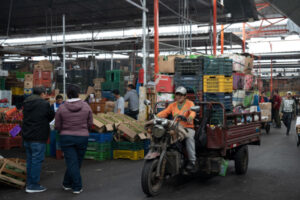
Local markets are one of the more quintessential Colombian scenes. Strolling through one, a visitor will find colorful and juicy fruits, aromatic species and herbs, fresh produce and diary. Due to its tropical location, Colombia is privileged to be able to produce these goods all year long. But today most of these products come from abroad. In Bogota's Corabastos, the largest wholesale market in Colombia and second-largest in Latin America, it is hard to find the label "Product of Colombia."
Beans, lentils and chickpeas come from Canada and the United States. Canned sardines and tuna are products of Ecuador and Peru. Apples, prunes, cherries, and peaches arrive from the U.S and Chile. Garlic and onions are from Japan and Mexico.
Even bocachico and bagre, two landmark fishes from the Magdalena River, now come from Argentina and Vietnam. Even coffee, Colombia's most famous export and international trademark, is imported.
The picture is worsening for local producers. Last week the government revealed that the country’s food imports climbed 52 percent in the first trimester of 2012 versus the same period last year—from 253 tons to 385 tons. The most dramatic rise in imports included milk, whey and dairy products, skyrocketing 543 percent. Sugar imports jumped by 217 percent.
Why is this happening? Not even local officials seem to know. Luis Fernando Salcedo, head of the Cámara Gremial de la Leche, a local daily producers’ guild, told the Colombian business newspaper Portafolio, “I don’t have any explanation for this increase,” adding, “My guess is that the Dirección de Impuestos y Aduanas Nacionales [Colombia’s customs administration] is not controlling the approved import quotas."
![]() |
Yesterday, at Mercosur’s presidential summit in Montevideo, Uruguay, foreign ministers of the bloc’s four founding members—Argentina, Brazil, Paraguay, and Uruguay—signed a free trade agreement (FTA) with the Palestinian Authority (PA). This trade deal is significant not only due to Mercosur’s strength as the world’s fourth-largest economic bloc, but also because this pact opens the Palestinian economy up to new South American markets. The PA had prior trade relations with Argentina, according to the Latin American Integration Association—importing over $1.7 billion of Argentine goods in 2010.
PA Foreign Minister Riyad al-Maliki was present in Montevideo on behalf of the Palestinian people and expressed his gratitude: “We are glad to know we have so many friends in the region.” All four founding Mercosur members endorsed a sovereign and independent Palestinian state over the course of the past 12 months, starting with Brazil in December 2010.
Mercosur also has an FTA fully in force with Israel; it was signed in December 2007 but needed ratification by the parliaments of each member state. Argentina’s congress became the last such nation to do so in March 2011.
Israel places strict controls on the flow of goods to and from the Palestinian territories of Gaza and the West Bank—and leaders like al-Maliki charge that Israel is stifling economic growth among the Palestinians. An Israeli representative from its Montevideo embassy said that while Israel would respect the Mercosur-PA FTA, it is “not the best way to promote peace” in the Middle East.
![]() |
On Wednesday, October 12, just in time for the October 13 State Visit of South Korean leader Lee, both the House of Representatives and the Senate passed the pending trade agreements with South Korea, Colombia and Panama. The agreements were too long delayed, but the overwhelming margin of victory for all agreements in both chambers gives credibility to the argument that the Administration frequently made: to build sustainability for the trade agenda, broad-based political support was required, and political support had to be developed over time, with careful and methodical coalition building. In the end, Panama received 300 votes in favor of the agreement in the House, passing by 171 votes. The most controversial agreement, Colombia, received 262 votes and passed by 95 votes. Compare that to the passage of the trade agreement with Central America in 2004, which won approval by exactly two votes. This new margin of victory lays the groundwork for renewal of a politically sustainable trade agenda, and is a bright spot for those of us who believe trade remains one of the best tools that the United States has to support our security and economic interests abroad.
The agreements still need to be signed by the President and there will be a period of time before implementation actually occurs. But the biggest battle has been won. As a result—this being Washington—claims of credit abound. Indeed, there is much credit to go around. But some are more equal than others in this department, and deserve to be singled out for special praise.
The first, of course, is President Obama himself. At a yet-to-be-determined political cost, and little potential direct political benefit, the President defied the roots of the Democratic party to advance the agreements as part of his “doubling exports in five years” initiative. Unquestionably, his views on trade have evolved since the 2008 campaign, and by moving the deals forward, he has effectively neutralized trade as a potential wedge issue for the 2012 presidential campaign, which, importantly, will provide greater political flexibility to the President on these issues after January 2013. He got the deals done and moved them forward. He won’t get appropriate credit for it, but that does not mean he does not deserve it.
Trade Representative Ron Kirk, who renegotiated the agreements, Secretary of State Hillary Clinton, who publicly set a deadline when she told the foreign minister of Colombia in June that the deals would be done by the end of 2011, and White House Chief of Staff Bill Daley did much of the political heavy lifting to lay the groundwork for submission to Congress. They are all on the heroes list.
![]() |
Colombian President Juan Manuel Santos yesterday hailed the U.S. Congress’ passage of a long-stalled free-trade agreement (FTA), saying the decision was “historic for relations between Colombia and the United States, a historic day for Colombia's insertion to the world and a historic day for Colombian businessmen and workers.”
Negotiations over the U.S.-Colombia Trade Promotion Agreement began in 2004 and were concluded in 2006 when former President George W. Bush and then-Colombian President Álvaro Uribe signed off on the pact. However, pushing the bill through the U.S. Congress—a top priority of the Obama administration—took nearly five years of legislative wrangling.
The final tally on the treaty was decisive: the House of Representatives passed the measure 262–167, followed by a 66–33 vote in the Senate. Two other FTAs—including the U.S. agreement with Panama—also passed which proponents say will boost U.S. exports by $13 billion and support tens of thousands of jobs. Opponents of the deal included Senate Majority Leader Harry Reid, who voted against the measure over concerns about Colombian trade unionist rights and its possible impact on export-competing industries in the United States.
![]() |
From Americas Society/Council of the Americas. AS/COA Online's news brief examines the major—as well as some of the overlooked—events and stories occurring across the Americas. Check back every Wednesday for the weekly roundup.
Guatemala Heads to Runoff after Ex-General Wins First Round
Otto Pérez Molina won the first round of Guatemala’s September 11 election by a wide margin, but well short of the 50 percent plus one vote need to avoid a runoff. With almost all ballots counted, the Patriotic Party (PP) candidate captured 36 percent of the vote compared to 23 percent for second-place finisher Manuel Baldizón of the Renewed Democratic Freedom (Líder) party. Pérez, who served as a general during the country’s civil war, campaigned on a platform that he would confront the country’s high violent crime rates with an “iron fist.” He is heavily favored to win against wealthy businessman Baldizón when they face each other in the second round on November 6. However, Pérez also faces a challenge over campaign spending; the country’s electoral agency says he already surpassed the legal limit while he contends that he can still spend $1 million between now and the runoff.
The website of Guatemalan daily Prensa Libre carries multimedia content exploring the electoral results, including graphs, video, and a timeline.
Read an AS/COA News Analysis about the Guatemalan election.
Congress up for Grabs in Guatemala
Guatemalans voted for legislators as well as presidential candidates on Sunday. Central American Politics blog looks at how the election reshaped the country’s Congress, with no party winning an outright majority. The governing National Unity of Hope and the Grand National Alliance (UNE-GANA) coalition, which previously accounted for the block that held the largest number of seats in the 158 unicameral Congress, will likely be outnumbered by members of the Patriotic Party. The lack of presidential candidate likely hurt the coalition’s candidates at the polls. UNE-GANA was left without a contender after the Constitutional Court banned former First Lady Sandra Torres from the race on the grounds that close relatives of a sitting president cannot run for the presidency.
![]() |
After Republicans won the House last November, predictions of gridlock usually cited one potential exception—trade policy. President Obama affirmed his support for free-trade agreements (FTAs) in his State of the Union address in January, raising hopes that the three pending deals could be approved this year. As a Senate Foreign Relations Committee minority report argued, in an era of divided government, the agreements “provide an opportunity for bipartisan cooperation on the administration’s stated goal of doubling exports in 5 years.”
If only it were that easy. While yesterday’s “mock mark-ups” were a welcome and necessary step, they didn’t stand out for bipartisanship. The House Ways and Means Committee approved the implementing bills for the Colombia and Panama FTAs on partisan lines, with all Republican Members voting for them and all Democratic Members voting against. Many of these Democrats expressed support for the agreements, but used their nay votes to protest the omission of Trade Adjustment Assistance (TAA) in the South Korea bill.
Indeed, TAA has proved to be the partisan sticking point. Many Republicans and Democrats can agree that free-trade agreements are tools to spur job creation and growth without deficit spending, but the same can’t be said of training for displaced workers. The unfortunate irony is that the fiscal cost of renewed funding for TAA would be much lower than the cost incurred to U.S. businesses by a failure to approve the three FTAs.
On the Senate side, the Finance Committee met yesterday on the second try, after Republicans boycotted the mock-up originally scheduled for June 30. The South Korea bill, with TAA language included, was the target of the partisan standoff, passing on party lines by 13 Democrats to 11 Republicans. Ranking Member Orrin Hatch vowed to vote against the agreement if it includes “the TAA poison pill.” For once, Colombia was less controversial with an 18-6 vote, and Panama passed easily, 22 to 2. No amendments passed.
![]() |
On Monday this week, the White House finally sent to Congress for approval the free-trade agreements (FTAs) with South Korea, Panama and Colombia. The Senate Finance Committee is already tackling the legislation by holding today a “mock” markup of all three implementation bills. Only this time, after President Barack Obama re-negotiated key provisions of the agreements to please segments of the Democratic base, it isn’t President Obama or his labor cohorts that are putting trade expansion at risk—but the Republicans in Congress.
Included in the FTAs sent to the Hill this week is a provision for continued funding of trade adjustment assistance (TAA). Designed to provide support for U.S. workers hurt by foreign trade, TAA has been a part of every trade bill since the 1960s, making it easier for Democratic representatives to vote in favor of trade by avoiding the charge that they were coldly placing global economic concerns over the interests of domestic labor.
Now, though, Congressional Republicans have decided to use TAA as a symbol of their zeal to cut public spending. Senator Mitch McConnell and Representative John Boehner have stated their intent to separate it from the vote on the FTAs—a move that will complicate Democratic support. The targeting of TAA as an example of economically damaging profligacy, though, is spurious; the budget for TAA is only estimated to account for $1 billion. This amounts to a drop in the bucket compared to the $13 billion of new exports that the FTAs are expected to generate for the U.S. economy.
Moreover, the tactic represents political cynicism at its worse. Since the agreements were originally negotiated under the George W. Bush administration, Republicans have derided Democrats as hurting American jobs and betraying U.S. allies when they have balked at supporting them. They were right then. But at the time they were negotiated, it was reasonable to expect—on the part of Republicans and Democrats alike—that TAA would be part of the package, as it has been for decades. Now, Republicans are changing the game. If they insist on sticking to their new rules, they will be the ones who will hurt the U.S. economy, U.S. workers and abandon U.S. allies who committed to an FTA under a Republican president.
*Christopher Sabatini is editor-in-chief of Americas Quarterly and senior director of policy at the Americas Society and Council of the Americas.
AQ's coverage and post-trip analysis of the President's May 2-4 visit.