![]() |
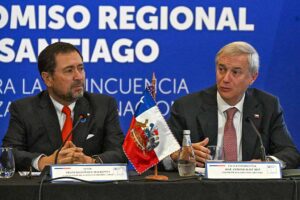
On Wednesday, the Bolivian government filed a formal law suit against Chile in the International Court of Justice (ICJ) in the Hague to recover territory and access to the Pacific Ocean it lost during the 19th century War of the Pacific.
Bolivia has been landlocked since 1904, when Bolivia and Chile signed the Treaty of Peace and Friendship to end the war. The war began with a disagreement over mining rights and escalated into a five-year conflict that ended with Chile annexing all of Bolivia’s 250 miles of coastline and much of the land abutting it.
The suit is only the most recent action in a dispute that spans generations and administrations. Bolivia, which still maintains a small navy and celebrates the Day of the Sea each year to commemorate its lost maritime access, has repeatedly attempted to regain access to the Pacific. The suit demands that Chile negotiate in good faith with Bolivia to provide a sovereign outlet to the sea on land that now forms part of Chile’ s Atacama region. Bolivia also maintains that the 1904 agreement is invalid because it was signed under pressure from Chile.
But Chile has never veered from its position that Bolivia lawfully ceded the territory in the 1904 treaty, which remains in effect. Previous attempts to re-negotiate the border have failed, nourishing lingering hostility between Bolivia and Chile. The neighboring countries last broke diplomatic ties in 1978 and have never reestablished them.
In order for the ICJ to move forward on the case, both Bolivia and Chile must agree to engage in the proceedings. The court’s decision, once made, would be binding on both parties. However, it seems unlikely that the ICJ proceedings will move forward. Chilean officials denounced Bolivia’s claim again on Wednesday, saying that President Sebastián Piñera will continue to defend Chile’s sovereignty and that the suit has no legal basis.
![]() |
Top stories this week are likely to include: Maduro narrowly wins Venezuela elections; U.S. Senators to release immigration legislation; Guantánamo prison standoff escalates; Mexican teachers plan more protests this week; Chile’s Michelle Bachelet begins her campaign.
Venezuela elections: Venezuelan voters narrowly elected Nicolás Maduro as president on Sunday in a highly contested election in which the results are currently being challenged by opposition candidate Henrique Capriles. Venezuela’s Consejo Electoral Nacional (National Electoral Council—CNE) reported that Maduro won 50.7 percent of the vote and Capriles won 49.1 percent. As the polls closed on Sunday amid violence, supporters of both Maduro and Capriles claimed electoral fraud. Maduro's lead in opinion polls before the elections suggested that he would win, but Capriles rapidly gained ground with Venezuelan voters in the last two weeks. Capriles has demanded a recount, but it is unclear whether this will take place.
Gang of Eight to release immigration plan: The bipartisan "gang of eight" group of U.S. Senators will unveil a proposal to overhaul the U.S. immigration system on Tuesday, according to Senator Charles Schumer (D-NY). The proposal is expected to step up enforcement and border security, create a new guest worker program and provide a pathway to citizenship for the 11 million undocumented immigrants living in the United States. Senator Marco Rubio (R-FL), one of the authors of the proposal, strongly endorsed the bill on Sunday. The Senate Judiciary Committee will hold a hearing on the bill on Wednesday.
Guantánamo prison protest escalates: Prisoners at the Guantánamo Bay prison clashed with prison guards on Saturday. At least 43 of 166 prisoners have continued a hunger strike to protest prison conditions that include separating inmates in communal housing and putting them in individual cells. The Pentagon reported that 11 inmates are now being force-fed after going on strike as a response to invasive searches and other controversial security measures. Some of the inmates have been imprisoned at Guantánamo for over a decade without being charged with a crime.
Mexican teacher protests continue: The Mexican government sent federal police to Guerrero state last week to confront teachers that have been protesting Enrique Peña Nieto's recently-introduced education reforms by creating roadblocks on the highway between Mexico City and Acapulco. The reforms include the implementation of a requirement that teachers pass a standardized test to teach, which many protesters fear will cause them to lose their jobs. The protesters have teamed up with local militias, such as the 1,200-member Regional Coordinator of Community Authorities, and say that they are planning more protests on Monday.
Michelle Bachelet hits campaign trail: Former Chilean President Michelle Bachelet officially launched her presidential campaign on Saturday, promising education and tax reforms if she is re-elected president. Bachelet’s possible opponents in the upcoming election include Andrés Allemand, a former defense minister, and Laurence Golborne, a former public works minister who led the rescue of 33 trapped miners in 2010. Though Bachelet left office with an 84 percent approval rating, she faces challenges. Tens of thousands of students took to the streets on Thursday, demonstrating that education will likely play a major role in the country's November 17 elections.
![]() |
Chile’s congress took a first step toward legislating rights for same-sex couples on April 10. If passed, President Sebastián Piñera’s Acuerdo de Vida Común (Life Partner Agreement—AVP) would allow same-sex couples to register their partnerships with notaries, granting them many of the same legal rights as married couples, such as shared health benefits, pensions and inheritances. The legislation stops short of permitting gay marriage, explicitly reserving that for heterosexual couples. Currently, Chile does not legally recognize gay couples.
President Sebastián Piñera sent the bill to Congress in August 2012, but it sat latent until Wednesday, when the Senate’s Constitutional, Legislative, and Judicial Committee approved the initiation of debate.
Chile, one of the more socially conservative countries in the region, has traditionally been among the last Latin American countries to adopt progressive social legislation. Only in 2004 did it legally permit divorce, and it still prohibits all abortions. Chile has been similarly slow to debate and enact gay rights laws, compared to its neighbors. Only in 1999 did Chile decriminalize gay sex, compared to Argentina and Brazil, which have allowed it since the nineteenth century.
Yet, in the past year, Chile’s gay rights movement has surged ahead. When the 2012 census gave Chileans the opportunity to declare living in a same-sex relationship for the first time, nearly 35,000 Chileans, or 0.5 percent of the population, did so—higher than in Uruguay and Argentina, both of which recently legalized gay marriage.
In early 2012, the government changed the rules on blood donation to prevent potential donors from being turned away for being gay and, in March 2012, the Inter-American Court of Human Rights (IACHR) ordered the state to pay compensation to a lesbian mother who had been denied custody of her daughters by Chile's supreme court because she lived with a woman. The IACHR went further, instructing the Chilean government to educate its judiciary about gender issues. In May, Congress passed anti-discrimination legislation—often referred to as the Zamudio law, after Daniel Zamudio, a young gay man whose violent killing because of his sexual orientation propelled the law’s passage.
These consecutive milestones instigated the largest gay rights march in Chile’s history in June and put pressure on Congress this week to move toward legally recognizing gay couples.
![]() |
Top stories this week are likely to include: U.S. Senators hope to introduce immigration reform bill this week; the Brazilian Federal Police will investigate whether Lula had a role in the mensalão scandal; Pablo Neruda’s body will be examined for signs of poisoning; Venezuela’s opposition rallies in Caracas; and the FARC bring extra peace negotiators to Cuba.
“Gang of Eight” Hoping for Immigration Bill by End of the Week: U.S. Senator Chuck Schumer (D-NY) said Sunday that the bipartisan group of senators working on a comprehensive immigration reform bill may have legislation ready to present to lawmakers by the end of this week. The bill is expected to provide for a wide range of reforms, including strengthened border security, a new guest-worker program and a pathway to citizenship for the 11 million undocumented immigrants living in the United States. Schumer said a best-case scenario could bring the bill up for a vote as early as May after it goes through the Judiciary Committee. On Wednesday, April 10, a rally in support of immigration reform is expected to draw tens of thousands to the U.S. Capitol. http://www.voxxi.com/unprecedented-rally-immigration-reform/
Lula to be investigated in Mensalão scandal: Brazil’s Federal Prosecutor has ordered an investigation into allegations by businessman Marcos Valério that former Brazilian President Luiz Inácio Lula da Silva was involved in the mensalão scandal, a 2005 vote-buying scheme involving members of the Partido dos Trabalhadores (Workers’ Party—PT) and others. Valério was sentenced to more than 40 years in prison last year for his role in the scandal. This weekend, the Federal Prosecutor ordered the Federal Police to investigate Valério’s accusation. Lula has denied all involvement in the scandal.
Pablo Neruda’s Body to be Examined: Chilean forensic investigators will exhume the body of Nobel prize-winning poet Pablo Neruda today to determine whether Chile’s military regime had eliminated Neruda when he died in 1973. Neruda, a communist, allegedly died of cancer just 12 days after the September 11, 1973, coup that installed Chilean dictator Augusto Pinochet. However, his former driver, Manuel Araya, claimed that a doctor gave Neruda a lethal injection on the day of his death. In February, a Chilean court ordered that Neruda’s body be examined for signs of poisoning. Results are not expected for another three months.
Venezuelan Opposition Rallies in Caracas: Tens of thousands of Venezuelans marched in Caracas on Sunday to express their support for opposition presidential candidate Henrique Capriles in the lead-up to Venezuela’s April 14 presidential election. Polls indicate that Venezuela’s interim president, Nicolás Maduro, enjoys a 10-percentage point lead over Capriles. Over the weekend, Maduro made headlines in Amazonas state when he invoked the “curse of Maracapana” on those who vote for his rival, and also accused “Central American mercenaries” of plotting to kill him.
FARC Negotiators Bring in Reinforcements: The Fuerzas Armadas Revolucionarias de Colombia (Revolutionary Armed Forces of Colombia—FARC) announced Sunday that rebel leader Pablo Catatumbo (Jorge Torres Victoria) arrived in Havana with other members of the guerilla group to reinforce the negotiating team during peace talks with the Colombian government. Catatumbo has allegedly been critical of leading FARC negotiator Iván Marquez (Luciano Marín Arango). Last Thursday, Colombian President Juan Manuel Santos said that the government would not engage in a bilateral ceasefire with the FARC until the two sides reach a final agreement. The next round of peace talks is scheduled to begin on April 18.
![]() |
Yesterday, former Chilean President Michelle Bachelet announced the names of her campaign team for the upcoming presidential elections on November 17. Among them are Rodrigo Peñailillo, Bachelet’s former chief of staff that will assume the role of executive secretary; Alvaro Elizalde, who will resign as the general secretary of the Partido Socialista (The Socialist Party - PS) and assume the role of head of communications; Senator Ricardo Lagos Weber, Bachelet’s former minister spokesperson who will be campaign team leader; Paula Walker, head of press; Alberto Arenas, Bachelet’s former budget director; and Orieta Rojas who will be head of the campaign.
The remaining members of the team will be representatives from other political parties and civil society leaders such as former student leader Karina Delfino, a pioneer in the "revolución pingüina” who will oversee youth initiatives, and Javiera Parada, a close friend to Bachelet’s daughter who will oversee culture. Rodrigo Peñailillo relied on Osvaldo Andrade Lara of the Partido Socialista (The Socialist Party - PS) and former minister of Labor and Social Security under Bachelet’s administration, and former Senator Jaime Quintana and founder of the Partido por la Democracia (Party for Democracy – PPD) to create a short list of candidates.
In addition to establishing her political campaign staff, Bachelet will also create a "political advisory council" that will provide a space for conversation and reflection for experienced political leaders to offer their opinion leading up to the election.
Her 84 percent approval rating when she left office in 2010 suggests that she will win her party’s June primary with ease. In the succeeding election, in November, she will face a candidate from the governing centre-right Coalition, either Laurence Golborne, who as mining minister was in charge of the rescue of 33 miners trapped underground in 2010, or Andrés Allamand, a former defense minister.
![]() |
Thousands of high school and university students protested in the Chilean capital of Santiago yesterday to demand education reform. The students denounced the country’s exorbitant university tuition fees—which represent 40 percent of the average household’s income—demanding an overhaul of the country’s higher education system and a guarantee to free, equal and high-quality public education.
Protests quickly turned violent, however, with hostility between the authorities and students beginning only 20 minutes after the protest was underway, when students were forced to change the agreed upon route for the march. Students reacted by tossing Molotov cocktails at authorities; police used tear gas and water for crowd control. Authorities reported 60 arrests and one policeman injured.
Minister of the Interior Andrés Chadwich responded to the situation: “Once again a group of students feels entitled to generate chaos, damage public property, interrupt transportation and generate violence in Santiago.” The student union spokesman, on the other hand, accused the police of using “excessive, repressive action.”
A series of large student demonstrations began in Chile in 2011. Despite the continued protests over the past two years, there has yet to be a government overhaul of the education system. The principal student-led organization, The Confederation of Chilean Students (La Confederación de Estudiantes de Chile—CONFECH), confirmed another protest for April 11.
![]() |
Former Chilean President Michelle Bachelet is expected to announce her candidacy for president in the November election when she returns from the United States this morning, Chilean newspaper La Tercera reported on Tuesday.
Bachelet, who served as president from 2006 to 2010, resigned from her position as under-secretary-general and executive director of UN Women last week. The Party for Democracy (Partido Por la Democracia) and Socialist Party (Partido Socialista de Chile) are expected to announce her as their parties’ candidate on April 13.
Former President Eduardo Frei feels confident in Bachelet’s bid. “Everyone [in Chile] talks about her,” he said, “her friends and her enemies alike have made her campaign for her, they’ve paved the way.” A Centro de Estudios Públicos (CEP) poll is already predicting a Bachelet victory. Still, she would encounter her first challenge on the road to La Moneda on June 30—the date of the primaries to select the opposition coalition’s presidential candidate. Other candidates include Claudio Orrego of the Christian Democratic Party (Partido Demócratico Cristiano) and José Antonio Gómez of the Social Democracy Radical Party (Partido Radical Socialdemócrata).
Presidential elections are scheduled for November 17. If no candidate secures an absolute majority in the first round, a runoff election will be held on December 15.
![]() |
Top stories this week are likely to include: debate continues on IACHR reforms; U.S. Supreme Court considers gay marriage; Bolivia takes Chile to court; Argentina wants UN discussion on Falklands/Malvinas; Indigenous groups protest World Cup construction.
Debate over IACHR Reforms to Continue: In a marathon extraordinary session on Friday, the General Assembly of the OAS resolved to continue discussing reforms to the Inter-American Commission on Human Rights (IACHR) that were proposed two years ago by Ecuador, Venezuela, Bolivia, and Nicaragua. Though external funding for the IACHR will be allowed to continue in the meantime, the reforms could mean eventually eliminating external funding for the regional human rights body and restricting the circumstances in which the commission can issue precautionary measures to protect victims.
U.S. Supreme Court Considers California's Prop 8 and DOMA: The U.S. Supreme Court will consider two high-profile cases on same-sex marriage this week. The court will convene Tuesday to consider the constitutionality of California's Proposition 8, a law banning same-sex marriage after California state courts had recognized gay marriage earlier in 2008. On Wednesday, the court will also consider the federal Defense of Marriage Act, which was signed into law in 1996 to deny federal benefits to gay and lesbian couples. The court’s decisions could overturn gay-marriage bans in 29 U.S. states.
Bolivia and Chile Dispute Escalates: Bolivian President Evo Morales said Saturday that Bolivia would take Chile to the International Court of Justice in the Hague in "coming days" to sue over Bolivia's lost access to the sea. Bolivia has been landlocked since the 1879-1884 War of the Pacific, but the issue has remained important in modern Bolivian politics. In a radio interview Sunday, Morales said that as long as Sebastián Piñera is president of Chile, he doesn't anticipate holding any further dialogue with Chile to negotiate a solution to the dispute.
Argentina to discuss the Falklands/Malvinas with the UN: Argentine Foreign Minister Héctor Timerman is expected to meet with UN General Secretary Ban Ki-Moon in New York early this week to request that the UN organize a dialogue with the United Kingdom over the political status of the disputed Falklands/Malvinas Islands. Argentina and more than 20 neighboring countries have said that the referendum held by islanders on March 10 and 11 is invalid. Voters overwhelmingly declared the islands a British Overseas Territory.
Brazilian Indigenous Groups Protest World Cup Displacement: Rio de Janeiro police in riot gear stormed a former museum occupied by Indigenous protesters on Friday, firing tear gas and pepper spray after an hours-long negotiation to convince protesters to abandon the building, which had been marked for demolition for the 2014 World Cup. The Indian Museum has been an important refuge for Indigenous Brazilians even after the museum was closed in 1977. On Friday, protesters were reportedly in the process of abandoning the building when the police entered, but the police say that the protesters started a fire inside. Human rights activists and public officials have denounced the police response.
![]() |
Top stories this week are likely to include: Cuba prepares for political successors in 2018; Venezuela’s opposition protests lack of information on Chávez; Tensions between Chile and Bolivia rise over Bolivian soldiers’ arrest; Oscar Arias visits Paraguay for OAS elections observations; and Cerrejón strike continues after explosives destroy trucks.
Raúl Castro Says he'll Step Down in 2018: On Sunday, Cuban President Raúl Castro told the Cuban National Assembly that he will step down at the end of his upcoming five-year term as president in 2018. Revolutionary icon Fidel Castro, whose public appearances are now rare, was present when his brother made the announcement putting an official end-date on an era of Castro rule that began in 1959. Raúl Castro then named Miguel Diaz-Canel Bermúdez, 52, his first vice-president. The younger Castro had indicated on Friday that he was thinking of retiring and might name a successor from among the next generation of Cuban politicians.
Venezuelan Opposition Demands Information as Chávez' Health Remains Uncertain: Hundreds of government opponents marched in Caracas on Saturday as part of the opposition’s new political offensive to protest the current political stasis in Venezuela as President Hugo Chávez remains out of sight in a military hospital. Since returning from Cuba on February 18, the Venezuelan government has shared limited information about the president’s cancer treatment and prognosis. On Friday, Venezuelan Vice-President Nicolás Maduro said that Chávez was “energetic” and had participated in a five-hour meeting with government leaders, though he acknowledged that the president can't speak because he is breathing through a tracheal tube. Meanwhile, Chávez supports held candlelit vigils outside the presidential palace to pray for the president’s recovery.
Hearing for Bolivian soldiers in Chile begins Monday: Three Bolivian soldiers arrested in Chile for crossing the border with weapons on January 25 will face a judicial hearing today in the northern Chilean city of Iquique to determine whether they'll remain in prison. The arrest of the soldiers has increased the diplomatic strain between Bolivia and Chile after Bolivia denounced Chile's actions via a letter to the UN on February 18. On Sunday, Bolivian President Evo Morales compared Chile’s imprisonment of the soldiers with Bolivia’s lost access to the Pacific Ocean since 1879, another source of recent tension. Chilean Minister of Foreign Affairs Alfredo Moreno said that Bolivia is blocking a swift resolution to the soldiers’ cases.
Oscar Arias Visits Paraguay to Prepare for April Elections: Former Costa Rican President Oscar Arias is visiting Asunción, Paraguay, until February 27 as head of the Electoral Observation and Political Accompaniment Mission of the Organization of American States (OAS). The mission aims to facilitate and monitor Paraguay’s presidential elections on April 21 to ensure that they are free and fair. It will be setting up elections observers and meeting with members of the Paraguayan government for the next two months. A number of the country’s neighbors view Paraguayan President Federico Franco as illegitimate due to the controversial impeachment of his predecessor, former Paraguayan President Fernando Lugo, in June 2012. Members of Mercosur and Unasur elected to suspend Paraguay from regional membership until the elections are held.
Explosives Destroy Trucks at Cerrejón while Mining Strike Continues: Unknown assailants detonated explosives at the Cerrejón coal mine in Colombia on Sunday as a strike that began on February 7 continued into its seventeenth day. Both Cerrejón and the leader of Sintracarbon, the coal miners' union, denounced the attack, which damaged four trucks but reportedly did not result in casualties. Cerrejón workers initially demanded a 7 percent pay raise, but they have since decreased that amount to 5.8 percent. According to the World Coal Association, Cerrejón’s coal accounted for 80 percent of Colombia’s coal exports last year. Union leader Igor Diaz said that the workers will meet with Cerrejón today to restart wage negotiations despite the attack.
Watch a recent AQ documentary on Cerrejón. http://www.americasquarterly.org/rio-rancheria-documentary
![]() |
Chile’s Mapuche population has long struggled for greater rights. So many warmly greeted President Sebastián Piñera’s recent promise to give “top priority and urgency” to finding a constitutional solution that will recognize Chile’s Indigenous Mapuche people, a 700,000-person strong minority group that constitutes 6 percent of Chile’s population. His reaction comes after a month of increased tension in the southern Araucanía region, where the majority of the Mapuche live.
After a mid-January summit was held in Temuco, Araucanía’s main city, Piñera has promised to set up a council for Indigenous peoples that is “truly representative of the community’s history, tradition and culture.” This is a positive first step in trying to integrate the Mapuche into the political process since they currently do not have any representation in Congress. At the same time, demands by the Mapuche for an independent state were ignored. The Indigenous group’s main struggle is for the return of what its members claim are their ancestral lands.
It is a positive sign that Piñera and the Chilean government seem to be trying hard to quell violence within the Araucanía region and are beginning to open up dialogue and negotiations with the Mapuche.
But efforts toward reconciliation are being viewed in an increasingly cynical manner by both sides.
The dismissal of Walter Ramirez, a policeman who killed Mapuche leader Matias Catrileo in January 2008, has been called tactical by Ramirez’ lawyer Gaspar Calderon. Calderon told CNN Chile that his client is a victim of "popular justice” and suggested that the decision was made merely to give Chilean Interior Minister Andrés Chadwick something to offer the Mapuche ahead of the Temuco summit.
AQ's coverage and post-trip analysis of the President's May 2-4 visit.