

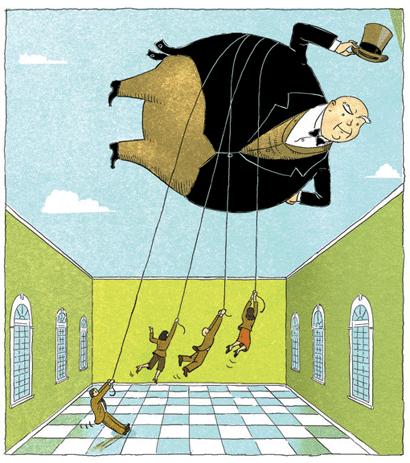
Let the voters decide. Executives should be allowed to run for re-election indefinitely. Yes: Patricio Navia; No: Steven Griner

Executives should be allowed to run for re-election indefinitely.
Let them run. The problem is not presidential re-election. The problem is presidentialism.
As long as Latin American democracies continue to be based on institutional arrangements—both formal and informal—that concentrate power in the executive, democratic development will be undermined. This concentration of power carries the seeds of instability that will hinder, if not reverse, democratic consolidation, regardless of whether presidential term limits are imposed. It underlines both the perils of authoritarianism and the lack of accountability that accompany governance in the region.
In recent months, the debate over presidential re-election has been fueled by the open effort to eliminate term limits championed by Venezuelan President Hugo Chávez and the more concealed campaign by Colombian President Álvaro Uribe to do the same. Recent constitutional assemblies in
To be sure, allowing officeholders other than the executive to seek reelection is generally seen as a good and convenient feature in well-functioning democracies. It increases responsiveness and places the correct incentives on officeholders to be accountable to their constituents. Without the possibility of re-election, representatives lack the incentive to serve those who voted them in. The prospect of re-election implies that representatives can be “fired” by constituents who feel they have not been served well. Efforts to introduce term limits were initially framed as promoting responsiveness. But it turns out that they do not have a significant effect in limiting political careers: officeholders who are term-limited simply switch to other elected positions to con- tinue their careers. Nor do they bring about a renewal of the political elite, since many local political bosses turn to their relatives to fill their places or have stand-ins elected to occupy their seats until they are allowed to run again.
There are better mechanisms to promote accountability and responsiveness. Rather than preventing people from running, reformers should promote institutional changes that foster competition, lower entry thresholds for new challengers and level the playing field in campaign spending. In short, rather than prohibiting a television series, regardless of its popularity, from going into a new season, the best way to promote better television is by facilitating competition among different networks. Television series will survive if they can withstand competition from new challengers. By forcing a television series off the air because it has been on the air too long, we will not automatically produce better- quality television. The same applies to politics.
True, individual politicians are not the only actors interested in serving constituents well. Political parties also have those incentives. In a healthy democracy with strong and accountable parties, if individual officeholders are not allowed to run for re-election, the political parties they represent have every incentive to make sure their representatives do a good job. Otherwise, the parties will be punished when voters go to the polls.
Unfortunately, Latin American countries have notoriously weak party systems. Thus, voters often have few tools at their disposal to punish and reward incumbents other than the threat or benefit of re-election. This is particularly true for presidents who run as independents. If reelection is impossible, independent presidents have no incentive to fulfill their campaign promises. Even worse, voters have no way to punish independent presidents who are banned from seeking re-election.
The debate about presidential term limits in
Yet when you get lemons, you might as well try to make lemonade. The drive in favor of allowing unlimited re-election for presidents in
Latin American democracies suffer from lack of competition. Individuals or political parties tend to promote monopolies and oligopolies that undermine it. Political parties favor high entry barriers to prevent new parties from challenging their oligopoly control. Individual politicians in congress make it difficult for newcomers to challenge them by enacting complex and opaque campaign finance rules—which in many cases directly favor incumbents.
The push to eliminate presidential term limits should be seen as a symptom of an ill-functioning democracy, rather than its cause. It would be wiser, therefore, to fight the disease itself, not the symptoms. Term-limited presidents already exercise too much power. Rather than replacing one overly powerful president with another equally powerful one, it would make more sense to reduce the powers and attributions of the presidency regardless of who occupies the office. Let them run as often as they wish, but make races more competitive, level the playing field and reduce the powers and attributions of the president.
Executives should not be allowed to run for re-election indefinitely.
Since the mid-1990s, no fewer than 10 countries of
Term limits fall into three general categories: the complete prohibition of re-election (
At the moment, several incumbent governments in Latin America are trying to allow a third presidential term; one,
Defeating a long-sitting president in
Eliminating or unduly extending term limits engenders corruption, the main cause of public distrust in democratic institutions, and a significant obstacle to economic development in the region. Latin American presidents possess a disproportionate amount of influence over other branches of government. In the face of political gridlock, they can rule by decree. They can choose and dismiss their cabinets with little or no congressional oversight and hire and fire other officials at will. In times of emergency, they can suspend basic civil rights and possess significant economic and political influence over the media.
Peruvian President Alberto Fujimori’s heavy-handed efforts to concentrate his presidential powers and his continued efforts to extend his mandate met with popular support at first: In 1990, he easily won an absolute majority of the vote. His shutdown of congress in 1992 met with even higher public approval ratings. Yet, as the shine on his important victories against terrorism and inflation faded, so did the patience of his electorate. By 2000, despite significant opposition to his administration, Fujimori was able to win a third term using a pernicious mix of bribery, intimidation and state largesse. Had Fujimori abided by the existing term limits, his legacy might have been a different one. As it was, the transition of power in 2001 shook Peruvian democracy to its core, its former hero turned villain.
With term limits, transitions take place as a natural course of events in the democratic system. Politics ceases to be viewed as a zero-sum game. Ruling parties are able to cultivate new leadership which can carry on the successful policies of their former leaders, but also correct for past missteps. They can remake themselves in the public eye and adapt to the dynamic challenges of the world around them. Such has been the case of
Likewise, the opposition is more likely to remain a loyal opposition, rather than try to upset the system, since it can envision taking power one day via a free and fair election. Peaceful transitions in
Of course, term limits alone will not guarantee a flourishing multiparty democracy. Despite its promise of “Universal Suffrage and No Re-election,” the Mexican Revolution did not usher in a meaningful multi-party democracy until seventy years later. To avoid another dictatorship, Paraguayans carefully included a no re-election clause in its constitution, yet the reign of the Colorado Party remained unbroken for nineteen more years until the election of Fernando Lugo last year. In both countries, however, presidential succession between individuals, even of the same party, paralleled a gradual change in political reform. Moreover, the vigorous, even acrimonious, debate within the ruling parties demonstrated the vulnerabilities of the ruling party and provided important opportunities for the opposition in the general elections. The legacy of “No Re-election,” one important check on the otherwise unrivaled power of these political parties, contributed in some small measure to the eventual peaceful transitions of power.
It is telling that when the issue of re-election was broached by sitting presidents in
Efforts to extend term limits beyond two terms are not driven by ideology. Their impetus comes from governments whose power is unrivaled and popularity unprecedented. In politics, though, both power and popularity are ephemeral. In a democracy, the electorate should maintain its prerogative to change its mind, and politicians should have the opportunity to encourage it to do so.
AQ's coverage and post-trip analysis of the President's May 2-4 visit.