
btn_subscribe-top
btn_give-a-gift
btn_login
btn_signup
btn_rss

Monday Memo: Colombian Peace Negotiations – Venezuela’s Audit – Alabama Immigration Law – Honduran Police – Maracanã

April 29, 2013

by AQ Online

Top stories this week are likely to include: Colombian civil society holds forum on political participation; Venezuela’s election audit begins on May 6; the U.S. Supreme Court upholds a lower court’s immigration ruling; Honduran police officials resign in the midst of a police crisis; and Brazil’s Maracanã stadium reopens after three years.

Colombian Civil Society Weighs in on Peace Negotiations: Hundreds of civil society groups convened in Bogotá on Sunday for a week-long forum on political participation in Colombia to discuss ways of integrating former FARC guerrillas into Colombian politics. The forum, organized by the UN and Universidad Nacional de Colombia, is the second to take place at the behest of the Colombian government and FARC negotiators after a forum on agrarian reform in December.  Participants will send their suggestions to the peace negotiators in Havana on May 20. Former Colombian President Álvaro Uribe, who has been highly critical of the peace negotiations, said that his political movement would not participate in the forum this week.

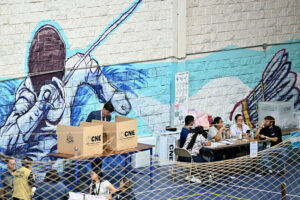
Venezuelan Vote Audit to Begin on May 6: Venezuela's Consejo Nacional Electoral (National Electoral Council—CNE) announced that an audit of ballots from the April 14 presidential election will begin on May 6 and last until June 4, but said that it was “unfeasible” to conduct a full recount of the vote. Opposition presidential candidate Henrique Capriles, who lost the election by less than 2 percentage points to rival Nicolás Maduro, called the audit a "joke" and has alleged dozens of cases of voter fraud and voter coercion during the elections. He said on Sunday that he would use “all the available instances” to fight Maduro’s victory.

U.S. Supreme Court Upholds Decision to Block Portions of Alabama Immigration Law: The U.S. Supreme Court on Monday rejected an appeal by the state of Alabama to enact portions of the state’s controversial immigration law that was blocked by a federal appeals court last year. The Supreme Court’s decision allows last year’s ruling by the 11th U.S. Circuit Court of Appeals to stand, meaning that Alabama cannot prosecute people who harbor or transport undocumented immigrants, but will still allow police to check people’s immigration papers if they are stopped by law enforcement. Justice Antonin Scalia was the only Supreme Court justice to dissent from the high court’s decision not to take the case.

Honduran Police Officials Resign: Following a strike of almost 2,000 police officers in Honduras this week, President Porfirio Lobo accepted the resignations of police officials Eduardo Villanueva and Mario Chinchilla, who led the country’s Dirección de Investigación y Evaluación de la Carrera Policial (Office of Investigation and Evaluation of Police Officers—DIECP). DICEP, the investigative body in charge of purging the Honduran police force of corruption, has been crippled by a lack of funds and by unrest among underpaid officers making only about $150 a month. Honduras’ Consejo Nacional de Seguridad Interior (National Internal Security Council—CONASIN) will convene Monday to propose candidates to take over the posts of Villanueva and Chinchilla.

Maracanã Reopens: Rio de Janeiro's iconic Maracanã stadium reopened on Saturday after three years of renovations intended to prepare the stadium for Brazil’s upcoming international sporting events. Maracanã will host the 2014 World Cup final and the opening and closing ceremonies of the 2016 Olympics. However, media attending Saturday’s exhibition match reported that several parts of the stadium are still incomplete, even though the project was delayed by four months. Maracanã is the fourth of twelve World Cup stadiums to open. The stadium will be officially inaugurated on June 2 in a match between Brazil and England.


Tags: Colombia, Venezuela, Honduras, Immigration

Dispute between Honduran Congress and Judiciary Escalates

December 13, 2012

by AQ Online

The Honduran Congress voted Wednesday to dismiss four Supreme Court Justices accused of blocking police reforms sought by Honduran President Porfirio Lobo, escalating a standoff between the country’s judicial, legislative and executive branches.

On Tuesday, Congress voted to approve the president’s reforms, which would require police applicants to submit to polygraph tests and toxicology exams and provide their financial and psychological records before joining Honduras’ police force. The reforms are intended to purge the Honduran police of corrupt officers, and along with other measures, would be put to a public referendum before they become law.

Congress passed the reforms on Tuesday despite the fact that they had already been blocked by the courts. In late November, four justices on the constitutional chamber of the Supreme Court ruled that the police reform measure was unconstitutional in a 4-1 vote. Since the decision was not unanimous, the full court must ratify the constitutional chamber’s ruling, but it has not yet done so.

In comments on Saturday, Lobo accused the dissenting  judges of being “against police clean-up efforts” and said they were acting “in collusion to subvert the institutions” with Honduras’ business elite.

A legislative commission that investigated the judges’ ruling determined that they had broken established rules in the decision, and, on Wednesday just a day after approving the stalled reforms, Congress voted 97-31 to expel the four dissenting justices and name their replacements. As the voting stretched into the early morning Wednesday, police and soldiers surrounded the legislative building.

Later on, Honduran Attorney General Luis Rubí fiercely criticized the dismissal of the four judges and said that he, in turn, would look into whether the legislators could be prosecuted for violating the constitution and for violating the separation of powers.

The judges themselves released a statement on Wednesday that called their dismissal “illegitimate, illegal and unjust.” It is not yet clear whether they will make way for the four new judges that Congress chose to replace them.


Tags: Honduras, Porfirio Lobo, police corruption, police reform

Honduras’ City-State Experiment

September 11, 2012

by Sabrina Karim

In what is perhaps a dream come true for political science researchers, Honduras has agreed to let investors build three private cities inside its territory. In about six months the investors—business consortium NKG and the South Korean government—will supposedly begin to construct the first of three private city-states complete with their own police, government, legal parameters, and tax systems. The cities will be empowered to sign international agreements on trade and investment and set their own immigration policy. Honduran president Porfirio Lobo has given his full backing to the plan and the government signed the memorandum of agreement approving the project earlier this month.  Envisioned to be like other city-states such as Hong Kong and Singapore, the idea is a clear example of a neo-liberal experiment. 

Honduran Congress President Juan Hernandez said that NKG will invest $15 million to begin building basic infrastructure for the first model city and South Korea has given Honduras $4 million to conduct a feasibility study. The first city will be built in Puerto Castilla on the Caribbean coast and that the other two would be built in the Sula Valley and an area in southern Honduras. Hernandez added that the project in Puerto Castilla would create 5,000 jobs over the next six months and up to 200,000 jobs in the future.

These investments will provide a boost for the economy and give Honduras a much needed facelift for investors. The project’s aim is also to strengthen Honduras’ weak government and withering infrastructure.

Read More

Tags: Honduras, Development, Foreign Direct Investment

Monday Memo: AQ's Top Expected Stories for the Week of September 10

September 10, 2012

by AQ Online

Top stories this week are likely to include: a political fracture among the Mexican Left; one month before the Venezuelan election; impact of U.S. suspension of intelligence sharing with Honduras; and the tenuous El Salvador gang truce. 

A Split among Mexico's Progressives: Presidential runner-up Andrés Manuel López Obrador’s (AMLO) departure from the Partido de la Revolución Democrática (Party of the Democratic Revolution—PRD) that he led since 1996 sent shockwaves around the Mexican political establishment. AMLO, who made the announcement yesterday at a rally in Mexico City’s zócalo, ran for president under the PRD label in 2006 and 2012, and placed second both times. He announced that he would focus his efforts through the Movimiento Regeneración Nacional (National Regeneration Movement—MORENA) movement, which has not been formally registered as a party according to BBC. How will the formation of MORENA affect the PRD, and will it mean a great split among the electorate of the Mexican Left?

Venezuela Election Countdown: The presidential contest in Venezuela between incumbent Hugo Chávez and challenger Henrique Capriles Radonski occurs in less than one month, on October 7. While Chávez claims that his victory is “written in stone,” Univisión reports that he is been falling in the polls, resulting in attacks on Capriles Radonski. Before the weekend, Capriles Radonski challenged Chávez to a debate anywhere in the country.

Related: Americas Society and Council of the Americas will host a discussion on September 18 entitled “The Road to Venezuela’s Elections: A Look at the Media, Public Opinion, and the Economy.”

Fallout of U.S.-Honduras Intelligence Cooperation Suspension: After two separate incidents in which Honduran forces shot down a suspected drug plane in July, it was likely that counternarcotics cooperation with the United States would be affected in some way. Over the weekend, the U.S. State Department announced that it was suspending intelligence sharing efforts with Honduras. This comes after a steady build-up in cooperation between the two countries. What will be the effect in overall security cooperation and on efforts such as the Central America Regional Security Initiative?

A Break in the El Salvador Gang Truce: Break in the El Salvador Gang Truce: After negotiation of a truce earlier this year between the Mara Salvatrucha and Calle 18 gangs, El Salvador has observed a dramatic drop in its murder rate. But is this delicate truce beginning to unravel? A new report from Fox News Latino seems to suggest that recent killings may point to a new reality in which gangs operate. “The truce was never intended to be the answer to El Salvador’s crime problems, but what it has done is placed increased urgency on finding solutions to prevent crime in the first place. This fragile peace is an opportunity for the country that cannot be missed,” notes AQ Senior Editor Jason Marczak.

Tags: El Salvador, Mexico, Venezuela, Honduras, Hugo Chavez, Counternarcotics, Andrés Manuel López Obrador, Henrique Capriles Radonski

Honduras Bans Guns in Heavily Violent Region

August 3, 2012

by AQ Online

Honduras’ Congress has approved a law that prohibits the public possession and transportation of guns in the province of Colón, located on Honduras’ Caribbean coast. Colón has been one of the most affected departments in a country with the world’s highest murder rate—86 homicides per 100,000 residents.

The region of Colón has seen dramatic levels of violence due to heightened narcotrafficking activity as well as a simmering agrarian conflict, which pits poor farm workers against agricultural businesses and the private guards they employ. The land conflict alone has led to 78 murders in the last three years in Colón.

This new law is seen as a victory for Honduran forces trying to crack down on organized crime. Honduran Security Minister Pompeyo Bonilla was pleased with the measure, noting that “the bloodshed that continues taking place must stop and the disarmament of the local population is needed.” The gun law applies to public citizens only, and exempts police, soldiers and private guards. 

Tags: Honduras, violence, Crime and Security

Monday Memo: AQ’s Top Expected Stories for the Week of May 21

May 21, 2012

by AQ Online

Top stories this week are likely to include: Dominican Republic presidential results; Raúl Castro’s daughter travels to the U.S.; Honduran uproar over counternarcotics operation; Colombia responds to last week’s assassination attempt; and Brazil’s economy slows. 

Medina Leads in Election Returns: With over three-fourths of the vote counted in yesterday’s presidential election in the Dominican Republic, ruling party candidate Danilo Medina leads challenger—and former president—Hipólito Mejía. The tally has Medina ahead of Mejía by 51 percent to 47 percent, according to the BBC, which would cross the majority threshold to avoid a runoff. However, more votes remains to be counted; the Dominican expatriate community could play a deciding factor. Stay tuned for the announcement of a winner.

Mariela Castro to Visit the U.S.
: The daughter of Cuban President Raúl Castro and outspoken gay rights activist, Mariela Castro, will begin a weeklong visit to the United States this week after being granted an entry visa by the U.S. government last week. She will make stops in San Francisco and New York City. In San Francisco, she will chair a panel on sexual diversity at the forthcoming congress of the Latin American Studies Association. Ms. Castro will also give a talk at the New York Public Library next Tuesday, May 29. What does this mean for the future of U.S.-Cuba exchanges? AQ Editor-in-Chief Christopher Sabatini comments, “While the decision to grant Raúl Castro’s daughter a visa likely indicates a shift in U.S. visa policy, the decision not to grant visas to well-known academics like Rafael Hernandez and others is odd and unfortunate.” 

Honduras-DEA Fallout: After a Honduran counternarcotics operation last week involving the U.S. Drug Enforcement Administration (DEA) ended in the death of four innocent civilians, local Honduran civil society groups are demanding an end to U.S. presence in their country with a consortium of five Indigenous groups declaring the DEA agents “persona non grata.” Residents burned down government offices last week in protest and U.S. House Committee on Foreign Affairs Ranking Member Howard Berman called for a review of U.S. assistance to Honduras. AQ Senior Editor Jason Marczak points out that “the Hondurans and the U.S. government are both saying that no shots were fired by DEA agents. But still, this incident will likely force a re-evaluation of what should be the exact terms of the U.S. support role.”

Read More

Tags: Cuba, Colombia, Dominican Republic, Honduras, Raul Castro, Dilma Rousseff, Bombing

Recasting the Security Policy in Central America

May 10, 2012

by José Miguel Cruz

In the mid-1990s, the Inter-American Development Bank published various reports indicating that El Salvador and Guatemala had the highest homicide rates in Latin America. Fast-forward sixteen years later and these two countries form, along with neighboring Honduras, the most violent region in the world by all accounts.

With a combined population of 28 million, Guatemala, Honduras, and El Salvador constitute the northern triangle of Central America; a sub-region that has experienced almost twice-as-much violence as Mexico has since 2006, when Calderon’s war on drugs started. According to official data, approximately 50 thousand people have been killed in Mexico since 2006. In contrast, the northern triangle, with a population four times smaller than Mexico, has endured nearly 90,000 murders during that same period. But while Mexico, with an annual homicide rate of 18 deaths per one hundred thousand inhabitants, is a tragedy, the northern triangle, with average homicide rates surpassing 60 per one hundred thousand, is a catastrophe.

Many believe that the appalling rates of violence in the sub-region are the result of the penetration of Mexican and Colombian drug cartels.  According to this argument, in their effort to control the drug routes from South America to the United States, criminal organizations are not only bringing unparalleled violence to Central America, but also taking over highly fragile public institutions.  The logical extension of this argument then is that this relentless assault of transnational gangs can only be addressed with greater police and military force.

Although the presence of criminal cartels has undeniably contributed to the skyrocketing violence in the northern triangle, the fundamental problem of security in Central America does not have to do merely with drug traffickers—or social conditions, for that matter. It has to do with government institutions.  It has to do with local political and criminal-justice organizations that are extremely corrupt. It has to do with institutions that have been historically pervaded by local criminal lords, death squads, crooked politicians, and vicious paramilitaries who were present long before the Mexican Zetas or the Colombian syndicates began crowding the illegal enterprises of the region. 

Read More

Tags: Central America, El Salvador, Mexico, Nicaragua, Honduras, Guatemala, Los Zetas, Crime and Security, Otto Perez Molina

Honduran Farmers Stage Nationwide Land Seizure

April 19, 2012

by AQ Online

Thousands of farmworkers seized 30,000 acres of land from major landowners and private companies in Honduras on Wednesday morning. The coordinated land seizure, which commemorated International Day of Peasant Struggle, marks the largest in the country’s history. The farmers say their actions are not motivated by politics, and claim that they have a right to cultivate the seized land because it is public property according to Honduran law.

Mabel Marquez of Vía Campesina’s Honduras chapter said that peasants “want to avoid any type of confrontation” and are open to dialogue with government officials. But hours after 1,500 farmers seized land belonging to Compañía Azucarera Hondureña, S.A. in the northern Cortés department, police had already begun evictions. Other land seizures occurred simultaneously in the Yoro, Santa Bárbara, Intibucá, Comayagua, Francisco Morazán, El Paraíso, and Choluteca departments.

Though Wednesday’s confrontations between farmers and law enforcement remained relatively peaceful, many previous land disputes have ended in violence. Tension over land has run high in Honduras for decades, as half the population lives outside of the cities and 72 percent of rural households live in poverty. Fifty-five farmers, farm security guards and policemen have died in land-related conflicts over the past two years alone.

Tags: Honduras, land rights, Land Dispute, Land Violence, Rural Poor

Questioning Drug Legalization in Central America

March 13, 2012

by Steve Mack

Over the past weeks, an unprecedentedly open debate has arisen over the wisdom of prevailing anti-drug policy in the Western Hemisphere. The present U.S.- led  strategy, which relies heavily on aggressive interdiction and law enforcement, is being openly called a failure and even counterproductive by some Latin American leaders, who are asking for renewed discussion of other options, including, most notoriously from the U.S. perspective, the legalization of consumption. The heavy emphasis of anti-drug policy on repression, say these critics, has encouraged the domination of the drug trade by well-organized, heavily armed, ruthless and extremely violent cartels, with horrifying effects.

Not coincidentally, the epicenter of the debate is Central America, a transshipment center for up to 80 percent of drugs headed for the U.S., where criminal gangs have overwhelmed weak governments and helped make some of these societies—especially Honduras and Guatemala—among the world’s most dangerous. One of the most interesting aspects of the debate is that the argument for legalization is being promoted most forcefully by Guatemala’s newly-elected president, Otto Pérez Molina, a right-leaning ex-general and former director of military intelligence during the country’s civil war: nobody’s idea of a naïve idealist.

The U.S., whose treasure, power and prestige has been invested in the war on drugs (a term now officially abandoned) since the Nixon administration, has reacted defensively to criticism. The Obama administration sent Homeland Security Secretary Janet Napolitano on a tour of the region to attempt to tamp down opposition, while Vice President Joe Biden met with the regions’ presidents soon after. Biden said last week that while the U.S. was not opposed to discussing the merits of drug policy, there was no chance that the U.S. would change its position against legalization. In the end, Biden mentioned in Tegucigalpa, Honduras, last week only that the Obama administration was asking the U.S. Congress for $107 million in continuing security assistance for the region in the coming year.

Read More

Tags: Honduras, Guatemala, Joe Biden, illicit drugs, Otto Perez Molina

Biden Discusses Arms Trade, Bilateral Ties in Mexico

March 6, 2012

by AQ Online

During Vice President Joe Biden’s one-day visit to Mexico City on Monday, President Felipe Calderón asked that the United States do more to "strengthen actions against the trafficking of weapons into our country and money laundering,” according to a statement from the president's office. More than 60,000 of the weapons used by Mexican cartels have been identified as originating in the United States.

Biden also met with the three presidential candidates participating in Mexico’s July 1 general election to discuss security and cooperation. The frontrunner, Enrique Peña Nieto, said after his meeting that his Partido Revolucionario Institucional (PRI) party is committed to fighting organized crime. "The discussion is not whether we should or shouldn't fight against it, but what we can do to achieve better results, he told reporters. Partido de la Revolución Democrática (PRD) candidate Andrés Manuel López Obrador said later that the U.S.-Mexico bilateral relationship should prioritize development, jobs and welfare to decrease the push of migration. Partido Acción Nacional (PAN) candidate Josefina Vásquez Mota, who is closing in on Peña Nieto’s lead in the polls, said that the candidates in the U.S. and Mexican presidential should avoid the contentious immigration issue in the lead up to their respective elections.

Biden travels to Honduras today to meet with President Porfirio Lobo Sosa, as well as the presidents of El Salvador, Panama, Costa Rica, and Guatemala. Over the past several months, the presidents of these Central American nations—including Guatemala's President Otto Pérez Molina—and Mexico have said they are open to the idea of legalizing drugs as a response to the U.S.’s inability to curb demand. But after Biden said "there is no possibility the Obama-Biden administration will change its policy."

Tags: Immigration, Honduras, Drug war, Drug Cartels, Mexico Elections, Biden Trip

Pages


Connect with AQ


Twitter YouTube Itunes App Store


Issues in Depth: President Obama's travel to Mexico, Costa Rica

AQ's coverage and post-trip analysis of the President's May 2-4 visit.

» Read more.


WEB EXCLUSIVES

Most Popular

MOST POPULAR ON AQ ONLINE

  • Most Viewed
  • Past:
  • 1 day
  • 1 week
  • 1 month
  • 1 year

NOW ON AS/COA ONLINE

Loading...

AQ MEDIA PARTNER

Loading...