

![]() |
In the fight against organized crime, Mexico and the Northern Triangle countries of El Salvador, Guatemala and Honduras grab the headlines—but politicos and analysts neglect to mention Belize.
This Central American country of 330,000 bordering Mexico and Guatemala is fast becoming fertile ground for organized crime, drug trafficking, human trafficking, and piracy. At 39 murders per 100,000 persons Belize is the fifth most dangerous country in the world, according to the United Nations Office on Drugs and Crime (UNODC). Honduras is the most dangerous with 86 homicides per 100,000, and Venezuela registers fourth at 67 per 100,000.
UNODC also adds that “intentional homicides” have doubled in Belize City, the country’s coastal commercial capital, since 2004.
Gangs working for Mexican cartels are to blame: according to the Statistical Institute of Belize (SIB), 43 percent of youth aged 14-24 are unemployed, while 46 percent of the total labor force is illiterate. Moreover, only 12 percent of the total labor force has completed high school.
Poor education quality and lack of economic opportunity are variables that push youth into environments of crime. Initiation into a local gang could lead to contract work for Mexican cartels that promise anything a young man could ever want: money; drugs; status; and power. Aside from routine murders and robberies, these same gangs are also responsible for the 2011 raid of the Belize Defense Force (BDF) armory in Ladyville, taking M-16 and M4 military issue riffles, 9 millimeter handguns, and grenades.
![]() |
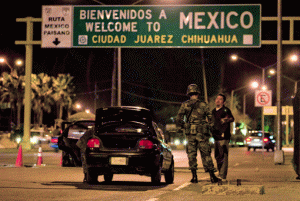
Secretary of State Hillary Rodham Clinton is traveling today to the central Mexican city of Guanajuato for one day of bilateral talks with her counterpart, Foreign Minister Patricia Espinosa. According to a Department of State press release, the main discussion points will cover joint efforts in the areas of organized crime, economic collaboration, border security, and climate change reform post-COP 16 in Cancún. Following her discussions with Minister Espinosa, Secretary Clinton will meet President Felipe Calderón in Mexico City.
The timing of Secretary Clinton’s visit is critical as Mexico continues to suffer from drug cartel-related violence throughout the country. More than 34,000 people have died in the last four years due to organized crime. President Calderón has mounted an aggressive government effort to stave off narco-violence, despite nearly 16,000 of the 34,000 deaths having occurred in 2010 alone.
In light of this, the Colombian army has begun training Mexican police officers to contain drug gangs. Colombian President Juan Manuel Santos notes that: “Mexico has what we had some years ago, which are very powerful cartels. What we can provide is the experience that we have had dismantling those cartels, training intelligence officers, [and] training judicial police.”
![]() |
Colombian presidential hopeful Antanas Mockus, said in an interview yesterday that, if he is elected, he would seek to normalize trade with Venezuela and use diplomatic channels to diffuse tensions between the two Andean countries, which have intensified in recent years. Mr. Mockus is Colombia’s Green Party candidate for president and has taken the lead in polls in recent weeks ahead of the country’s May 30 elections.
In the interview, Mockus expressed his desire to “choose the path of respect and prudence” with Venezuela but also noted that, “if Venezuela becomes another Cuba, it would be sad for everyone.” He also discussed relations with the United States and expressed his intention to continue strengthening ties to the United States and to ensure the continuation of the Plan Colombia aid program that has helped Colombia combat narcotrafficking and guerilla groups.