
btn_subscribe-top
btn_give-a-gift
btn_login
btn_signup
btn_rss
  • Monday Memo: AQ’s Top Expected Stories for the Week of May 14

    May 14, 2012

    by AQ Online

    Top stories this week are likely to include: Hugo Chávez post-radiation therapy; Michel Martelly begins his second year as president; Dominicans head to the polls; Peru minus two ministers; and Brazil creates a new social program.

    Chávez Ends Cancer Treatment: Venezuelan President Hugo Chávez returned from Cuba on Friday claiming that he had ended his radiation therapy session in Havana “in a successful manner.” This appears to be the first full week in the past several weeks where Chávez governs the country while on its soil. Despite his repeated absences, the latest poll by Datanálisis reports that Chávez returns home with a 17 percentage point advantage over opposition candidate Henrique Capriles Radonski ahead of the October presidential election. Now the question is whether Chávez is truly recovered; the recently-formed Council of the State casts some doubt. AQ Editor-in-Chief Christopher Sabatini points out, “Sure Chávez says he is in the clear, and we all hope he is. But President Chávez has said that before. Given the chronic lack of transparency of this regime, it’s impossible to know.”

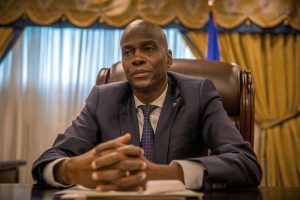
    Martelly in Second Year: Haitian President Michel Martelly was sworn in one year ago last Friday, and this is his first full week of the new presidential year. The Associated Press ranks his first year as one of “modest gains” that many in Haiti view with “guarded surprise.” Despite clashes with parliament, Martelly has overseen successes such as reduced tuition for schools, funded by a tax on international phone calls, as well as a steady recovery after the devastating January 2010 earthquake. But it has not been without challenges. According to AQ Senior Editor Jason Marczak, “A top priority in the next few months will be getting to the UN to devote all the resources necessary to control the cholera outbreak. This cannot be a piecemeal approach; it must be dealt with rapidly and comprehensively before more Haitians die.”

    Elections in the Dominican Republic: Dominicans elect a new president on Sunday, May 20; the two leading candidates are Hipólito Mejia of the Partido de la Revolución Dominicana (Dominican Revolution Party—PRD) and Danilo Medina of the ruling Partido de la Liberación Dominicana (Dominican Liberation Party—PLD). President Leonel Fernández of the PLD is not running for re-election. Sabatini notes, “This election, and the Dominican Republic’s future, turns really on the ability of the PLD and the political system’s capacity generally to renew itself. The truth is: without broader leadership change across the parties, the political and economic miracle of the DR may be at risk—not now, but in the future.”

    Peru and the Ministerial Gap: After last week’s resignation of the interior and defense ministers, Peruvian Prime Minister Oscar Valdés must quickly restore order to President Ollanta Humala’s cabinet. The ministers resigned after a failed operation against the Shining Path rebels killed at least nine soldiers, and they faced a congressional censure. This is not the first ministerial change; the entire cabinet was dissolved by former Prime Minister Salomón Lerner after Indigenous Peruvians protested against the controversial Conga mine. “Increasingly, we’re seeing a government that is shifting more in favor of investor rightism in large part as a recognition of the need of the state to generate revenue to support its social inclusion agenda,” observes Sabatini.

    Brazil Combats Extreme Poverty: Brazilian President Dilma Rousseff announced a new social program to fight extreme childhood poverty yesterday. The program, Brasil Cariñoso (Caring Brazil), will spend $4 billion to create 6,000 new daycare units for children and an increased subsidy of the popular Bolsa Família program—and it will affect the most impoverished areas of Brazil, the north and northeast. Marczak says, “The very poor have yet to join in the Brazil miracle, but this newest program has the right ingredients for their young children to have access to many of the foundations needed for success. Once again, Brazil is an example for the region.”

    Tags: Brazil, Cuba, Danilo Medina, Dominican Republic, Haiti, Henrique Capriles Radonski, Hipolito Mejia, Hugo Chavez, Michel Martelly, Ollanta Humala, Peru, Venezuela

  • Haiti Lawmakers Approve New Prime Minister

    May 4, 2012

    by AQ Online

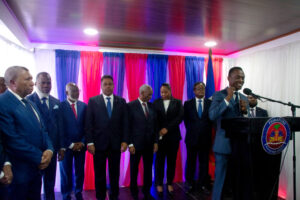
    Haitian legislators yesterday approved President Michel Martelly’s nominee for Prime Minister, Laurent Lamothe, ending a confirmation standoff that has brought Haiti’s federal government to a virtual standstill for nearly two months. Lamothe, a former special adviser to President Martelly before being appointed foreign minister in September 2011, was confirmed by a vote of 62–3 after a six-hour long debate centered on whether he met residency requirements for public officials stipulated in the country’s constitution.

    In an interview after the vote with the Associated Press, Lamothe vowed to immediately begin working to get Haiti’s post-earthquake recovery back on track saying, “We have a lot of work to do now… I feel that the country finally has the opportunity to work on the people’s problems. We have a lot of different issues to deal with and finally we have the team in place to start solving the people’s problems.”

    The confirmation will also ease concerns in the international community—particularly among donors and aid organizations—which had grown weary of dealing with a government partner hobbled by political infighting. In remarks delivered before the vote, UN Special Envoy to Haiti Bill Clinton weighed in saying officials needed to set aside self-interest for the good of the country and “restore confidence in Haitian institutions so that donor funds can flow again and attract new investment.”

    Observers note that even with the confirmation, it could still take weeks before the legislature finally approves Lamothe’s government plan and his choices for Cabinet positions.

    Tags: Bill Clinton, Haiti, Laurent Lamothe, Michel Martelly

  • DC Water Cooler: Hold Drops and Ambassador Swaps

    April 11, 2012

    by Liz Harper

    On March 29, the U.S. Senate confirmed several of President Obama’s diplomatic nominations, many of whom were tapped to serve in the State Department’s Bureau of Western Hemisphere Affairs (WHA). Here’s a brief rundown of the confirmed WHA officials and their new positions: Roberta Jacobson, Assistant Secretary of State for Western Hemisphere Affairs; Larry Palmer, Ambassador to Barbados; Pamela White, Ambassador to Haiti; Phyllis Powers, Ambassador to Nicaragua; Jonathan Farrar, Ambassador to Panama; and Julissa Reynoso, Ambassador to Uruguay.    

    Not only do these confirmations provide a celebratory sense of relief, as many of these officials waited months for their nominations to proceed through the Senate, but the timing could not be better as the U.S. delegation prepares to depart for Cartagena, Colombia, to attend this weekend’s Sixth Summit of the Americas.

    Jacobson was nominated in late September after becoming acting assistant secretary in July 2011 when her predecessor, Arturo Valenzuela, returned to academia. It’s both notable and laudable that a woman is leading WHA for the first time.  

    Jacobson’s candidature was challenged by Cuban-American Senator Marco Rubio (R-FL), who placed a hold on her nomination last November with a call to the Obama administration to “review abuses in the people-to-people Cuba travel policy.” Rubio dropped his hold on March 22 following guarantees from the State Department that it would require “applicants to demonstrate how their itineraries constitute purposeful travel that would support civil society in Cuba and help promote their independence from Cuban authorities,” according to the senator’s news release.

    Read More

    Tags: Barbados, Bolivia, Ecuador, Haiti, Nicaragua, Panama, Roberta Jacobson, U.S. Department of State, Venezuela

  • Monday Memo: AQ’s Top-Five Expected Stories for the Week

    February 27, 2012

    by AQ Online

    AQ Online today launches its weekly Monday Memo that looks ahead to what it expects to be the top headline grabbers for the week. The top anticipated stories for the week of February 27 include: Hugo Chávez’ surgery; U.S. Secretary of Homeland Security Janet Napolitano’s current five-country Latin America tour; U.S. Vice President’s forthcoming visit to Mexico and Honduras; the search for a new prime minister in Haiti; and FARC suspending kidnappings in Colombia.

    Chávez' Cancer: As the Venezuelan president heads to Cuba for a second surgical operation, the rumor mill on his real health status will continue as will the discussion about what its implications will be for Venezuela's October presidential election. Christopher Sabatini, AQ editor-in-chief, observes: “While it may translate into sympathy support, President Chávez' lack of transparency about his illness and treatment will likely raise fears among some Venezuelans about their future and a potential successor—irrespective of what the president says upon his release.”

    Napolitano on Latin America Tour: U.S. Secretary of Homeland Security Janet Napolitano begins a five-country tour today through Wednesday in Mexico, Guatemala, El Salvador, Costa Rica, and Panama. According to a Department of Homeland Security (DHS) press release, Secretary Napolitano will be accompanied by Acting Commissioner of U.S. Customs and Border Protection David Aguilar and DHS Assistant Secretary for International Affairs Alan Bersin. Her visit is likely intended to reiterate support for security measures like the Central America Regional Security Initiative and reinforce counter-trafficking efforts to interdict narcotics through key transit points.

    Biden to Mexico and Honduras: U.S. Vice President Joe Biden will visit Mexico and Honduras on March 4-6, meeting with both Presidents Calderón and Lobo. Why is the Vice President going to Honduras?  While Mexico remains an important economic, diplomatic and strategic partner in the war on drugs, the trip to Honduras is a mystery. Since the 2009 coup, Honduras has become the murder capital of Central America. Two weeks ago, a fire at a Honduran prison left 350 inmates dead—an incident that Human Rights Watch blamed on poor and overcrowded conditions in Honduran prisons.

    Haiti Prime Minister Watch: The abrupt resignation of Haitian Prime Minister Gary Conille on Friday culminated weeks of disagreement between him and President Michel Martelly. The departure of the former UN diplomat and favorite of the international aid community is a blow for both political stability in Haiti and for donor nations that had great hopes in a government that included his technical skills. Jason Marczak, AQ senior editor, says: “Expect President Martelly to move quickly in naming a successor, with a candidate likely announced this week.” Foreign Minister Laurent Lamothe is one possibility as is Chief of Staff Ann-Valerie Milfort. However, both would face a tough confirmation by an opposition-controlled legislature. 

    FARC Hostage Release: Colombia's FARC announced on Sunday that it will suspend all kidnapping and free remaining prisoners. Is this a political ploy or a true change in tactics? Given the group's decentralized nature, it is unclear whether the FARC secretariat can actually enforce the order, if it chooses to do so. Expect renewed debate this week on whether this may help to clear the way for an eventual peace dialogue or if the current strategy should continue without talks.

    Tags: Colombia, Costa Rica, Counternarcotics, FARC, Felipe Calderon, Garry Conille, Guatemala, Haiti, Honduras, Hugo Chavez, Janet Napolitano, Joe Biden, Mexico, Michel Martelly, Panama, Porfirio Lobo, Venezuela

  • Time for UN Peacekeepers to Rethink their Role in Haiti

    February 21, 2012

    by Abby Goldberg

    Last week, a United Nations Security Council delegation visited Haiti to assess the 10,500-member peacekeeping force, known as the UN Stabilization Mission in Haiti or MINUSTAH. The visit was to assess security needs in Haiti before the UN Security Council makes a decision about whether to reduce the number of forces stationed in the country.

    In a complete departure from past assessment missions, this trip included minimal assessment of actual peacekeeping, the reason MINUSTAH was sent to Haiti in the first place. Instead, the Security Council focused primarily on two major afflictions caused by MINUSTAH: Their admitted introduction of cholera to Haiti and corresponding failure to respond adequately despite ongoing death and illness, as well as reports of sexual abuse by peacekeeping troops, some of which were even recorded on film. Both of these crimes, very distinct in nature, have made it nearly impossible for the UN peacekeeping mission to be successful in its mandate to “keep the peace,” if there is even a peace to keep. Indeed, if anything, MINUSTAH is responsible for much of the unrest and instability.

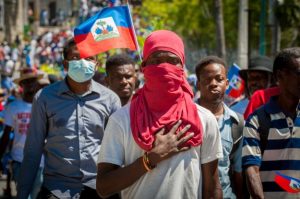
    Recent protests in Haiti have largely focused on the problems brought by the peacekeepers. Not surprisingly, the Security Council visit last week brought on a new wave of such protests—one of the ways Haitian people have expressed their ongoing frustration with the UN “occupiers” as they are called. One in ten MINUSTAH peacekeepers worldwide are currently stationed in a country the size of Massachusetts, a country where there is no war. Even so, the UN continues to spend more than $2 million a day on the peacekeeping operation. In my own conversations with MINUSTAH personnel, they expressed boredom and difficulty communicating with Haitians, but never mentioned war or peace. They admitted that it is unclear how much security forces can do for Haiti. Haitians, for their part, are calling for justice.  They are demanding accountability. They know the UN is responsible for so much pain they have suffered, and they are asking for compensation. 

    Read More

    Tags: Cholera, Haiti, MINUSTAH

  • UN Investigates Sexual Abuse Allegations in Haiti

    January 24, 2012

    by AQ Online

    The United Nations announced yesterday that it is investigating two cases of sexual exploitation of children allegedly committed by UN police personnel in Haiti. One case involves the UN Police (UNPOL) in Port-au-Prince, while the other implicates one or more members of the Formed Police Unit (FPU) in the northern city of Gonaives.

    UN Spokesperson Martin Nesirky said that the Stabilization Mission in Haiti (MINUSTAH) alerted UN headquarters of the allegations last week. “The United Nations is outraged by these allegations and takes its responsibility to deal with them extremely seriously,” said Nesirky in a statement. The UN has not disclosed the nationalities of the police officers in question, but confirmed that they have been removed from duty while under investigation.

    Since peacekeepers first arrived in Haiti 2004 to restore order following the ouster of former President Jean-Bertrand Aristide, the UN has had a sometimes tense relationship with the local population. Last September, five Uruguayan peacekeepers were recalled after being accused of sexually abusing a Haitian man at a UN base, while recording the incident on a cellphone. Four months earlier, an independent UN panel concluded that the Cholera epidemic that infected 344,000 Haitians and killed over 6,000 likely originated from poor sanitation by Nepalese peacekeepers stationed in Mirebalais. Both incidents resulted in protests and clashes between protesters and UN and Haitian police.

    In an effort to ebb anti-UN sentiment in Haiti, the Security Council decided last October to withdraw 3,000 troops from the Caribbean nation, returning the force to pre-earthquake levels. Still, President Michel Martelly maintains that UN troops are a necessary presence in Haiti until the country’s police force—or a new military—can ensure security.

    Tags: Cholera, Haiti, President Michel Martelly. MINUSTAH, Sexual Abuse, UN Peacekeepers, UN Police, UN Security Council, Uruguayan Peacekeeprs

  • AQ Video: Infrastructure Development in Haiti

    January 19, 2012

    by AQ Inclusion

    Last week marked the two-year anniversary of the January 2010 earthquake in Haiti, one of the most devastating in history. It magnified global attention to the Western Hemisphere’s poorest nation, especially as the hardest-hit neighborhoods in Port-au-Prince were 25 kilometers from the tremor’s epicenter.

    In order to prevent these areas in Haiti from sliding into indigence, the World Bank is proactively funding initiatives to empower Haiti’s government and civil society to become more prepared against future natural disasters. Learn about how financing and training from the World Bank is helping the poorest communities of Haiti better determine risk through infrastructure and urban planning as the country continues to rebuild.

    Tags: Haiti, Infrastructure, Social inclusion, World Bank

  • Female Peacekeepers in Haiti

    January 4, 2012

    by Sabrina Karim

    The peacekeeping mission in Haiti (UN Stabilization Mission in Haiti or MINUSTAH) is the only peacekeeping operation in the Western Hemisphere. It is the third largest mission and about 12.5 percent of the world’s peacekeepers are concentrated on the island. Several Western hemisphere countries contribute to the forces including Brazil, Uruguay, Canada, Chile, Colombia, Peru, El Salvador, Jamaica, Ecuador, Guatemala, and even the United States. Yet, over the past years MINUSTAH has received a lot of negative publicity.

    Originally, the mission was established in 2004 after President Bertrand Aristide departed Haiti for exile in the aftermath of an armed conflict, which spread to several cities across the country. Then in 2010, the January earthquake struck the island, killing over 220,000 people including 96 UN peacekeepers. This led to a dramatic setback to the mission and the UN Security Council increased the overall force to support the immediate recovery, reconstruction and stability efforts in the country. Today, there are about 12,438 UN personnel in Haiti with 167 having been killed.

    Read More

    Tags: Haiti, MINUSTAH

  • Haiti to Offer Child Education Subsidies

    October 4, 2011

    by AQ Online

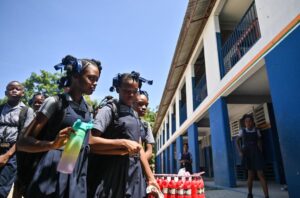
    Haitian President Michel Martelly announced yesterday that his administration plans to provide education subsidies for 772,000 children in an attempt to boost student enrollment. The announcement coincided with the opening of the school year in Haiti. Martelly’s National Fund for Education (FNE) will cover the tuition of 142,000 students who will attend school for the first time ever. 

    The Clinton Foundation donated $1.25 million to cover the registration fees of some students. FNE, the initiative that Martelly launched shortly after he took office in May, is funded by per-minute fees assessed to incoming international calls as well as a flat tariff on international wire transfers. Gaston George Merisier, Martelly’s advisor on education, announced last week that $28 million had been raised thus far from these taxes, and that much of the additional monies had been sent by Haitian expatriates abroad.

    Martelly repeatedly called for free education during the 2010-2011 presidential campaign. Education is a much-needed social service in Haiti, which is still ravaged by the aftermath of the January 2010 earthquake. Much of the donor money into Haiti thus far has been funneled into short-term delivery of education and health services in tent camps—and reconstruction of hospitals and schools over the long term.

    Tags: Education, Haiti, Michel Martelly, Social inclusion

  • UN Proposes Truth Commission on Duvalier Dictatorship

    July 6, 2011

    by AQ Online

    On Tuesday United Nations Deputy High Commissioner for Human Rights Kyung-wha Kang  supported  the creation of a truth panel to investigate the human rights abuses of Jean-Claude “Baby Doc” Duvalier, Haiti’s president from 1971 to 1986. Speaking at a press conference in Haiti, Kang said the initiative would facilitate reconciliation among Haitian victims of the dictatorship, and that it would proceed alongside current efforts to prosecute Duvalier in local courts. The former despot has been accused of torture, arbitrary detentions, rape, enforced disappearances, and extrajudicial executions.

    During a four-day trip to Haiti, Kang met with government officials, including President Michel Martelly and the president of the lower chamber in Congress, as well as human rights groups and civil society organizations. She reminded them of the importance of human rights in the context of development and insisted on the importance of a truth commission. “I hope it will thoroughly examine this period of Haitian history as well as others, promote memory and reconciliation, and raise awareness of the need to protect and promote human rights, particularly among young persons,” she said.

    After being overthrown by a popular uprising in 1986, Duvalier fled to France, where he spent the last 25 years in exile. He returned to Haiti in January of this year, after which several criminal charges were brought against him. More than 20 lawsuits have been filed in local courts for crimes including murder, torture and embezzlement. Bobby Duval, a former soccer celebrity who favors the creation of a truth commission, is among the plaintiffs; he has spoken several times about the tortures he suffered during 17 months of imprisonment without charge.

    Duvalier’s lawyer, Reynold Georges, opposes the creation of a truth commission, arguing, “We have our own legal system, and we're going to stick to it. ... Love Duvalier or leave the country.” Additionally, in April, President Martelly told a Montreal newspaper that he would be willing to consider amnesty for Duvalier on the basis of national reconciliation. He has already reached out to Duvalier allies; Daniel Supplice, minister of social affairs under Duvalier, was the head of Martelly’s transition team and is among the candidates to become Martelly’s Prime Minister.

    Tags: Haiti, Human Rights in Haiti, Jean-Claude Duvalier, United Nations

  • Haiti Overhauls Adoption Procedures

    June 24, 2011

    by AQ Online

    Haitian President Michel Martelly on Thursday announced that he intends to ratify the Hague Convention on Inter-Country Adoption, which sets forth guidelines and procedures governing international adoptions and mandates that all adoptions be processed by government-recognized agencies.

    The announcement was made after a summit in Port-au-Prince that brought together representatives from ten adoption-destination countries to discuss efforts to revamp Haiti’s adoption laws.  Problems with Haiti’s adoption laws entered the international spotlight following numerous incidents in the aftermath of the 2010 earthquake, including one occasion in which a group of U.S. missionaries were accused of kidnapping 33 children from Haiti under the guise of adoption.

    Prior to the earthquake, in 2007, UNICEF reported that there were approximately 380,000 orphans in Haiti—a number that has surely increased in recent years.

    Tags: adoption, Haiti, Michele Martelly

  • Weekly Roundup from Across the Americas

    May 18, 2011

    by AS-COA Online

    From Americas Society/Council of the Americas. AS/COA Online's news brief examines the major—as well as some of the overlooked—events and stories occurring across the Americas. Check back every Wednesday for the weekly roundup.

    Sign up to receive the Weekly Roundup via email.

    Giuliani Advises Peru’s Fujimori as She Pulls ahead

    Conservative Peruvian presidential candidate Keiko Fujimori contracted former New York Mayor Rudy Giuliani this week as an adviser to help design public security programs. The news came as polls indicated that Fujimori has begun to pull ahead of leftwing nationalist Ollanta Humala for the June 5 runoff election. A Datum released Sunday night found Fujimori leading over nationalist Humala by nearly six percentage points, with 46 percent against Humala’s 40.2. Another pollster, Ipsos Apoyo, released a figure the same day that found Fujimori winning by a smaller margin, with 51.1 percent compared to Humala’s 48.9 percent. 

    Victims Law Reaches Final Debate in Colombian Congress

    A law that would provide state compensation to victims of violence in Colombia’s civil conflict reaches its final debate in Congress today. Before passing the law, legislators will debate whether to legally recognize that Colombia faces an internal conflict with enemy combatants or to classify the FARC guerrilla army as a terrorist group for the purposes of the law. Colombian ex-President and FARC nemesis Álvaro Uribe explains to Foreign Policy why he supports categorizing the guerrillas as terrorists rather than combatants. Investigative website La Silla Vacía charts the positions of key Colombian politicians on the issue. 

    Scandal-tainted Colombian Envoy to Venezuela Resigns

    Eight months into his job, Colombia’s Ambassador to Venezuela José Fernando Bautista stepped down Monday after admitting he had ties to a Colombian construction conglomerate involved in bribing politicians for work contracts. He will be replaced by Ricardo Montanegro, who served as the Colombian business attaché in Caracas.

    Read More

    Tags: Celso Amorim, Colombian Congress, Free-trade agreement, Haiti, IMF, Keiko Fujimori, Michel Martelly, Venezuela

  • Haiti Prepares for Presidential Inauguration

    May 13, 2011

    by AQ Online

    Preparations are underway in Port-au-Prince today as Haiti readies for the inauguration of President-elect Michel Martelly on Saturday. The ceremony, which will take place on the grounds of the heavily damaged national palace, marks the first transfer of power since the 2010 earthquake that left nearly 1 million homeless.

    Approximately 150 foreign dignitaries are expected to attend the event, including former U.S. President Bill Clinton, U.S. ambassador to Haiti Kenneth Merten and numerous heads of state from Latin America and the Caribbean. However, Mr. Martelly has stirred controversy in Haiti by inviting all eight of Haiti’s living presidents to the event, including former dictator Jean-Claude “Baby Doc’’ Duvalier. In a statement, Haiti's National Human Rights Defense called the decision to invite Duvalier “a total disregard to the tens of thousands of victims” of his regime.

    Mr. Martelly will face daunting challenges as president. The earthquake recovery effort is far from complete and recent months have brought increasing insecurity and economic hardship. Robert Maguire, associate professor of international affairs at Washington DC-based Trinity Washington University, provides in-depth analysis of Haiti’s precarious situation and offers a few possible solutions in his article, “Haiti's New President: Welcome to the Toughest Job in the Americas,” in the latest issue of  Americas Quarterly.”

    Tags: Haiti, Inauguration, Michel Martelly

  • Haiti Votes to Allow Dual Nationality

    May 9, 2011

    by AQ Online

    Haitian lawmakers voted yesterday evening to allow dual nationality for Haitians living abroad—extending them political rights such as the ownership of land and the option to run for public office. There are over two million Haitians living in the U.S., Canada and elsewhere, and yesterday’s parliamentary vote reverses a provision in Haiti’s 1987 constitution which banned dual nationality.

    Prior to yesterday’s vote, Haitian expatriates were permitted to remit funds back to their homeland and even donate to presidential candidates, but they were barred from running for public office.  Dual nationals under the new rules will not be allowed to run for president, or to hold the offices of prime minister, police chief or Supreme Court judge, but supporters of yesterday’s changes say they will still help to redefine what it means to be Haitian.

    This legislative move has the support of the U.S. government. United States Representative Frederica Wilson, whose Miami district encompasses the largest constituency of Haitians in the United States, endorses the plan. Wilson also supports the extension of Temporary Protected Status (TPS) which allows Haitians to live and work in the United States legally, albeit temporarily, in the wake of the January 2010 earthquake. The TPS extension is set to expire next month.

    Tags: Haiti

  • Haitian President-Elect to Visit U.S.

    April 19, 2011

    by AQ Online

    Haitian President-elect Michel Martelly traveled to Washington DC today to meet with U.S. Secretary of State Hillary Clinton and the heads of the International Monetary Fund, the World Bank and the Inter-American Development Bank. Talks will focus on job creation, education, security, reconstruction, public health, and the future relationship between Haiti and these multinational organizations.

    The three-day trip to the U.S. comes two weeks after preliminary results confirmed that Mr. Martelly received 68 percent of the vote in a March 20 run-off election, beating former First Lady Mirlande Manigat. The President-elect will also meet with the U.S. news media, including CNN, the Washington Post, and Fox News. The National Press Club in Washington has confirmed that Martelly will hold a press conference on Thursday, the last day of his trip.

    The Provisional Electoral Council had intended to release final results on April 16, but the announcement was since rescheduled for tomorrow. If the preliminary results stand, Martelly will become Haiti’s 44th president on May 14. One of his first responsibilities will be to nominate a new prime minister, who must then be approved by a parliament still largely controlled by members of outgoing President Réne Préval’s INITE party.

    Tags: Haiti, Haitian Elections, Hilary Clinton, Michel Martelly, René Préval

  • Haitian Presidential Runoff Results Delayed

    March 30, 2011

    by AQ Online

    Haiti’s Provisional Electoral Council (CEP) announced yesterday that large voter turnout and a “high incidence of fraud and irregularities” during the March 20 presidential runoff will delay the announcement of preliminary results. Though the results were scheduled for release tomorrow, presidential hopefuls Mirlande Manigat and Michel Martelly will have to wait until April 4 for the first vote tallies.

    Compared to the first round of voting on November 28, 2010, which was marred by widespread fraud, low voter turn out and three days of violent protests, international monitors had praised the second round for being better organized. The violence following the first round broke out when it was announced that Martelly, a kompa star that is a favorite among Haiti’s poor, was left off the runoff ballot. Not until the Organization of American States reviewed the voting results was Martelly placed back on the ballot over then-second place holder Jude Celestin—the candidate of current president Réne Préval’s party.

    Though the delay affects the release of preliminary results, final results remain on schedule to be released on April 16. The next president of Haiti, who will assume power this May, will face the daunting task of procuring billions of dollars in promised foreign aid and rebuild a weakened public sector in a country currently dominated by nongovernmental organizations.

    Tags: Haiti, Haitian Elections, OAS

  • U.S. Urges Aristide to Delay Return to Haiti

    March 15, 2011

    by AQ Online

    United States officials asked former president of Haiti, Jean Bertrand Aristide, to delay his return to the country until after the March 20 elections amid fears that his presence will influence voters.  President Aristide has been living in exile in South Africa since his removal from office in 2004.  U.S. State Department spokesman Mark Toner stated in comments yesterday that the decision to allow Mr. Aristide to return was up to Haitian authorities but warned that his return before the election could be “destabilizing” and “could only be seen as a conscious choice to impact Haiti’s elections.”  Mr. Aristide’s lawyer, Ira Kurzban, has echoed the U.S. State Department’s sentiment that the former president’s return be left up to the Haitian authorities while noting that Mr. Aristide wishes to return to Haiti to dedicate himself to education and not to politics. 

    Speculation of Mr. Aristide’s return to Haiti has increased since the return of another exiled former Haitian leader, Jean-Claude “Baby Doc” Duvalier, to Haiti on January 16, 2011, after 25 years of living in exile in France.  U.S. authorities have appealed to the South African government to delay Mr. Aristide’s departure from the country.  However, South African deputy foreign minister Marius Fransman stated today that it was not “our responsibility to say if Jean-Bertrand Aristide should or should not leave South Africa before the election” while noting that the Haitian government has cleared the way for Aristide’s return by issuing him a passport this past February. 

    Both presidential candidate’s in this weekend’s run-off, Mirlande Manigat and Michel Martelly, or “Sweet Micky” as he is more popularly known, have no objections to Mr. Aristide’s return.  Meanwhile, Mr. Aristide remains a divisive figure in Haitian politics and still retains some support, especially among Haitian living in slums and tent cities where the since the January 2010 earthquake, where people have become frustrated with the slow pace of recovery. 

    Tags: 2010 Haiti elections, Haiti, Jean Bertrand Aristide, U.S. State Department

  • Jean-Bertrand Aristide’s Return to Haiti Imminent

    February 18, 2011

    by AQ Online

    After seven years in exile in South Africa, former Haitian President Jean-Bertrand Aristide is widely expected to soon arrive in Port-au-Prince, raising fears that turmoil looms in the run up to national presidential elections next month. According to reports, Mr. Aristide has received a diplomatic passport from the Haitian government, and officials in South Africa, where he now resides, have said they will facilitate his return back home.

    The United States and others have warned that Aristide’s return to Haiti could be an "unfortunate distraction" for voters and have urged him to wait until after the second round of voting. But Mr. Aristide remains very popular among Haiti's poorest communities, many of whom are jubilant at the prospect of his arrival.

    Mr. Aristide became Haiti’s first democratically elected president in 1991, following the 29-year reign of the father-son Duvalier dictatorship. But he was also removed from power twice, most recently in 2004 when Aristide fled the country aboard a U.S. supplied aircraft. In the years since, supporters have organized periodic protests demanding his return, while critics have lobbed accusations that Mr. Aristide allowed drug-fueled corruption and violent attacks on opponents by armed militias.

    Tags: Haiti, Jean-Bertrand Aristide

  • Government Favorite Excluded from Haitian Presidential Runoff

    February 4, 2011

    by AQ Online

    Haiti’s Provisional Electoral Council (CEP) announced yesterday morning that government party candidate Jude Célestin is not eligible to run against frontrunner and former first lady Mirlande Manigat in the March 20 national presidential runoff elections. The long-awaited decisions means that  Haitian pop singer Michel Martelly, who placed second in November’s first round voting will proceed to the second round.

    The announcement mirrors recommendations made by the Organization of American States (OAS), which found evidence of widespread fraud, missing votes and altered tallies in favor of government-backed candidate Célestin. To many observers, the decision is a sign of progress in a country that witnessed a surge of violence and voter ballot confusion during the first round elections in November. Other tumultuous events such as the onset of an ongoing cholera epidemic and the recent return of former dictator Jean-Claude Duvalier on January 16 have raised the overall uncertainty regarding the election.

    Support for the decision from international observers was immediate with Farhan Haq, a United Nations spokesperson, saying, "it is of capital importance for Haiti to have a new democratically elected government, to work on the pressing issues of reconstruction and the fight against cholera." The OAS also supports the decision and says it will send a new team of observers for the presidential runoff, as has been requested by the Haitian government. 

    The results of the runoff will be announced on April 16. Follow AQ Online for more updates and coverage.

    Tags: Elections, Haiti

  • Duvalier’s Return to Haiti Reignites Préval Debate

    February 1, 2011

    by Ferentz Lafargue

    The unexpected arrival of former dictator Jean-Claude “Baby Doc” Duvalier has incited another plot twist in the tragic-comedy known as Haitian politics. Duvalier’s reasons and/or ambitions for this return has elicited endless speculation from the moment his Air France flight touched down in Port-au-Prince. One of the first writers to solve this mystery was Huge Desrameaux. Writing in the Miami Herald, Desrameaux revealed that Duvalier had returned to Haiti in a quixotic attempt to reclaim what’s left of his ill-gotten fortune, which is currently being withheld by Swiss authorities. These fortunes will now be easier for the Haitian authorities to reclaim after the Duvalier Law—a Swiss law that eases the ability of a country to retrieve ill-gotten gains—went into effect today.

    In spite of Duvalier’s efforts at arguing that his motives are more benevolent (he’s allegedly returned to help with earthquake relief and to donate his remaining bounty to the Red Cross) the audacity of returning to the island that he and his father plundered requires a voluminous amount of hubris. After all, did Duvalier seriously believe he could return home to Haiti and everyone would turn the other cheek?

    Duvalier’s impromptu homecoming also offers another opportunity to debate the efficacy of President René Préval’s tenure in office. “Baby Doc” may be the spectacle du jour, but the real question that Haitians must address at this moment is, what is its post-Préval future?

    Read More

    Tags: Haiti

  • Clinton Pushes for an End to Haiti’s Political Impasse

    January 31, 2011

    by AQ Online

    Secretary of State Hillary Rodham Clinton visited Port-au-Prince yesterday to meet with Haitian politicians regarding the ongoing presidential elections. She met with incumbent president René Préval and the three leading candidates after the November 2010 vote: former first lady Mirlande Manigat, construction executive Jude Célestin and popular musician Michel Martelly.

    The preliminary results were originally contested when Martelly—long expected to advance to a second round—lost out to Célestin to advance to the runoff. After much international pressure, the Organization of American States (OAS) conducted an investigation, and issued a report recommending that Martelly be included in the runoff instead of Célestin. Secretary Clinton said yesterday that the Obama administration supports the OAS’ findings. Haiti’s Provisional Electoral Council is expected to issue its final ruling on Wednesday.

    Although the presidential runoff is scheduled for March 20, with results to be announced on April 16, Préval is constitutionally required to leave office on February 7. However, an emergency bill passed by Haiti’s parliament last year allows Préval to stay in office until May 14. Célestin, a member of Préval’s Inité party and widely viewed as his political protégé, has in recent days rebuffed Préval’s calls to withdraw from the race.

    In addition, a Department of State press release noted that Secretary Clinton visited a cholera treatment clinic to monitor ongoing reconstruction efforts after last year’s earthquake.

    Tags: 2010 Haiti elections, Haiti, Hillary Clinton, René Préval

  • Weekly Roundup from Across the Americas

    January 13, 2011

    by AS-COA Online

    A Year after the Quake, Good Manufacturing News for Haiti

    In Haiti, Sae-A Trading Company, a South Korean clothing-manufacturing giant, opened for business this week. Its factory will employ 20,000 Haitians once fully operational. On the same day, the historic downtown Port-au-Prince Iron Market reopened after Caribbean mobile phone carrier Digicel paid to have it reconstructed. Jean-Max Bellerive, Haiti’s prime minister, said: “I have to say this is the best day of my life.”

    Read More

    Tags: Chile, Earthquake, Haiti, Nicaragua, Peruvian

  • Haiti’s Second Chance: A Time for Reflection and Progress

    January 12, 2011

    by Richard André

    One year has passed since Haiti was rocked by the 7.0-magnitude earthquake on January 12, 2010. In just three minutes, a nation already suffering from hunger and neglect was hit with a seemingly decisive blow.

    The media’s coverage of Haiti is as insightful today as it was in the weeks immediately following the earthquake. Then, as now, there is a cache of grim photos and figures that find their way into each segment. Running down a list of casualties—supposedly to paint a picture of the situation plaguing Haiti—tends to oversimplify an unnervingly complicated situation. At the same time however, it’s important to take stock of what has been lost in just a year: more than 250,000 killed in the earthquake alone; 1 million displaced persons; 3,500 dead by Cholera with 400,000 more cases estimated to surface in 2012; upwards of $10 billion in damages; and political violence rampant surrounding the political election. As they say, ‘if it bleeds, it leads’.

    But amidst the cripplingly slow reconstruction effort, some progress has been made. The most symbolic achievement—and perhaps the most dramatic as well—is the presidential election that took place on November 28, 2010. Why would a fraud-ridden election that played out like a telenovela be so key? Because the single most important entity in post-earthquake Haiti will be an established, well-funded Haitian government. Not only will this government be in charge of delivering social services the government has failed to provide for decades, but the legitimacy of the government (and I use the word legitimacy optimistically) will determine how much of the $10 billion in donations and foreign aid actually makes its way to Haiti, and from that point, how effectively it is invested.

    Granted, it will be several months before Haiti’s next president comes into power, let alone establishes him or herself. But the Organization of American States (OAS) took a crucial step on Monday when it published a review of the hotly contested election results. The outcome: disqualification of 17,220 votes for ruling-party candidate Jude Celestin and 7,150 votes for kompa star Michel “Sweet Mickey” Martelly. The OAS put an end to the back and forth about who will participate in the run-off next month (assuming President Préval accepts the report, which he should given that he invited the 10-man OAS team in the first place). With Martelly likely to earn a second-place victory with 22.2 percent of the vote, he would face undisputed first-place finisher Mirlande Manigat for perhaps the most important presidential post in Haiti since the 1960s.

    Read More

    Tags: Clinton, Earthquake, Elections, Haiti, Manigat

  • Haití: Mañana Dios Dirá

    January 12, 2011

    by Tabata Peregrin

    Si no supiera que murieron casi 300.000 personas y que todavía hoy en día hay 1.200 campamentos de refugiados con casi un millón de personas diría que hoy los haitianos celebran algo. El día en que se cumple un año del terremoto por las calles de Puerto Príncipe desfilan miles de personas vestidas de blanco, cantando y bailando. Cantan a Dios y no se sabe muy bien por qué bailan, pero bailan, incluso muchos sonríen. Hoy en Haití no lloran. Las iglesias están llenas de gente. Muchos cierran los ojos y rezan, otros simplemente agachan la cabeza y parecen meditar en lo que pasó y lo que vendrá.

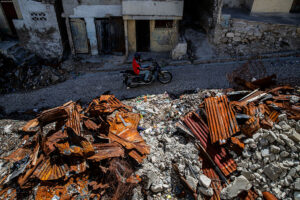
    Un año después del terremoto las calle de la capital parece una imagen congelada de hace un año. Apenas se ha recogido el 10% de los restos del terremoto y las tiendas frente al palacio presidencial están en el mismo sitio que la semana que se instalaron después del seísmo.

    A treinta kilómetros al oeste de la capital en Camp Corail—el campamento de refugiados más grande montado por el gobierno haitiano—para Sherline sin embargo hoy es un día como otro cualquiera. Se ha levantado y no tiene nada que hacer, no hay trabajo ni dinero para comprar mercancía que revender. El campamento está situado en una zona totalmente seca, sin árboles, agua, ni mucho menos un pueblo o iglesia cercana donde ir a rezar. Junto a ella viven 10.000 personas. Atendidos por doce ONG´s internacionales y con patrulla de la ONU permanente, en Camp Corail se viven con mejores condiciones de salud y seguridad que en los campamentos espontáneos de la capital—pero sus habitantes pasan el mismo hambre que sus vecinos capitalinos.

    Sherline tiene 32 años y está embarazada de su cuarto hijo: un bebé “Goudu-Goudu”, como se conoce a la generación de bebés nacidos después del terremoto. La joven haitiana comparte con sus cuatro hijos una pequeña casa de madera prefabricada a la que se acaba de mudar después de meses en una tienda. “Después del terremoto me sentía sola y tenía miedo. Me enamoré pero cuando me quedé embarazada se marchó”.

    Read More

    Tags: 2010 Haiti earthquake, Haiti

  • On One-Year Anniversary, Hope Amid Haiti’s Struggle to Rebound

    January 12, 2011

    by AQ Online

    The citizens of Port-au-Prince, Haiti, gathered today to commemorate the one-year anniversary of the cataclysmic earthquake that struck the Haitian capital last year, killing an estimated 300,000 people, leaving thousands homeless and causing $8 billion to $14 billion in damage.

    Former U.S. President Bill Clinton, who is now the United Nations special envoy to Haiti and co-chair of an Interim Haiti Recovery Commission, responded from Port-au-Prince to widespread criticism that the international community’s efforts to help rebuild Haiti have achieved little in the past 12 months. Mr. Clinton says he was encouraged by the quickened pace of reconstruction in the final months of 2010.

    One symbol of the speedier recovery, says Clinton, is the recent signing of an investment agreement between the Haitian government and South Korean garment manufacturer Sae-A, which plans to  build a $78 million plant in Haiti that will create 20,000 and make it the largest private sector employer in the country. Outgoing Haitian Prime Minister Jean-Max Bellerive also commented on the deal, saying the ineptitude of the international relief efforts highlight the need for private-sector investment: "This will help Haiti overcome dependence on aid ... we need jobs," Bellerive told reporters.

    Tags: Bill Clinton, Haiti, one year later, relief effort

  • Haiti Detrás del Cristal

    January 10, 2011

    by Tabata Peregrin

    (Homepage rotator photo: Haitians in Grand Boulage are employed in one of UNDP's watershed management projects that are part of reconstruction and rehabilitation efforts. Courtesy of United Nations Development Programme.)

    No es fácil realmente conocer la realidad de Haití y no precisamente porque los haitianos sean desconfiados o no quieran contar su historia. No es fácil conocer Haití porque nadie que no sea haitiano pone un pie en el día a día de la calle.

    Hasta mil organizaciones no gubernamentales (ONGs) están trabajando en el país, una gran mayoría internacionales, pero los expatriados no pasean por Puerto Príncipe, no compran en los supermercados haitianos, ni se paran a adquirir siquiera una tarjeta para recargar el móvil en la pequeña tienda de la esquina. Al extranjero los haitianos lo ven montados en pick ups nuevas, circulando con los pestillos de seguridad echados y con la clara directriz de no bajarse del vehículo a hacer ninguna foto o tomar imágenes. El riesgo de secuestro es lo primero que a uno le advierten al llegar al país.

    De vez en cuando por la carretera se cruza algún camión de la MINUSTAH presente en el país desde el 2004. Los cascos azules patrullan bajo el capítulo siete del Consejo de Seguridad, toda una operación de paz. Su presencia apoya el trabajo de los 10.000 policías del país garantizando la seguridad de un país de cerca de diez millones de habitantes. El toque de queda para el extranjero es de 11 de la noche a 6 de la mañana, tiempo en que la policía de Naciones Unidas no patrulla.

    Cartel del candidato para la presidencia Jude Célestin. Photo by Tábata Peregrín.

    Pero, es real la inseguridad que nos venden a los visitantes? Reniteau Ojean, profesor de comunicación de la Universidad de Puerto Prince lo pone en duda. “No nos podemos comparar con un país como Afganistán. El  problema es que los mismos haitianos sobreprotegemos al extranjero”.

    Read More

    Tags: Consejo de Seguridad, Haiti, MINUSTAH, Naciones Unida, Reniteau Ojean

  • Weekly Roundup from Across the Americas

    December 22, 2010

    by AS-COA Online
    Dear Readers: Weekly Roundup will take a winter break.
    Look for the next issue on January 12, 2011. Happy holidays!

    Chávez in Charge

    The Venezuelan National Assembly granted to President Hugo Chávez on December 16 the power to rule by decree for the next 18 months, in what El Tiempo calls legislators’ “fourth instance in 11 years of hari-kari.” The “Enabling Law” comes two weeks before the new National Assembly takes office, after which Chávez’s party will lack the needed two-thirds majority to enact new legislation. A Venezuelan archbishop came out against the law, saying it will turn the country into a “constitutional democratic dictatorship.”

    Legislators also approved on December 20 other laws extending Chávez’s power, including two that tighten regulations on the internet and telecommunications. The Committee to Protect Journalists (CPJ) warns these lawscould promote further censorship. “The reforms,” argues CPJ senior program coordinator for the Americas, “passed without any debate, are a clear attempt by the Venezuelan government to further its clampdown on critics and independent media.”

    Read More

    Tags: Elections, Haiti, Venezuela

  • Weekly Roundup from Across the Americas

    December 16, 2010

    by AS-COA Online

    From the Americas Society/Council of the Americas. AS/COA Online's news brief examines the major—as well as some of the overlooked—events and stories occurring across the Americas. Check back every Wednesday for the weekly roundup.

    Sign up to receive the Weekly Roundup via email.

    Come Again: Recount or Revote in Haiti?

    With concerns running high about electoral fraud in Haiti’s November 28 presidential vote, some observers—including former U.S. President Bill Clinton—have called for a ballot recount. But third-place finisher Michel Martelly believes electoral officials should take it a step further and hold a revote on January 16, the date slated for a runoff between Mirlande Manigat and Jude Célestin. Martelly finished less than 7,000 votes behind Célestin, who was endorsed by current President Réne Préval. PBS NewsHour spoke with Joel Dreyfuss, native of Haiti and editor of TheRoot.com, about a potential recount and suspicions about the neutrality if Haiti’s electoral commission.

    Read an AS/COA Online analysis about the Haiti’s disputed presidential vote.

    Read More

    Tags: Haiti

  • Haitian Presidential Candidate Contests Election Results

    December 9, 2010

    by AQ Online

    On Tuesday, Haiti’s Provisional Electoral Council (CEP) announced former first lady Mirlande Manigat had won 31.4 percent of the November 28 presidential vote and that construction company chief Jude Célestin had earned 22.5 percent. The two candidates will compete in a runoff election on January 16.

    Third-place finisher Michel Martelly, a popular singer who is known locally as “Sweet Micky” and “Bald Head,” did not advance to the runoff, having earned 6,845 votes less than Célestin.

    The U.S. Embassy in Port-au-Prince responded to the CEP announcement with a statement of concern. Locally, thousands of Martelly supporters took to the streets in violent protest. They set fire to Célestin’s party headquarters, blocked streets with rubble from the January 12 earthquake, and ignited hundreds of tires. As a result, four deaths have been reported, businesses and schools were closed and the international airport shut down. In an interview with Haitian radio, Martelly urged his supporters to protest nonviolently—arguing that the only way to challenge the results was through the legal process. However, he added that he would not participate in the runoff if Célestin remained a candidate.

    CEP’s ruling was questioned by international monitors who did not expect Célestin to advance past the first round of voting due to his relatively unknown status among the electorate. Célestin was widely known as incumbent president René Préval’s handpicked successor, and observers allege fraud and ballot-stuffing on the part of the CEP.

    Tags: 2010 Haiti elections, Haiti

  • Weekly Roundup from Across the Americas

    December 1, 2010

    by AS-COA Online

    From the Americas Society/Council of the Americas. AS/COA Online's news brief examines the major—as well as some of the overlooked—events and stories occurring across the Americas. Check back every Wednesday for the weekly roundup.

    Sign up to receive the Weekly Roundup via email.

    Waiting for the WikiLeaks Shoe to Drop in Latin America

    WikiLeaks continues to reveal U.S. government cables, which The Miami Herald says are “fueling a wave of rumors and resentment in Latin America.” A few hundred of the 251,287 confidential cables have been released so far, leaving many countries waiting for the other shoe to drop. For example, 2,836 of the cables are relevant to Mexico, but it’s not clear yet when the records will go public.

    Still, news relevant to the hemisphere has been trickling out , with some of the latest documents revealed on December 1 showing that the “United States saw big opportunities in helping Brazil boost its military capabilities as a way of ‘supporting U.S. interests,’” according to AFP. Other leaks range from topics such as Bolivian President Evo Morales purported sinus tumor to a description of the interim government that led Honduras after the 2009 coup as “totally illegitimate” to Cuban spies advising the Venezuelan government in what one diplomat called an “Axis of Mischief.” Global Voices looks at blog coverage of a range of leaked cables relevant to the Americas.

    Speaking to The Christian Science Monitor, AS/COA Senior Policy Director Chris Sabatini said “I think most of what is going to be found will embarrass other leaders but will not do much to embarrass U.S. leaders.”

    Read More

    Tags: Haiti, Mexican Drugs, Weekly Roundup, Wikileaks

  • Haitian Protestor Killed by Peacekeeper

    November 16, 2010

    by AQ Online

    At least one Haitian was killed in a clash with UN peacekeepers on the outskirts of Cap Haitien, Haiti, on Tuesday. The man was shot amid mass protests in response to the rapidly spreading Cholera epidemic that has killed more than 1,000 people and which many Haitians believe was spread by the mostly Nepalese UN forces. Haitians protesters in Cap Haitien and Hinche reportedly threw stones and set up burning barricades to which the UN troops responded by firing tear gas. According to the UN, the protestor who was shot had first fired at a UN soldier, who fired back in self defense.

    The protesters were demanding the departure of peacekeepers and the end of the MINUSTAH stabilization mission, which has been a presence in Haiti since 2004. However, the confirmation of Cholera cases in Port-au-Prince and all of Haiti’s 10 provinces is largely responsible for the unrest. As Haiti nears the one-year anniversary of the devastating earthquake, many of its social services are provided, not by the government, but by the multitude of non-governmental organizations that are currently on the ground. Given the damaged and largely decentralized health care system, access to adequate care is still scarce.

    Though fear and anger surrounding Cholera is no doubt the primary agitator behind this week’s protests, the UN believes violence and political manipulation surrounding the presidential elections could also be responsible. The Haitian elections commission may choose to postpone the elections, scheduled for November 28, given the heightened risk of Cholera contamination and Haitian people’s reluctance to leave their homes to vote.

    Tags: Cholera, Haiti, Health care, Human Rights, protest

  • Weekly Roundup from Across the Americas

    November 10, 2010

    by AS-COA Online

    From the Americas Society/Council of the Americas. AS/COA Online's news brief examines the major—as well as some of the overlooked—events and stories occurring across the Americas. Check back every Wednesday for the weekly roundup.

    Sign up to receive the Weekly Roundup via email.

    Cholera Outbreak Worsens in Haiti

    In the wake of tropical storm Tomás, the number of cases and deaths related to cholera continues to climb; the outbreak officially reached Haiti’s capital, Port-au-Prince, according to the Pan American Health Organization. The Miami Herald offers a collection of AP videos about the outbreak, the storm, and preparations on the ground.

    Argentine Junta Leader Massera Dies

    Emilio Eduaro Massera, one of the main leaders of Argentina’s 1976 military coup and subsequent military government, died of a cerebral hemorrhage on November 8. Many see Massera as the brains behind the junta’s Dirty War, which led to the murder and disappearance of between 13,000 and 30,000 people. “Over his tomb will fall the spit of an outraged public, like intermittent rain,” said biographer Osvaldo Bayer, according to the Canadian Press.

    Read More

    Tags: Argentina, Gang Violence, Haiti, Mexico

  • Weekly Roundup from Across the Americas

    November 3, 2010

    by AS-COA Online

    From the Americas Society/Council of the Americas. AS/COA Online's news brief examines the major—as well as some of the overlooked—events and stories occurring across the Americas. Check back every Wednesday for the weekly roundup.

    Sign up to receive the Weekly Roundup via email.

    What the U.S. Midterms Mean for Immigration, Hemispheric Policy

    AQ’s Jason Marczak writes in the Americas Quarterly blog that Republican congressional victories in the November 2 U.S. mid-term vote could spell setbacks for progress on comprehensive immigration reform. “[I]f the Pledge to America—the Republicans’ legislative agenda unveiled in September—is any indication, the new House leadership’s immigration focus will be on issues of border enforcement, immigration law enforcement and strengthening visa security," writes Marczak. "Plans do not include any focus on creating a path toward legalization of the 11 million undocumented immigrants currently living in the shadows.” In terms of foreign policy, COA Vice President Eric Farnsworth writes in the National Journal’s national security blog to expect a “harder line” with the Republican House, including a reversal on easing restrictions against Cuba, a stronger position against Venezuelan President Hugo Chávez, and less efforts to stop the flow of illicit arms into Mexico.

    Read More

    Tags: Brazil, Cholera, Democrats, Dilma, Haiti, Immigration, Mid-term Elections, OAS, Republicans, SB1070

  • Haitian Cholera Outbreak May Impact Elections

    October 28, 2010

    by AQ Online

    Doubts have begun surfacing this week in Haiti about the viability of holding national elections on schedule on November 28 as the country grapples with an ongoing cholera epidemic, which has already claimed over 300 lives. While electoral officials including Pierre-Louis Opont, director general of Haiti's Provisional Electoral Council, insist that polls will open as planned, at least one presidential candidate has said that if the outbreak reaches national proportions, the polls should be postponed.

    The deputy director of the Pan American Health Organization noted yesterday that 500 new cases of cholera have been confirmed in the northern part of the country and World Health Organization officials have alerted the Haitian government to brace for the possibility of the disease spreading to Port-au-Prince, in which case the country would witness a severe epidemic.

    Although some observers are skeptical that the presence of the disease could affect the national elections next month, current President René Préval has also recently voiced fears that voters could potentially contract the disease at the polls. Others have warned that potential voters may stay home on election day out of fear.

    The United Nations peacekeeping force in Haiti says it can guarantee security during the elections, but low levels of public confidence in the electoral process, lingering post-earthquake disarray and, now, cholera may prove insurmountable obstacles to successful national elections.

    Tags: Disease, Elections, Haiti, Public Health

  • Weekly Roundup from Across the Americas

    October 27, 2010

    by AS-COA Online

    From the Americas Society/Council of the Americas. AS/COA Online's news brief examines the major—as well as some of the overlooked—events and stories occurring across the Americas. Check back every Wednesday for the weekly roundup.

    Sign up to receive the Weekly Roundup via email.

    Former President of Argentina Dies Suddenly

    Néstor Kirchner, who served as the president of Argentina from 2003 to 2007, died after suffering a heart attack on October 27. A former governor from the Patagonian State of Santa Cruz, Kirchner won high approval ratings for steering his country through troubled waters to economic growth in the wake of a 2001 financial crisis. In 2005 his government negotiated the restructuring of the country’s $81 billion in bond debts and on December 15 of that year, he announced that Argentina would pay off its remaining $9.8 billion debt to the IMF. Despite his popularity, he chose not to seek reelection, yet played an active role as an advisor to his wife and successor, Cristina Fernández de Kirchner. There was broad speculation that he would run for president again in 2011. The Christian Science Monitor describes Kirchner as a “Latin American statesman” and quotes ruling party congressman Juan Carlos Dante Gullo as saying, “This will leave a huge hole in Argentine politics.” Clárin.com explores Kirchner’s life as a powerbroker and carries ongoing coverage.

    Read an AS/COA Online article about Kirchner’s political career.

    Read More

    Tags: Cholera, Dilma Rouseff, Fernández de Kirchner, Haiti, Midterm Elections


Subscribe

Follow AQ on

Heros of Social Inclusion

WEB EXCLUSIVES

Issues in Depth

2012 U.S. Elections: Follow AQ coverage of U.S. presidential candidates' positions on issues affecting the Americas. Updated May 4, 2012.


On AQ's Social Inclusion Portal

May 4: Read about Brazil's historic court ruling to legalize racial quotas in the federal university system.
Plus, read more on public and private efforts that promote inclusion and economic growth.

» Go to the Portal.

NOW ON AS/COA ONLINE

Loading...

AQ MEDIA PARTNERS