

![]() |

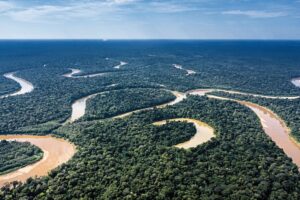
En el Perú, las aguas de la Amazonía que viajan en forma de ríos, que bañan las riberas de los bosques, que traen la vida desde las nubes hasta las sombras de un árbol, que aseguran un hogar a las especies animales o que se deslizan cuenco adentro en las manos de una niña a orillas de una comunidad nativa son las venas de este mundo; el eje de comunicación de muchas poblaciones y la fuente de sustento para pescadores, transportistas, albergues turísticos y operarios de algunas actividades extractivas.
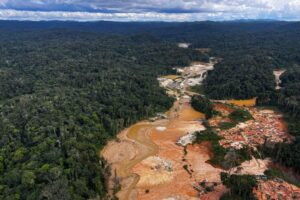
En la Amazonía Peruana, las áreas naturales protegidas buscan salvaguardar que los ríos, bosques, hábitats de especies animales y de comunidades nativas; puedan perpetuarse en el perfecto equilibrio de los ecosistemas amazónicos. Las actividades económicas, sin embargo, que se desarrollan dentro del espacio amazónico no viven, ni dependen del equilibrio amazónico, aparentemente. Es decir, madereros que depredan el bosque sin respetar planes de manejo o mineros artesanales que contaminan las aguas con una visión de corto plazo no asumen que si el ecosistema se rompe, no habrá donde realizar las actividades que los sustentan.
![]() |
Yesterday evening, the Brazilian Senate voted 59 to 7 in support of reforming the Forest Code to reduce the amount of Brazil’s territory that requires environmental conservation. The code—agreed to over 45 years ago—mandates the protection of up to 80 percent of forests in Amazonian regions and 20 percent in other areas of the country. This loosening of restrictions has drawn the ire of environmentalists, who claim the measure gives license for accelerated deforestation. Just yesterday, Brazil’s National Institute of Space Research reported the lowest national deforestation rate in 23 years—a trend that many fear may reverse with yesterday’s changes.
However, the law has received wide praise from farmers and other agricultural stakeholders. Supporters of this bill argue that Brazil needs more land for food production. Brazil is the world’s second-largest agricultural producer behind the United States, and, if signed, the new legislation could vault Brazil to number-one status. Senator Kátia Abreu, also the president of Brazil’s National Agriculture and Livestock Federation, hailed last night’s passage as an end to “the environmental dictatorship.”
The bill now returns to Brazil’s Chamber of Deputies, which voted to overhaul the Forest Code last May. The Senate’s updated version has nearly 70 amendments, but the Chamber is expected to pass all the new provisions. The bill will likely arrive on President Dilma Rousseff’s desk in early 2012. Greenpeace Amazon has launched an advocacy campaign calling on her to veto the legislation.
![]() |
From Americas Society/Council of the Americas. AS/COA Online's news brief examines the major—as well as some of the overlooked—events and stories occurring across the Americas. Check back every Wednesday for the weekly roundup.
Victorious Humala Plans SouthAm Travels
The latest numbers from Peru’s electoral authority confirm that Ollanta Humala maintains his lead over Keiko Fujimori, who conceded defeat on Monday. Humala won 51.465 percent of the votes against Fujimori’s 48.535 percent, with 98 percent of the ballots counted. Several Latin American leaders congratulated Humala on his victory and invited him to visit their countries. Humala begins a tour of South America next Wednesday that will take him to Brazil, Uruguay, Argentina, and Chile, and then the rest of South America. The goal of the trip will be to strengthen bilateral relations with Peru’s regional neighbors and to push agreements aimed at promoting Peru’s development. Humala also says he hopes to visit the United States.
Humala gave his first sit-down interview since the election to CNN en Español on June 6, in which he proposed allowing recall elections for the president and legislators, as well as reforming the Peruvian Constitution to allow the state to invest public money. He also said that under his administration military figures will only occupy military positions and there will be “zero tolerance for drugs.” He noted that ex-President Alberto Fujimori, currently serving time for corruption and human rights abuses, will only be transferred to an ordinary jail cell if the courts decide to move him. “We don’t want more divergence. We want unity.”
Peru’s Stock Market Rebounds after Monday’s Steep Drop
The Peruvian stock market continued to recover Wednesday, after ratings agencies said that President-elect Ollanta Humala’s election would not affect the country’s investment-grade status. The Lima General Index plummeted 12.5 percent on Monday—the largest drop since it was created in 1981—and closed early, after conservative Keiko Fujimori conceded defeat to Humala. The Economist Intelligence Unit explores the meaning of the election for Peru’s economy.
Read an AS/COA Online News Analysis about Humala’s electoral victory.
Ecuador, Venezuela Oppose OPEC Production Increase
The presidents of Ecuador and Venezuela met this week and released a statement arguing against an increase in oil production by the Organization of the Petroleum Exporting Countries (OPEC), of which both countries are members. Their statement came a day before a June 8 summit in Vienna, where OPEC failed to ratify a proposal by Saudi Arabia and three other Persian Gulf countries to raise output.
![]() |
The Brazilian government announced this week that deforestation in the Amazon fell 14 percent in the August 2009 to July 2010 period compared with the previous year. Satellite monitoring showed that 6,450 square kilometers (2,490 square miles) of the world’s biggest rainforest were cleared during this latest reporting period—a stark decline from a peak of 29,100 square kilometers (11,235 square miles) in the 1994 to 1995 period.
The government’s announcement coincided with a United Nations global climate conference in Cancún, Mexico, in which Brazil wants to showcase its progress and reiterate its commitment to cutting greenhouse gas emissions. Isabella Teixeira, Brazil’s Minister of the Environment, said the achievement means Brazil is well on its way to achieving its self-imposed goal of reducing deforestation—a major contributor to the country’s overall carbon emissions—by 80 percent over historic highs by 2020. Brazil is likely to use the news to seek a bigger role in climate negotiations, especially under the Reducing Emissions from Deforestation and Forest Degradation (REDD), where it could potentially get paid billions for slowing deforestation.
At a ceremony Wednesday in Brasília, the Brazilian government criticized industrial nations for not doing their part to commute greenhouse gas emissions. President Luiz Inacio Lula da Silva said news of the reduction showed Brazil was “keeping its promises” on addressing global warming, while advanced countries “are still not doing anything.”
Environmental groups, including Greenpeace International, celebrated the announcement as proof that deforestation can be halted—and accompany a period of economic expansion. The low rate of deforestation can be attributed both to increased policing and pressure from consumer groups, with the government fining illegal cattle ranchers and loggers and confiscating their products, and the beef and soy industries voluntarily banning products from illegally deforested areas.
AQ's coverage and post-trip analysis of the President's May 2-4 visit.