
![]() |
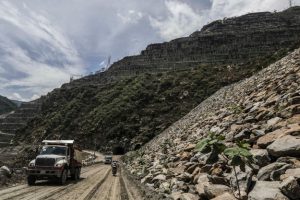
An article in the fall issue of Americas Quarterly, released today, explores the record of Chinese state-owned mining corporations on labor and the environment. In “Do Chinese Mining Companies Exploit More?” three researchers from the Peterson Institute for International Economics (PIIE) explore the impact of China’s foreign direct investment in natural resource extraction in Peru—underlining China’s increasing economic footprint in emerging regions like Latin America.
The article highlights an issue that is of growing concern. Just this month, Human Rights Watch (HRW) released a 122-page report outlining labor abuses by Chinese firms operating in copper mines in Zambia. The HRW paper states that the Chinese firms clamp down on union activity, promote low pay compared to the international average of copper mines, enforce 18-hour workdays, and operate mines with workplace safety concerns. The Chinese embassy in the Zambian capital of Lusaka has flatly denied HRW’s charges.
In comparing the practices of two OECD-owned companies to those of two Chinese companies, the PIIE scholars note some alarming differences in adherence to international labor and environmental standards. For example, the Shougang Corporation, which purchased the Hierro Perú mine in 1992, “angered the local population by cutting the Peruvian workforce in half and bringing in Chinese laborers. It reduced the quantity and quality of workers’ housing, while leaving blocks of homes once occupied by workers vacant in a town with an acute housing shortage.”
Nonetheless, Chinese firms may be treading a different path since the days of their earliest investments. According to the PIIE research, the Aluminum Corporation of China “appears to be working to avoid the behavior of Shougang.” It has not imported labor from China, has conducted public hearings with members of the local community, and has invested in infrastructure and community development.
![]() |
From the Americas Society/Council of the Americas. AS/COA Online's news brief examines the major—as well as some of the overlooked—events and stories occurring across the Americas. Check back every Wednesday for the weekly roundup.
Sign up to receive the Weekly Roundup via email.
Haiti Rocked by Destructive Earthquake
A magnitude 7.0 earthquake struck Haiti on January 12, resulting in widespread chaos and substantial casualties. “Parliament has collapsed. The tax office has collapsed. Schools have collapsed. Hospitals have collapsed,” said Haiti’s President René Préval in an interview with The Miami Herald, who described the catastrophe as “unimaginable.” The United Nations and other agencies have warned that the rampant devastation is hampering efforts and The International Red Cross says as many as three million people have been affected and tens of thousands may have been killed by the earthquake, the epicenter of which lies just outside the Haitian capital. Images and reports of the destruction have been widely distributed via Internet and social media. Get updates via Twitter at #Haiti.
AS/COA has compiled a resource page with information about how to support relief efforts and get more information.
![]() |
Chile will become the first South American country to enter the Organization for Economic Cooperation and Development (OECD), under an agreement signed this morning in Santiago between Finance Minister Andrés Velasco and OECD Secretary-General Angel Gurría. Chile is the thirty first country and second Latin American nation (Mexico entered in 1994) to join the group, which includes a membership that represents 70 percent of global wealth.
In the past two decades, Chile’s economy has grown at an average annual rate of 5 percent, and the percentage of the population living below the poverty line has fallen from 39 percent to 14 percent. When the invitation was announced in December, Gurría praised Chile’s “prudent fiscal policies, including putting aside the copper bonanza ‘for a rainy day’,” and institutional reforms in the past 20 years.
Estonia, Israel, the Russian Federation, and Slovenia are currently seeking OECD membership, and the organization is “working closely” with China, India, Indonesia, South Africa, and Brazil.
AQ's coverage and post-trip analysis of the President's May 2-4 visit.