
![]() |
The White House on September 27 announced the nomination of Acting Assistant Secretary of State Roberta Jacobson. This is good news for the U.S. and the region; she is precisely the right person for the job. Her confirmation hearing is not yet scheduled, though she is not expected to face major difficulties (unlike several other recent nominees for Western Hemisphere positions).
As often happens with any change of leadership, goals and strategies will be reconsidered. This change-of-guard moment provides a great opportunity for the Obama administration to come forth with an idea, an initiative of its own—something that isn’t cribbed from the Bush administration—and to make its mark on the region. After all, it has been popular parlor talk that what is needed is a major initiative and a clear strategy for the region. Time is ticking.
One smart idea comes in a report issued by Sen. Richard Lugar’s office last week, Latin American Governments Need to ‘Friend’ Social Media and Technology. It outlines an innovative strategy to advance U.S. goals, namely through social media and technology. Because governments that embrace new media technology are shown to be more responsive to their citizens and more transparent, the report argues, the U.S. has an interest in Latin America’s technological development. And, “[a]t a time when U.S. political influence is waning in the region, it is clear that U.S. driven technological trends could redefine relationships with many countries in Latin America,” writes the report’s author, Carl Meacham, senior Senate Foreign Relations Committee staffer. And a good way to regain some of that influence is by leveraging technology—in part because it’s an industry in which we lead, Meacham says.
![]() |
Coalition operations in Libya to enforce UN Security Council Resolution 1973 is being met by mixed reaction in the Americas. On the one hand, the leaders of Argentina, Bolivia, Cuba, Ecuador, Nicaragua, Paraguay, Uruguay, and Venezuela have criticized the mission as being a foreign intervention in a domestic Libyan conflict. At the same time, countries such as Colombia, Chile, Mexico, Panama, and Peru have backed the military action to varying degrees. Colombia, for example, voted in favor of the resolution, while others abstained from taking a position. The mixed reaction may be traced to differing perspectives on state rights to self-determination regardless of political ideologies.
Brazil, a rotating member of the UN Security Council, abstained from the vote approving military intervention in Libya, but clarified that their abstention should not be seen as approval of the Gadaffi regime or as "negligence" of the need to protect Libyan civilians. The Brazilian Foreign Ministry further stated that their abstention was based on the uncertainty that military intervention would bring about the "immediate end to the violence or that it would protect civilians." Brazil issued a statement calling for a ceasefire in Libya on Monday, following President Obama’s departure from Rio de Janeiro, Brazil.
Other Latin American leaders have been more aggressive in their reaction to the Security Council's actions. Ecuadorian President Rafael Correa called the military action "unacceptable," and Bolivian President Evo Morales called for Obama's Nobel Peace Prize to be rescinded while criticizing the United Nations and the Security Council for adding to global insecurity. Paraguayan Chancellor Jorge Lara Castro struck a more diplomatic chord saying that approval of joint military action "reflected a weakness of the United Nations" while calling for "diplomatic negotiations to prevail."
![]() |
By all accounts, 2010 was a challenging time for Canadian Prime Minister Stephen Harper on the foreign policy front.
The low point came when Canada failed to win a non-permanent seat in a secret vote at the United Nations Security Council in October, the first time since 1948. Canada had held the prestigious two-year position virtually nonstop every 10 years or so since the early days of the United Nations.
As expected, Germany easily one of two Western Bloc regional seats but most observers had not seen the duel shaping up between Canada and Portugal for the second seat. To avoid a humiliating defeat, Canada withdrew from the race after the second ballot.
The outcome sent shockwaves across the nation.
Opposition parties labelled the loss a blow to Canada’s international reputation. Liberal leader Michael Ignatieff attributed the rebuke to the Harper government’s ideological positions, incompetence and neglect of African issues. He reminded the government 80 percent of the Security Council’s work is focused on Africa.
![]() |
U.S. President Barack Obama announced in his State of the Union address last night plans to travel to Brazil, Chile and El Salvador this coming March “to forge new alliances for progress in the Americas.” Obama is scheduled to arrive in El Salvador on March 23 after first visiting Brazil and then Chile. The March trip will be the first visit to South America by a sitting U.S. President since George W. Bush visited Brazil, Uruguay, Colombia, Guatemala, and Mexico in March 2007.
This will mark the president’s first trip to South America as either a private citizen or head of state. However, Obama did travel to Trinidad and Tobago to attend the 34-nation Summit of the Americas in 2009 where he pledged to re-engage the region. Of the three countries Obama plans to visit, he last met with President Mauricio Funes of El Salvador in March in Washington DC where the two expressed a desire to work together to combat organized crime and drug trafficking.
The decision to visit these countries is timely given the recent presidential elections in both Brazil and Chile and their roles as economic leaders in the region, writes Eric Farnsworth in the AQ blog. Both Brazil and Chile have elected new presidents in the last 12 months.
The visit also comes as the newly sworn-in 112th U.S. Congress recently appointed Connie Mack as Chairman of the Sub-Committee on the Western Hemisphere. But his seeming unwillingness to engage Latin America on its terms poses a challenge to the administration’s desire to re-engage with the region, writes Christopher Sabatini in the AQ blog.
![]() |
Latin America is changing. Do we have the tools and intellectual framework to deal with it?
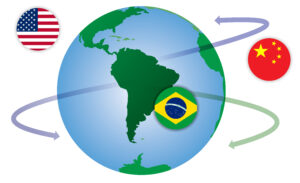
From Brazil to Mexico, Latin America has found new diplomatic muscle, asserting itself into international issues and all the while deepening ties with new trade partners from China to Russia. At the same time, despite increased rhetoric of regional solidarity and independence from the U.S., the region is at its most divided, ideologically and in its economic trajectories.
All this presents a challenge, not just to U.S. policymakers, but to policy analysts and scholars alike. For the first time, Latin America is becoming a complex international relations topic.
In the past, Latin Americanists (a term I apply loosely to people who work in or on the region) have tended to focus on domestic and development issues. Discussions of U.S. policy, by policymakers and analysts alike, have followed a different path for Latin America than for other regions.
In the 19th and first half of the 20th centuries Latin America was largely seen as the backyard of the United States. During the Cold War, the region was the staging ground for proxy wars between the U.S. and the Soviet Union, in which broader ideological battles were projected onto (and inflamed) internal social, political struggles. With the third wave of democratization and the fall of the Berlin Wall came the heady days of collective action for democracy and the promise of economic integration.
That ended. And with the rise of the anti-globalization governments aspiring to build a multipolar world by cozying up to rogue regimes (read: Venezuelan President Hugo Chavez), the rise of China and India with their voracious appetites for natural resources, and Brazil’s aspirations to find a political role commensurate with its size, economic potential and independent world view, we’re no longer dealing with your grandfather or even father’s region.
Latin America has entered the realm of foreign policy in which the U.S. is not the primary axis around which countries define their economic and political interests or defend themselves. That’s not to say that, as one unfortunately titled article in Foreign Affairs said, the U.S. is “losing Latin America.” Yes, U.S. influence has waned in the region, giving political and economic space for these diverse relations in the region. But despite all the talk of other countries eclipsing it in the region, it remains a powerful force in defining the agenda, both positive and negative, for the region.
What is significantly different is that the U.S. now has to grapple with multiple, competing issues, a far more diverse region (in terms of orientation and interests), greater potential for intra-regional friction, and more contrarian countries—even when they may agree on broad points of principle.
AQ's coverage and post-trip analysis of the President's May 2-4 visit.