
![]() |
The contentious relationship between Indigenous communities, mining companies and the state came to a head last week in Peru. Mines and Energy Minister Jorge Merino persuaded Peruvian President Ollanta Humala to exclude Quechua-speaking communities from a law that gives Indigenous groups the right to be consulted about major mining and infrastructure projects that would directly affect them.
At issue is the country’s consulta previa (prior consultation) law—based on ILO Convention 169—which requires that Indigenous and native communities be consulted prior to the establishment of any policy and development processes that would directly affect them. President Humala formally signed ILO 169 into national law in 2011 in a symbolic ceremony in the town of Bagua—the location of the fatal 2009 clash between law enforcement and native communities in the Amazon that killed 33 people and cast a shadow on then-President Alan García.
Yet just one and a half years after ILO 169 became Peruvian law, it appears the state is rolling back what was once a win for the Indigenous communities. The cabinet battle being led by Merino prompted Deputy Culture Minister Iván Lanegra to resign from his post on Friday. Lanegra, who was responsible for overseeing the implementation of consulta previa and improving relations with Indigenous communities, announced his resignation via Twitter.
![]() |
The impasse in the genocide trial of Guatemalan General Efraín Ríos Montt should be cleared this week, following a succession of rulings by Guatemala’s Constitutional Court. On Monday afternoon, the court turned the case back over to presiding Judge Yassmín Barrios, who looked to resume the trial on Tuesday morning.
However, the 8:30 am proceedings were halted when Rios Montt's attorneys failed to show up, leading Judge Barrios to suspend the trial for two more days. May 1 is a national holiday in Guatemala, and it remains to be seen whether there will be a defense team in place when the trial resumes on Thursday. If not, Ríos Montt will be assigned a public defender.
The historic genocide trial against Ríos Montt and his former intelligence chief, José Mauricio Rodríguez Sánchez, has been on hold since April 19, pending a Constitutional Court decision on how and when to proceed after Ríos Montt’s defense counsel abruptly walked out of the trial on April 18 in protest. On April 19, Judge Carol Patricia Flores stopped the trial—which was then being presided over by Judge Barrios—after she was reinstated by the Constitutional Court.
The news comes against a backdrop of increasingly powerful demonstrations by survivors and human rights groups on the one side, and by Ríos Montt sympathizers and ex-military veterans on the other. On Friday, Guatemala commemorated the anniversary of the murder of Bishop Juan Jose Gerardi, a co-author of a report by the Oficina de Derechos Humanos del Arzobispado (Office of Human Rights of the Archbishopric—ODHA) that documented over 400 massacres by the army during Guatemala’s 36-year internal conflict. Gerardi was murdered two days after the report was published in 1998. As a convoy of buses made its way from Nebaj, at the centre of the Ixil triangle where Ríos Montt is accused of ordering the deaths of 1,771 people, many Ríos Montt sympathizers carried inflammatory banners such as, “Hairy Hippies and Foreigners, Stop Making Money off the Lie of Genocide!”
![]() |
Top stories this week are likely to include: Horacio Cartes will be Paraguay’s new president; Guatemala’s Constitutional Court will decide whether Efraín Ríos Montt’s genocide trial can continue; Argentines protested Cristina Fernández de Kirchner’s government; Guantánamo prisoners’ hunger strike grows; the Venezuelan election audit process will take a month.
Horacio Cartes Wins Presidential Election in Paraguay: Tobacco magnate and soccer club president Horacio Cartes will be the next president of Paraguay after voters elected him with 46 percent of the vote on Sunday. Cartes’ main rival, Efraín Alegre of the Radical Liberal Party, captured 37 percent of the vote. Cartes’ victory marks the return of Paraguay’s Colorado Party to power and the likely normalization of Paraguay’s status with its Mercosur and UNASUR neighbors. The Colorados ruled Paraguay for 61 years before the election of former Paraguayan President Fernando Lugo in 2008.
Guatemala Awaits Fate of Rios Montt Trial: Guatemala’s Constitutional Court will determine whether or not the genocide trial of former dictator Efraín Ríos Montt will go forward. On Friday, Judge Yasmin Barrios declared that a decision to annul the trial by Judge Carol Patricia Flores was illegal. Judge Flores ruled on Thursday that all testimony since November 2011 had been invalid, a decision protested by human rights groups and victims of Guatemala’s internal conflict. Read more about the trial in an AQ blog post by Nic Wirtz.
Argentines Protest Government: Thousands of Argentines gathered in the streets on Friday in countrywide protests against a proposed judicial reform bill that would allow voters to elect magistrates that appoint and remove judges. Argentine legislators will vote on the judicial reform bill on Wednesday. Protesters, many from the political opposition and critical of Argentine President Cristina Fernández de Kirchner, also expressed a general dissatisfaction with Argentina’s crime and high inflation.
Over Half of Guantánamo Prisoners on Hunger Strike: A U.S. military spokesperson said on Sunday that 84 prisoners being held at the Guantánamo Bay military prison are now on hunger strike, and that 17 are being force-fed through tubes. Some of the detainees have been striking since early February, protesting abuse and searches that the prisoners say are invasive. Many of the detainees have been in the prison for over a decade without any charges.
Audit of Venezuelan Elections will take a Month: Venezuela’s Consejo Nacional Electoral (National Electoral Council—CNE) said it will take a month to carry out an audit of the April 14 presidential election results, and said that the results of the audit will not alter the election’s outcome. The CNE has said that president-elect Nicolás Maduro defeated rival candidate Henrique Capriles by 1.8 percentage points. Maduro was sworn in as president on Friday, but the U.S. government has not yet recognized him as Venezuela’s new president. Meanwhile, Maduro has begun to appoint his cabinet members.
![]() |

Este mes se observó el día internacional de la mujer, ocasión propicia para conocer la historia de una mujer emprendedora que ha tenido que afrontar una serie de dificultades y retos para lograr sacar adelante a sus cuatro hijos.
Doña Ruth Susana Aguilar es una mujer guatemalteca originaria del municipio de Chichicastenango—a 145 kilómetros al occidente de la capital—quien trabaja como voceadora de periódicos en la población. Cada día se levanta a las 5 de la mañana para llegar a esperar la camioneta que trae los periódicos y luego empieza su recorrido por las calles para distribuirlos. Esa es prácticamente su rutina diaria, a excepción de los sábados cuando va a la iglesia.
Doña Susana es padre y madre de cuatro hijos. Durante 20 años vivió junto a su esposo Diego Tebelan Calgua, pero ante los múltiples problemas y agresiones que sufría decidió denunciarlo. Acudió a varias instancias como la defensoría de la mujer Indígena y la Policía Nacional Civil, logrando que a su esposo se le obligara a darle la respectiva pensión alimenticia. Sin embargo, éste no cumplió y le llegó a deber más de 15 mil quetzales, por lo que llegaron al acuerdo de que ella se quedaría con la propiedad que construyeron juntos durante los 20 años de matrimonio.
Doña Susana califica a su esposo como un hombre machista que no cumple con sus responsabilidades de padre y esposo, al no brindarle la respectiva manutención a su familia. Estas razones la motivaron a iniciar un proceso de demanda de divorcio, el cual debió suspender por resultarle muy costoso.
Por ese ejemplo de sacrificio y valentía, Doña Susana fue invitada recientemente a un foro organizado por el comité de víctimas de violencia sexual del hospital nacional Santa Elena donde compartió su testimonio con los asistentes entre los que se encontraban representantes de instituciones y estudiantes. En su discurso compartió que después de haberse separado de su esposo decidió quitarse la vida. Esperaba el momento en que quedaba sola en casa para cumplir con su cometido, pero cuando tuvo la primera oportunidad de estar sola, casualmente llegó a su casa el hijo de una vecina para pedirle prestados unos juguetes, petición que no pudo negar pues ella amamantó al niño cuando estaba recién nacido.
Esta misma historia se repitió en otras tres ocasiones, lo que ella interpretó como un mensaje de Dios que la hizo recapacitar e iniciar su lucha diaria para sobrellevar la situación. Desde ese entonces se dedicó a muchas cosas para obtener recursos, como realizar trámites contables, ser voceadora, vender productos de distinta clase. Su esposo llegó muchas veces a la casa para quebrar las ventanas, golpear la puerta y hasta la agredió físicamente, pero todo esto la hizo a ella convertirse en una mujer valiente y emprendedora y a tener un carácter más fuerte. Hoy por hoy doña Susana trabaja de sol a sol y lucha día a día junto a sus cuatro hijos—dos hombres y dos mujeres—quienes también la apoyan para conseguir los recursos necesarios.
![]() |
The aftershocks from Guatemala’s largest earthquake since 1976 continue to reverberate around the country, causing a halt to governmental efforts to introduce constitutional reform.
In August, President Otto Pérez Molina went to Congress with a list of 35 proposed constitutional reforms covering everything from the mining industry to educational reform. This prompted countrywide protests, leading to the deaths of six civilians in Totonicapán.
On a visit to San Marcos, the area most affected by the 7.2-magnitude earthquake on November 7, Pérez Molina announced that the Q200 million ($25.2 million) that was to be spent on constitutional reform will be set aside to help with the earthquake recovery.
The sheer scale of the earthquake is only just being felt, with 3.4 million people affected by it and 225 aftershocks ranging from 3.5-6.1 on the Richter scale in the past three weeks. At its peak, over 30,000 people were evacuated from their homes.
![]() |
An earthquake struck off the Pacific coast of Guatemala on Wednesday morning, killing up to 15 people and leaving 100 missing.
The quake was centered about 15 miles off the coastal town of Champerico and about 100 miles southwest of Guatemala City, but it shook buildings as far away as Mexico City, El Salvador and Nicaragua, according to the U.S. Geological Survey. The magnitude-7.4 quake struck about 20 miles below the earth’s surface.
The mayor of Mexico City, Marcelo Ebrard, said no serious damage or injuries had been reported in the city, although many people left their offices during the earthquake to go home.
At a news conference, Guatemalan President Otto Pérez Molina claimed that not all the reported deaths had been confirmed, but there were reports that some 30 residences collapsed in the town of San Marcos, near the northwestern border with Mexico. San Marcos, where most of the catastrophe was reported, has not experienced an earthquake of this magnitude since a1976 trembler that killed 23,000 people.
In a radio interview, Pérez Molina urged Guatemalans to evacuate tall buildings as an emergency measure while the country is on its highest level of disaster alert.
"I've been in Guatemala for almost two years. I am used to earthquakes. This was a lot more severe, a lot more shaky," said Peace Corps volunteer Adam Baker Carmel.
![]() |
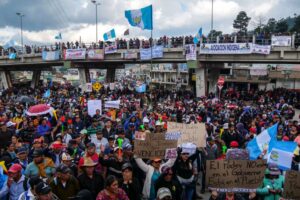
The arrest of eight soldiers in connection with the Totonicapán incident on October 4—which resulted in the deaths of at least seven Indigenous protestors—heralds the first test of Guatemalan President Otto Pérez Molina’s mano dura (iron fist) approach to restoring law and order.
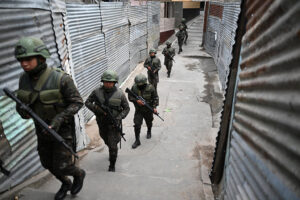
Pérez Molina campaigned for office promising to use the army, from which he is a retired general, to help combat narcoterrorism and the associated random violence that pervades the country. Instead, the remilitarization of Guatemala, with mixed army and Policía Nacional Civil (National Civil Police—PNC) roadblocks a common sight, has brought back memories of the 36-year civil war where state brutality was a daily occurrence.
Events in Totonicapán, an Indigenous-majority department in the west of the country, are especially poignant on Día de la Hispanidad, which is a day to commemorate Indigenous resistance against Spanish conquerors. Hispanity Day, which is celebrated in the U.S. as Columbus Day, also saw a heavy police presence in Guatemala City as authorities feared a backlash by Indigenous groups.
Colonel Juan Chiroy Sal has been charged with extrajudicial murder as the commander of a detachment of the honor guard sent to Cuatro Caminos, an intersection that links Totonicapán with Quetzaltenango, Huehuetenango and Guatemala City. It is a frequent spot for demonstrations and the October 4 protest against rising electricity prices in the area saw other community members join in to complain about proposed changes to the Constitution and other education reforms.
![]() |
Walking down London’s famous The Mall, Erick Barrondo’s head swiveled from side-to-side searching for his nearest opponent. As it turned out he was 30 seconds behind and the mixture of astonishment and ecstasy on the walker’s face revealed history in the making―Guatemala’s first Olympic medal.
The fact that it was silver was immaterial. In a sport-mad country where every weekend the roads are packed with pickups transporting entire soccer teams to games, to win a medal at the Olympics for the first time since they started competing in 1952 was an incredible achievement.
Although soccer remains the most popular sport in the country, the national team has yet to reach a World Cup final. After years of heartbreak, the population is looking to new sports to find their national hero and may have done so in the 21-year-old Barrondo. To show their patriotic fervor, local Olympic broadcaster Albavisión replayed the entire race twice just after the live one had finished.
Speaking to reporters after the end of the 20-kilometer race, Barrondo said, “It is well known that Guatemala has problems with guns and knives. It is a country that has suffered much, but that also has dreams. If somebody tomorrow changes a gun or a knife for a pair of shoes and begins to train for a sport, I would be the happiest person on earth”.
![]() |

Guatemala's youth represent 70 percent of its 14.7 million inhabitants but they face many challenges in their medium- to long-term development, notes a new United Nations Development Programme study. Malnutrition, illiteracy or low levels of education, unemployment or informal employment, and the lack of documentation limit their abilities to get ahead in society and result in migration and violence. Video, en Español.
![]() |
Proposed reforms to the education system have resulted in tense stand-offs between students, their teachers and riot police across Guatemala. Just this week at least 40 people were injured after riot police were called in to break up a protest.
The crux of Education Minister Cynthia del Aguila’s proposed changes is a requirement that those who are studying to become primary school teachers will have to study for two additional years—for a total of five years of training—and complete a university degree. This has split public opinion between those who believe the country's educators should be well-educated and those who are concerned that there will be fewer teachers because of the increased costs that will result from more training.
Teaching is one of the few professions that does not require a university degree in Guatemala, with the result being a surplus of teacher supply.
Complicating the picture is the pending reelection of Joviel Acevedo, the general secretary of the Guatemalan Education Workers Union. After 14 years in the position, Acevedo has overseen numerous labor disputes but remains popular with teachers after helping to push through two recent pay raises despite warning from consecutive finance ministers that there is no money in the budget to pay for them.
The role of the education minister is also fraught with uncertainty. Over the past 12 years, there have been 18 education ministers, including three appointments in a six-month period. A combination of poor infrastructure, dilapidated buildings and a lack of teaching hours has resulted in the mandated 180 school days per year remaining a pipe dream. Guatemala generally places poorly on international standardized tests with a system plagued by difficult labor relations.
AQ's coverage and post-trip analysis of the President's May 2-4 visit.