




This article is adapted from AQ’s special report | Leer en español | Ler em português
GUAYAQUIL, Ecuador—Why would Ecuador, of all places, be a focus in Latin America’s new space race? Well, the answer is in the country’s name.
On a recent afternoon, Robert Aillón and his colleagues were seated at a table in a chain hotel restaurant in Guayaquil, Ecuador’s business capital, radiating enthusiasm for their proposed project: a new private spaceport for vertical launches and horizontal vehicle recovery at one of three potential sites nearby.
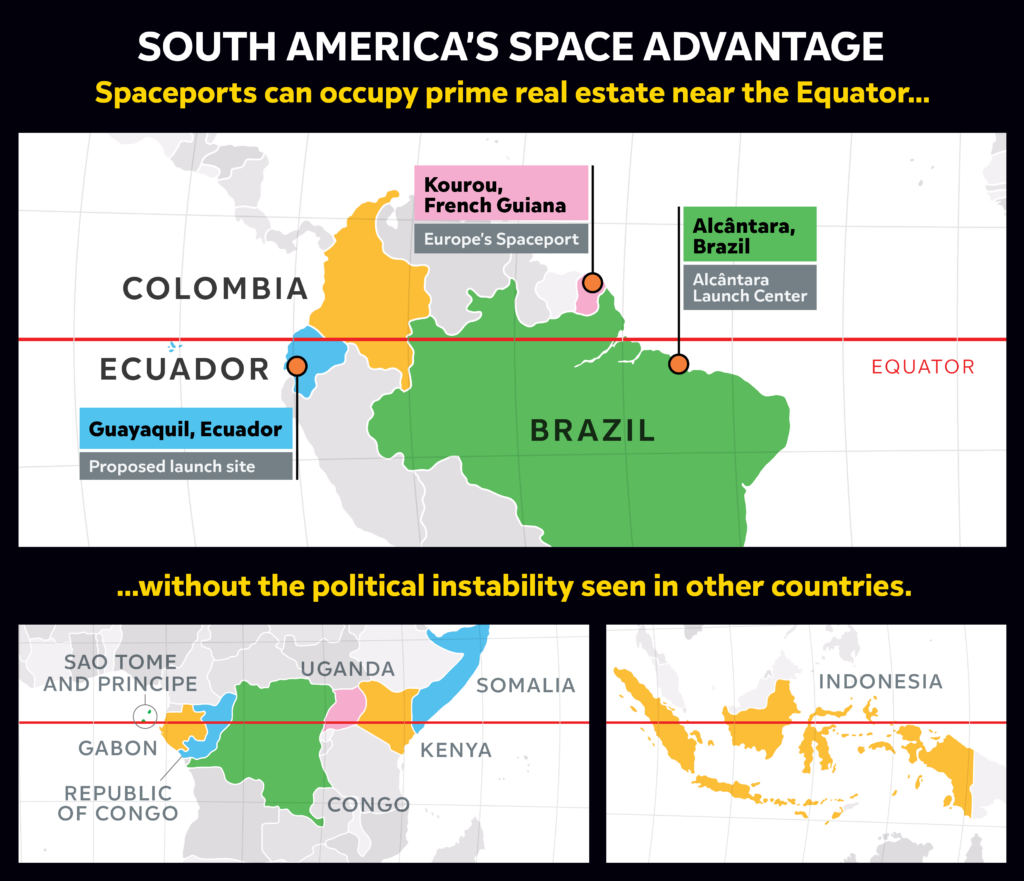
Some foreign investors regard Ecuador with caution at a moment when organized crime groups are battling for control of the country’s seaports, key transit hubs for cocaine bound for Europe and Asia. But for Aillón and his partners, the Guayaquil area is strategic for a different reason: It sits just two degrees south of the imaginary line dividing the world into two hemispheres.
The planet rotates at its maximum speed at the equator—1,040 miles (1,670 kilometers) per hour—making it more efficient to launch rockets from these latitudes. Thanks to the rotational boost, less fuel is needed to reach orbital velocity, which in turn means rockets can carry more payload at a lower cost.
Compared to many other countries that sit directly on the equator—a list that includes Congo, Somalia, Uganda and Indonesia, as well as Colombia and Brazil—Ecuador, with its dollarized economy and business-friendly government, looks attractive despite its security challenges.
“What’s coming is big,” enthused Aillón, a 50-year-old Ecuadorian who worked as a banking executive in his home country and in the United States before founding his firm Leviathan Space Industries LLC. “Spaceports are a cornerstone of future competitiveness.” Many agree. A report by the World Economic Forum and McKinsey & Company projected the global space economy could reach $1.8 trillion by 2035, up from $630 billion in 2023. The June initial public offering Elon Musk’s SpaceX, which raised a record $75 billion, ignited even greater interest in the sector worldwide. Musk has said he will look beyond the United States for future spaceports, with Latin America an obvious potential beneficiary.
Space is also increasingly an important theater in the strategic rivalry between China and the United States, with both superpowers vying in Latin America for allies and key geography such as the Southern Cone region, whose clear skies are ideal for tracking satellites. Meanwhile, Latin American governments are determined to be not just a battleground in a new Cold War, but key protagonists in the space industry’s growth and governance.
The ambitions are literally out of this world. Musk’s stated goal is to establish a permanent human presence beyond Earth, thereby ensuring the long-term survival of the species. Aillón uses similar language on his LinkedIn page, calling a private spaceport in Ecuador a “first step” to interplanetary travel. Plans for launch facilities have also been floated in Uruguay, the Dominican Republic and Peru. For those still residing on Earth, Argentina and Brazil are producing satellites that have practical implications for everyday people, such as assessing crop quality and helping governments better manage natural disasters.
Yet observers warn of a gold rush mentality in which some investors may be overestimating the private sector’s ability to build a space industry in Latin America on its own. Governments and companies must first address numerous challenges including weak institutions and limited infrastructure, they say.
“Opportunities exist, yes, but they will not materialize automatically,” said Laura Delgado López, a senior fellow at Florida International University’s Jack D. Gordon Institute for Public Policy. “We need to better understand the mechanisms that shape the space sector.”
Indeed, the question facing Latin America’s space sector today is: What is mere hype, and what is truly within reach?
Proven potential
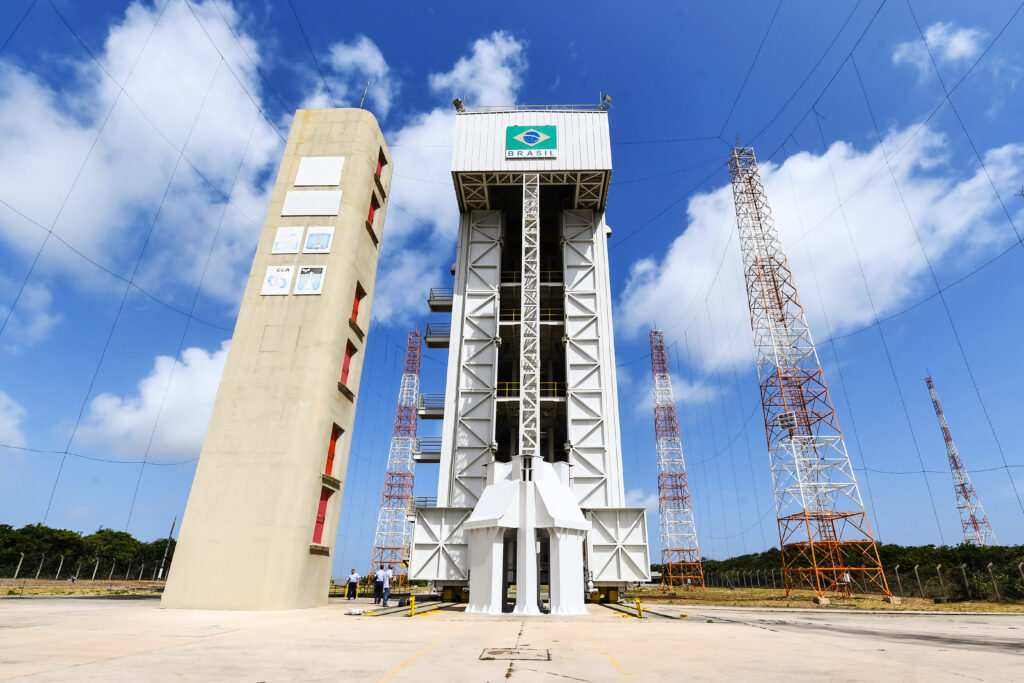
It’s certainly not all speculative: The region already has a proven record when it comes to launch sites. The Alcântara Launch Center (CLA by its initials in Portuguese) sits on Brazil’s northeastern coast, in the state of Maranhão. Created in 1983, the CLA lies just 2.3 degrees south of the equator in an area with low air traffic and population density. The site is attractive enough that U.S. officials were elated in 2019 when, after decades of conversations, then-President Jair Bolsonaro signed a so-called technology safeguards agreement allowing U.S. technology to be used at the site.
However, even Alcântara has been a story of frustrated potential. Following a rocket explosion on a CLA launch pad in 2003 that killed 21 engineers and technicians, observers say the center was under-utilized for many years. Most launches are suborbital, meaning they reach space just briefly, at about 60 miles above sea level, allowing for microgravity experiments, atmospheric studies and the growing industry of space tourism.
Alcântara saw its first commercial launch in December 2025, with a rocket from the South Korean firm Innospace that crashed under a minute after liftoff. Innospace plans to launch from the CLA again this year.
The other major launch site on the continent lies about 1,250 miles east—in French Guiana, an overseas region of France. Often called Europe’s Spaceport, the facility began operations in 1968 and is jointly operated by the European Space Agency (ESA) and France’s National Centre for Space Studies, launching both government and commercial rockets.
In recent years, many countries in Latin America and the Caribbean have used the European facility to transport their satellites, illustrating the lack of fully viable alternatives inside the region itself.
Still, no one doubts the growth possibilities. The ESA projects the number of satellites orbiting the Earth will soar from about 10,000 today to 100,000 by 2030. Many will be small devices deployed in constellations, like those SpaceX operates in low Earth orbit over various parts of the world to provide internet services, a market Amazon is poised to enter as well.
Evaristo Sa/AFP/Getty
All that growth will require new launch sites, as well as new players. SpaceX’s IPO was considered a milestone in what some call “new space”—an era in which state monopolies are being replaced by private companies that take large risks, have financial backing, and are oriented toward profits.
But the barriers to entry are high. Aillón, the Leviathan Space CEO, cited the example of SaxaVord Spaceport on the Scottish coast, which with an initial investment of $57 million is expected to see the launch of a suborbital rocket this boreal summer. For Leviathan’s initiative, Aillón said he was attempting to raise $800 million beginning this year. The firm has already secured its first partner: Florida-based Blackstar Orbital, which is betting on breaking into the market for cargo or surveillance space drones.
Not everybody can follow the SpaceX model, warned Victoria Valdivia, global fellow at the European Space Policy Institute and fellow at the COSPAR-EUROMOONMARS-LUNEX initiative.
“In Latin America there is a tendency to talk about ‘new space’ and the space economy, particularly among many startups that seem to fill the void in an area where states have been inefficient,” said Valdivia, who is also a PhD student at the Instituto de Estudios Avanzados at Universidad de Santiago de Chile.
“Because their projects are attractive, they receive a great deal of visibility, but since they are more focused on business than on regulations, they forget that they need an entire organizational framework to operate,” Valdivia said. She cited environmental permits, as well as flight and tax considerations, where Latin American bureaucracies “are not exactly agile.”
The U.S.-China rivalry
Still, the region has other natural advantages. Satellites must be monitored and tracked from the ground, but only about one-third of the Earth’s land area lies south of the equator. That places South American territory at a premium, especially areas where skies are generally clearest.
Indeed, certain locations are coveted by major powers looking to maximize their reach—what the nascent field of “astropolitics” understands as the set of activities and technologies a state can deploy in space for purposes of war, development, and prestige.
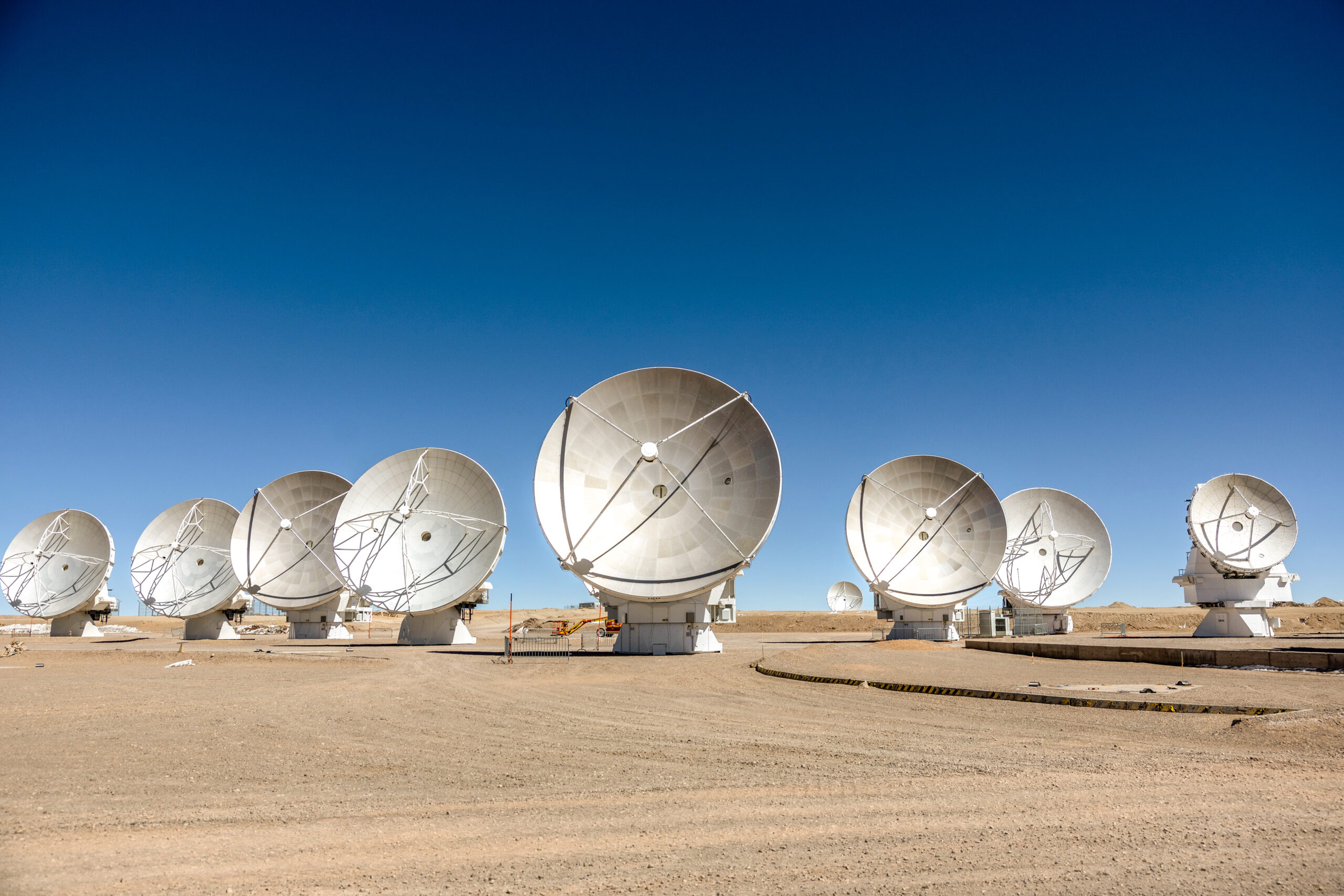
A recent U.S. congressional committee report noted that China has built 11 facilities for satellite communications and radio telescopes in Latin America, including in Argentina, Bolivia, Brazil, and Venezuela, sparking concern among U.S. officials over their dual-use potential, given Beijing’s explicit doctrine fusing civil and military operations.
To block new initiatives, the Trump administration—in an updated application of the Monroe Doctrine—is openly pressuring countries not to host new Chinese space-related installations. In the mountains of Argentina’s San Juan Province, the CESCO radio telescope that China was building sits inactive, having been sidelined by U.S. pressure.
In Chile’s Atacama Desert, atop the flattened peak of Cerro Ventarrones, some of the components that were to form part of an astronomical observatory remain in place—a project canceled by Chilean authorities citing legal issues, following Washington’s warnings about the threat it posed to the security of U.S. space assets.
China’s ambitions remain large. Following in the footsteps of Musk’s Starlink, Chinese companies are seeking to build their own satellite constellations to provide wireless communications services—among them Guo Wang, managed by the state-owned China Satellite Network Group, and Qianfan, developed by Shanghai Spacesail Technologies Co. Ltd.
According to the International Telecommunication Union’s website, several Chinese satellite operators filed requests during the final week of 2025 to deploy more than 200,000 devices in the coming years—an astronomical figure that runs up against bottlenecks in the launch sector and has already prompted the Asian giant to explore the possibility of establishing an equatorial spaceport in Malaysia. Some analysts wonder if their next push will be in South America.
John Moore/Getty
Confronting the obstacles
In the meantime, companies and government officials are working to solve some of the bottlenecks facing the space industry—and hopefully seize the moment.
In 2024, Brazil enacted a space activities law that “would enable more legal security for launch operators from Brazil” and thus represented “an important step toward future CLA business with other foreign, private and government launchers,” according to Bruno Martini, an aerospace scientist at the Brazilian Air Force University (UNIFA). A new state-owned company, Empresa de Projetos Aeroespaciais do Brasil S.A. (ALADA), also began operations in 2025 with the goal of strengthening the Brazilian space program, including the commercial use of the CLA. Brazil is now working to develop its own rockets.
Despite this renewed momentum, lack of funding remains a challenge. The National Confederation of Industry noted in a 2025 report that the national budget of $47 million allocated to the space sector equated to just 0.002% of Brazil’s GDP in 2023—the second-lowest level of investment among G20 countries.
Much farther north, in the Dominican Republic, President Luis Abinader himself announced during his annual address to Congress in February that his country would begin construction of a spaceport—thanks to an agreement with U.S. company Launch on Demand (LOD Holding) involving an investment of $600 million. “We are going to launch a satellite or a rocket into space from Pedernales—just wait and see,” the president declared. The milestone is expected to occur in May 2028.
LOD Holding is led by Burton Catledge, a retired U.S. Air Force colonel who previously commanded the Air Force’s 45th Operations Group, 45th Space Wing, supporting numerous rocket launches for industry giants like SpaceX, Blue Origin, and Moon Express, and also served at the Pentagon.
“Opportunities exist, yes, but they will not materialize automatically,” said Laura Delgado López, a senior fellow at Florida International University’s Jack D. Gordon Institute for Public Policy.
In an interview with AQ, Catledge explained that the site in the Dominican Republic was chosen because of its relative proximity to the equator (18 degrees north), access to open waters, low population density, favorable high-altitude winds, and availability of multiple orbital trajectories. He also pointed to the construction of a nearby seaport—enabling the delivery of large space hardware—and the expansion of a neighboring airport for satellite transport, both being promoted by the government.
“President Abinader said in a meeting: ‘Burton, here is my phone number. If you have to wait more than 48 hours for anything, call me’ … From that moment on, every door opened,” Catledge said. As recently as May, 528 acres of state-owned land were acquired for this purpose, and a Memorandum of Understanding was signed with the Instituto Tecnológico de Santo Domingo (INTEC) to train engineering and related students in highly specialized aerospace disciplines, laying the groundwork for the development of a space economy in the country.
The project envisions four launch pads—two for heavy and superheavy rockets, one for medium rockets, and one for small ones—that will operate independently. Financing comes from private institutional investors rather than public funds, Catledge said.
The Launch on Demand CEO said the project also has political backing from the U.S. government, eager to expand launch sites within the Western Hemisphere as part of its geopolitical chess match with Beijing. Catledge said he saw a “tangible commitment from the U.S. that they’re not just saying they’re pivoting to the Western Hemisphere—they in fact are.”
Matters of national interest
Far from the enthusiastic entrepreneurs of the private sector, Peru has chosen to travel the “old space” route to attempt to develop a spaceport—drawing on its experience managing large infrastructure projects in partnership with foreign actors, despite its persistent political instability of recent years.
In November 2024, Peru’s space agency, an entity under the Ministry of Defense, signed a Memorandum of Understanding with NASA, under which cooperation began on joint feasibility studies of launch sites, technical assistance, and planning for future launches.
The Ministry of Defense’s 2023–2026 Multi-Year Investment Report on Public-Private Partnerships estimated the project’s cost at $270 million and said it would aim to facilitate rocket launches for orbital as well as suborbital flights: “Those that will transport people to other continents in less time without completing a full orbit of the Earth.”
The spaceport would be located at a Peruvian Air Force base—either in Chiclayo, Arequipa, or Talara, with the last of these generating the most discussion given its location four degrees south of the equator. Delegations of U.S. space specialists have visited Peru to discuss the vast array of political, social, financial, economic and regulatory considerations the country must take into account if the project is to go forward.
“It is part of a national initiative through which the country aims to become a connectivity hub, given its strategic location and policy of openness and global integration. It is also a way of compensating for weaknesses in infrastructure,” explained Clemente Rodríguez, a researcher at the Center for Strategic Studies of the Peruvian Army. He noted that Peru recently opened a major Pacific port, expanded its main airport in Lima, and is considering the construction of a rail corridor to Brazil.
Even the Peruvian Congress overcame its chronic divisions to pass by a wide margin, in March, the bill submitted by former President Dina Boluarte declaring the creation of a spaceport to be a matter of national interest. Law 32571 authorizes the Ministry of Defense to lead the technical and legal studies that will determine the project’s viability.
In past centuries, the peoples who inhabited the American continent gazed upon the Infinite to find their gods, devise complex calendars and orient their pyramids. Today, even though work is still needed to bring these dreams to fruition, Latin Americans are once again looking to the stars.
ABOUT THE AUTHOR

Juan Pablo Toro
Reading Time: 10 minutesToro is a Senior Research Fellow at AthenaLab think tank (Chile) and Senior Associated Fellow at RUSI. He recently visited Antarctica for the fourth time.

The Crucial Challenge of Building Space Expertise
As Latin America acquires more space technology, workforce development will be key to reaping the benefits.