



This article is adapted from AQ’s forthcoming issue on Mexico’s path forward
When Argentina’s President Javier Milei told me months ago that his country can boost economic growth by attracting massive investments in artificial intelligence, my first reaction was polite skepticism. As he described it in an interview, the nation has unique qualifications to become a regional—if not global—hub for data centers, the foundational infrastructure of AI.
Milei argued that Argentina has abundant energy, rare earth minerals, strong human capital, vast territory, and cold climates ideal for cooling data centers cost-effectively. On top of that, Argentina could benefit from a growing backlash against data centers in the U.S. More and more towns and cities are rebelling against planned data centers nearby, worried they could drain resources and drive up electricity bills. A Gallup poll published this year found that 71% of Americans oppose nearby data center construction.
That’s leading Big Tech companies to look abroad. “Data centers will generate a phenomenal acceleration of economic growth” in Argentina, Milei told me. A few months after our interview, Milei doubled down in a Financial Times op-ed, announcing that he had submitted a bill to establish a new legal framework for AI that includes “a commitment to keep AI unregulated.” The proposed legislation even includes a headline-grabbing provision creating a new business category: “the non-human corporation,” for companies operated by AI agents.
The momentum is real; the Inter-American Development Bank reported last year that Latin America is already experiencing “a significant boom in data center investment.” And as global demand for data continues to grow about 20% annually, countries across the region are emerging as attractive tech hubs.
To be sure, cutting ribbons at new data centers will make for great photo-ops in the coming years, and will bring in important revenue. But without robust public programs to prepare both workforces and local businesses, this won’t do much to secure Latin America’s future.
A regional race
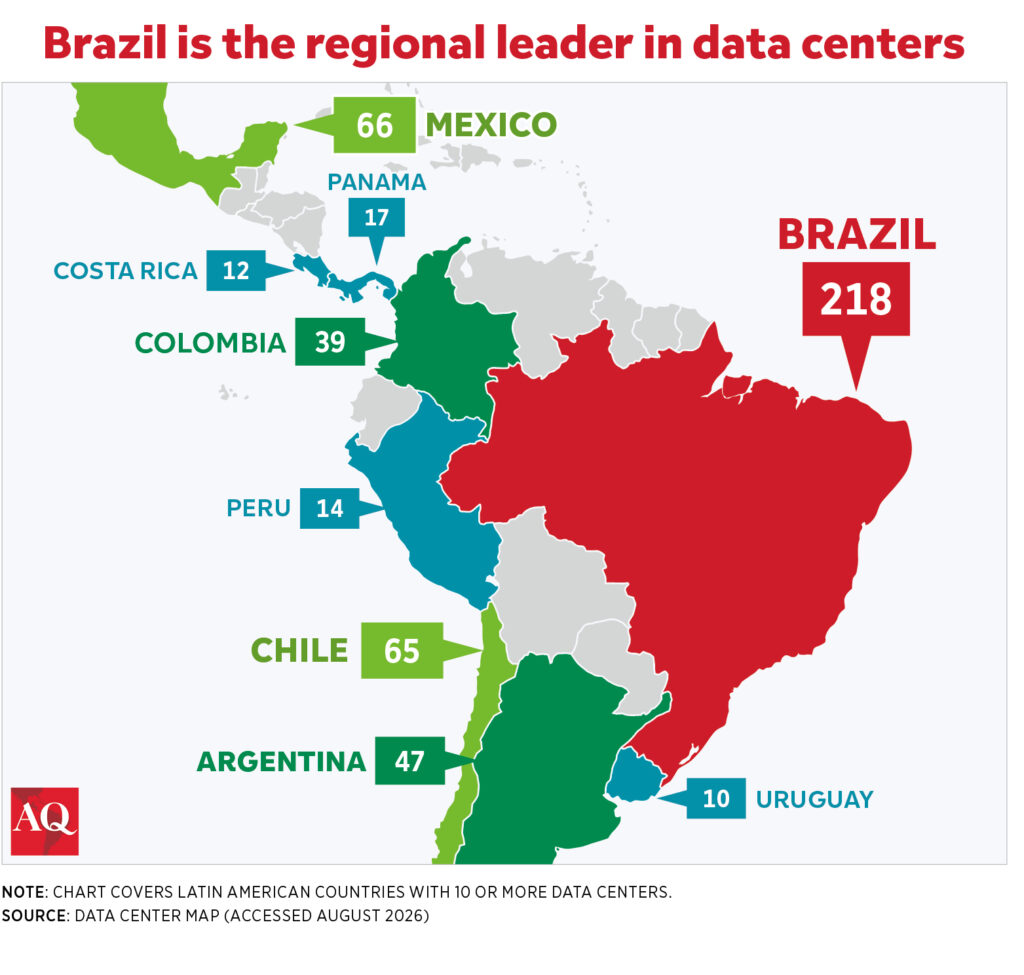
Brazil, Mexico, Chile and others are pressing ahead at full steam with ambitious data center plans. Brazilian President Luiz Inácio Lula da Silva signed an executive order late last year exempting data centers from federal import taxes on key equipment like servers and refrigeration parts. According to the Finance Ministry, this framework could draw $377 billion in new investments over the next decade.
With this push, the Brazilian government is “aiming to position the country as a leading hub for digital infrastructure in Latin America,” the U.S. International Trade Administration noted in an information sheet for investors. Brazil’s Getulio Vargas Foundation went even further, publishing a study highlighting that the country “has the structural advantages to become one of the world’s leading digital infrastructure hubs.”
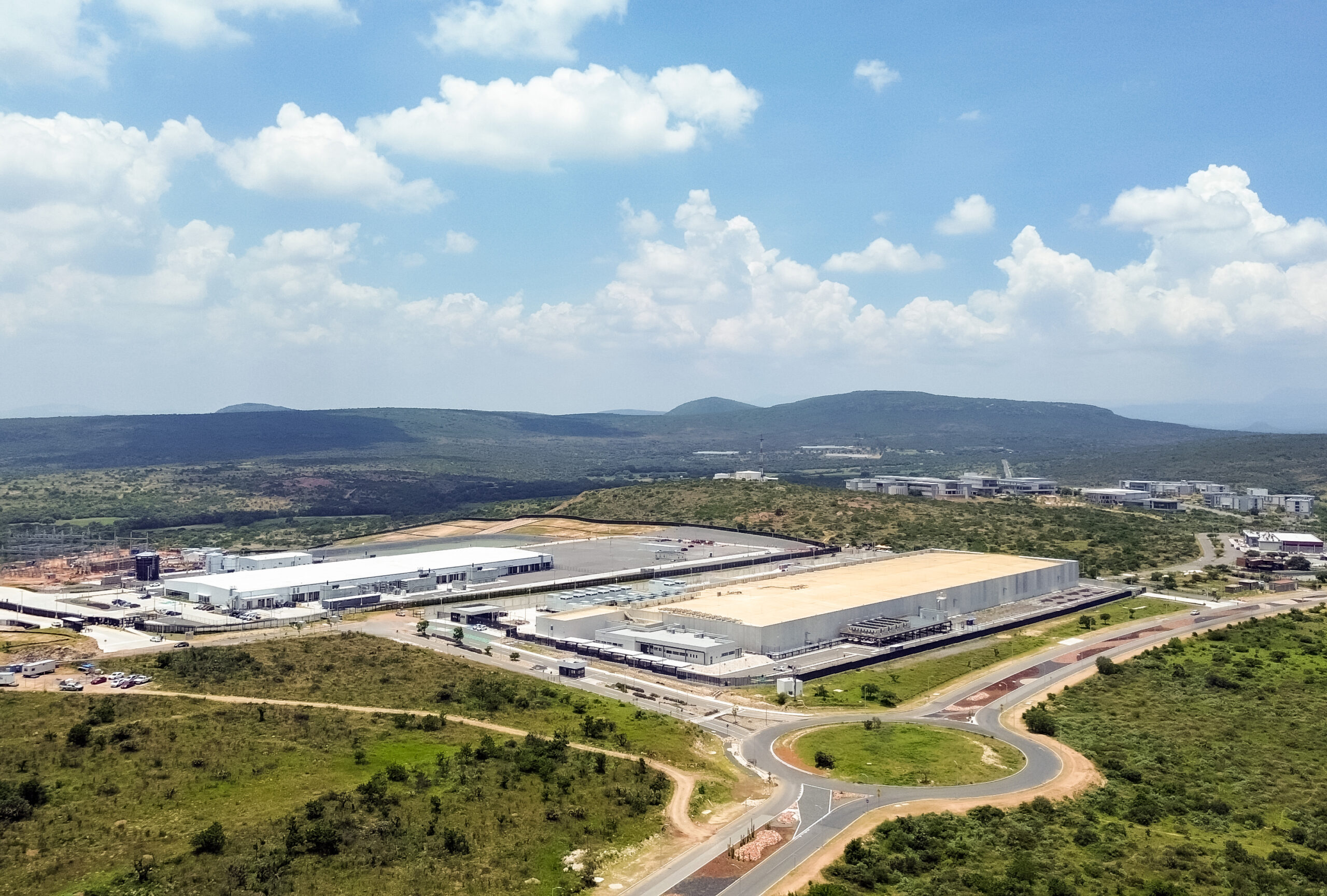
In Mexico, President Claudia Sheinbaum celebrated a $4.8 billion investment in six data centers in Querétaro last year, calling it a vital step for the country’s future. The Mexican Data Center Association (MEXDC) forecasts that investment in the sector will reach $82.5 billion between this year and 2031, positioning Mexico as a “digital” gateway between the U.S. and Latin America.
“Data centers are the big opportunity for Latin America,” Rodrigo Durán, executive director of the Chile-based Latin American Artificial Intelligence Index, told AQ. “There’s a fierce race going on right now among countries in the region to offer the best conditions for foreign investment in these facilities.” Rooting for his own country, he cited two more key factors: “Chile’s northern region already has an energy surplus that is literally being thrown away. Plus, Chile already has excellent connectivity, with (direct fiber-optic submarine data) cables linking it directly to the United States.”
Cautious optimism
Still, while listening to Latin American officials and industry leaders, one can’t help but wonder if they are being naive about their countries’ chances of becoming major data center hubs. These facilities cost billions of dollars to build and maintain. Will the world’s biggest AI companies risk that kind of capital in a region prone to political instability, where governments frequently change the rules of the game?
In 2023, Latin America and the Caribbean received only about 1.6% of the world’s spending on artificial intelligence, according to a UN study published in January. Political and economic uncertainty are part of the reason.
And even if investors receive written guarantees that their assets will be safe from nationalization or abrupt new terms, can they rely on local power grids? As some skeptical Latin America watchers asked me, only half-jokingly: “Do you really think Silicon Valley’s AI giants will rely on countries where the power grid collapses in the summer the minute you turn on the air conditioning?”
What’s more, will the advantages that Latin American leaders tout—huge territories, abundant energy, and geographic proximity—even matter in a few years? New technologies will likely reduce server sizes and make cooling more efficient. If future data centers require much smaller, less energy-hungry facilities, the allure of building them south of the border may quickly disappear.
Despite these hurdles, most industry experts believe Brazil, Mexico, Argentina, Chile, and others in the region can become viable data center hubs. The region already hosts more than 500 data centers, including some massive hyperscale facilities used by Amazon, Microsoft, Meta, and Google to transmit their own data. Still, the future is not a straight line: Some huge facilities remain on the drawing boards. Last October, OpenAI—the creator of ChatGPT—and Argentina’s Sur Energy signed a letter of intent to explore building a $25 billion large-scale data center project in Argentina to “bring the first Stargate project to Latin America.” But so far, construction is not known to have started, reflecting the complexities of getting projects of this caliber off the ground.
Eduardo Levy Yeyati, a professor at Torcuato di Tella University in Buenos Aires and scholar at the Brookings Institution, wrote in a recent article for AQ that the region is emerging as a credible destination for digital infrastructure investment “for reasons that go beyond hype.” But, in an interview, he cautioned against the idea that data centers will be an economic silver bullet.
“It’s an extractive industry, much like mining. It can be profitable and bring in tax dollars, but it won’t do much for employment,” Levy Yeyati told me. “It’s a good thing, but it would be naive to embrace the idea that we’ll save our countries with data centers.”
Keys for the road ahead
After interviewing dozens of experts for a forthcoming book on the region’s future in the age of AI, I concluded that while Latin American countries should keep pursuing data centers, they must also prioritize two other critical areas.
First, they must fix their dismal education systems to build a workforce that can compete in the global AI economy. Right now, the region lags far behind Asia and other parts of the world in the international PISA test for 15-year-old students. Meanwhile, according to the UN, only 22% of adults over 25 in Brazil and Mexico have tertiary education, compared to nearly 60% in Japan and 55% in South Korea.
Without a dramatic education overhaul, Latin America won’t be able to compete. It’s already slated to lose millions of jobs—perhaps more than in other parts of the world—to automation, as manufacturing and services such as call centers are rapidly replaced by algorithms. If the region’s countries become mere consumers—rather than producers—of AI technologies, they risk permanent dependence on foreign tech giants. They will need to produce their own large AI models, as the Chile-based Latam-GPT and the Brazil-based Sabiá are trying to do.
Second, Latin American countries must aggressively help small and medium-sized enterprises (SMEs) adopt AI tools. These businesses account for more than 95% of the region’s companies and employ 60% of its formal workforce, a UN report showed last year.
These small companies lack the funds and skilled workers needed to reinvent themselves and compete in the AI economy. Latin American governments and universities should urgently offer advisory services and training to these companies, much like the Fraunhofer institutes in Germany or Japan’s Kohsetushi centers.
“While you certainly need data centers in Latin America, the biggest barrier isn’t infrastructure—it’s AI adoption by small and medium-sized enterprises,” Raul Katz, a Columbia University professor and co-author of the UN study on SMEs, told me. “Governments need to create regional technology institutes where small enterprises can learn which technology tools they need and learn how to adopt them.”
The rising tide of pro-market leaders across the region should be a golden opportunity to upgrade education, science and technology. Unfortunately, the opposite is happening. Many right-of-center leaders are copying President Donald Trump’s playbook, slashing budgets for public universities and scientific research under the banner of cutting spending and fighting “wokeness.” Trimming bureaucratic fat and political patronage inherited from disastrous populist governments is often justified, but starving education, science and technology cannot build modern economies.
The data center boom is creating real opportunities for Latin America. But to make the best of them, its countries will need to drastically improve their education systems and invest heavily in worker training, especially in small companies.
ABOUT THE AUTHOR

Andrés Oppenheimer
Reading Time: 6 minutesOppenheimer is an author, international columnist and anchor of “Oppenheimer Presenta” on CNN en Español. His forthcoming book on Latin America’s future in the age of AI is to be published by Penguin Random House in early 2027.

Latin America’s Data Center Gold Rush: Myth and Reality
Governments need to define rules of engagement to secure the best terms from the current investment boom.