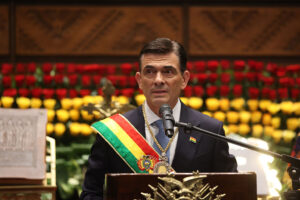



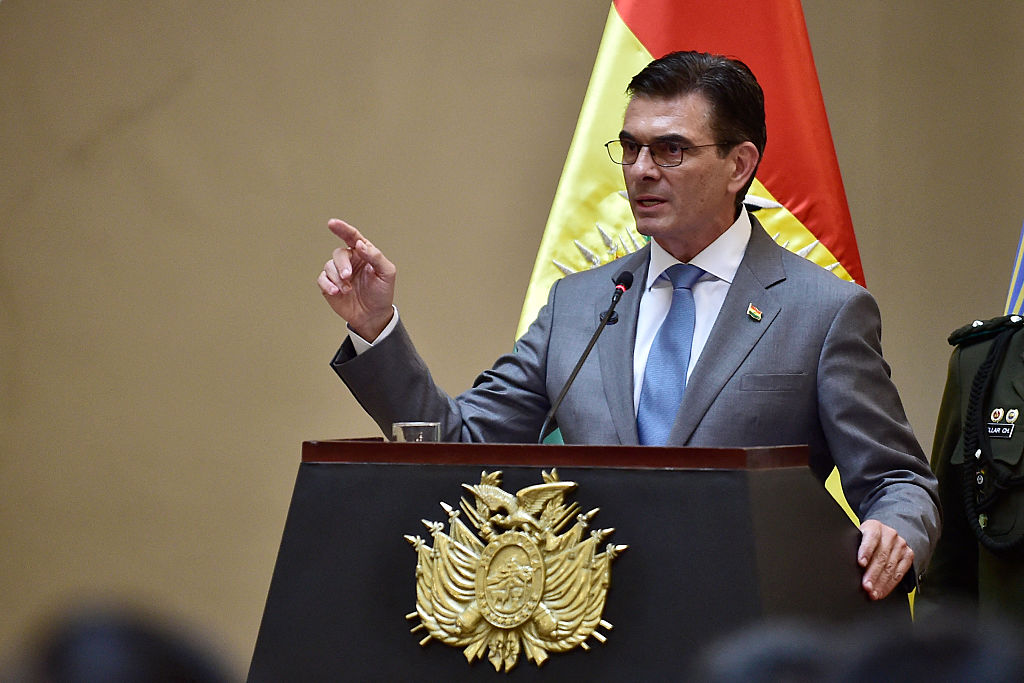
LA PAZ—Barely four months after assuming office, President Rodrigo Paz is facing an early political test. On March 22, Bolivians will vote for the fourth time in fewer than 18 months, after judicial elections in late 2024 and two rounds of general elections in 2025. This time, they will elect governors, mayors, and other local authorities. The stakes for the new government are high, and rifts and realignments are already evident.
The president has joined forces with businessman Samuel Doria Medina (the third-place finisher in the first round of the presidential election, with 19.7% of votes) and others, under an umbrella alliance called Patria. Their candidates are not running with the Christian Democratic Party (PDC), which brought Paz to power.
Vice President Edmand Lara, whose popularity helped propel Paz to the presidency but has since publicly declared himself in opposition to Paz, is supporting candidates from other political parties and alliances. Almost 200 political acronyms are on the ballot, but only a very small percentage of parties are running on the national level.
Paz has already weathered one major crisis after taking office last November under extraordinarily adverse circumstances. His administration inherited an economy in disarray, weakened state institutions, and entrenched corruption networks. The lifting of fuel subsidies by decree in mid-December 2025 triggered social unrest for several weeks. Broader escalation was contained only after repealing most of the decree, but the elimination of fuel subsidies remained in place.
Still, tensions remain. Inflation and the cost of living are still high, and the government’s reliance on executive decrees has sidelined Congress. This is exacerbating strain within the political system and also within the executive branch itself. The March 22 elections will be a crucial test of Paz’s real political support in the country.
Fragmentation at the subnational level
With the long-dominant Movimiento al Socialismo (MAS) no longer the central organizing force in Bolivian politics, the party system has fragmented dramatically. In early December 2025, around 20 candidates were registered for governor and another 20 for mayor in La Paz alone. Since then, the lists have narrowed only slightly. The proliferation of candidacies illustrates the dispersion of political forces. Both the government and the main opposition have limited control at the local level.
Former MAS leaders, especially those linked to ex-President Evo Morales, so-called “Evistas”, are now scattered across multiple political platforms. A prominent example is Leonardo Loza, a Morales strongman. He is running for governor of Cochabamba under a new party acronym, and has even joined forces with other factions of the former MAS, despite the party’s internal feud prior to the general elections in 2025.
The results of these elections will show how much influence the “Evistas” especially, and the central government, will have across the country. Cochabamba is particularly important. It lies in the center of Bolivia and connects the highland and lowland. In recent years, whenever Morales wanted to pressure the government in charge, his supporters blocked major highways in Cochabamba. This disrupts trade and causes significant economic damage.
The Chapare region in this department is also one of the country’s main coca-growing areas and where Morales is based. Most, if not all, of its coca production is believed to be used for drug manufacturing. If Loza, who is currently leading in polling, were to win the governorship, it would mean a major opposition layer of political obstruction to the central government.
“TikTok telenovela” and a fractured executive branch
Beyond economic turbulence and the upcoming elections, Bolivians are witnessing what might be described as a “TikTok telenovela” with Vice President Lara as the main protagonist. Frequently appearing in soccer jerseys, Lara posts videos or livestreams almost daily. In them he accuses Paz and Cabinet ministers of mismanagement or corruption. These videos often go viral, amplifying polarization.
Only six weeks into the administration, Lara declared himself to be the government’s “constructive opposition,” even though he is constitutionally part of the executive branch. He continues to position himself as an anti-corruption crusader, a strategy that proved successful during the campaign. Now, however, that image is beginning to erode. In a recent legislative session, he spent most of the time fending off criticism from lawmakers, some of whom even openly called him a dictator. Polling from late February set the vice president’s approval rating at a mere 18%.
This context also explains two decrees Paz issued this year, which observers have found controversial. One allows him to govern from abroad without temporarily transferring power to the vice president (as stipulated by the constitution). Another decree from late February strips the vice president of almost all his power and resources, transferring them to the Minister of the Presidency José Luis Lupo (Samuel Doria Medina’s running mate in 2025). This minister in particular has become indispensable for Paz, and today functions almost as a de facto vice president.
While the mentioned decrees’ constitutionality has been questioned, these moves clearly signal the depth of the rift between the two men. Bolivia’s political history offers multiple cautionary tales of vice presidents turning against, or replacing, their presidents. For now, any hope of Paz and Lara resolving their animosity seems distant, if not impossible.
Subnational power and governability
If Paz fails to build alliances at the subnational level, co-governance and the implementation of his campaign promises will be difficult. That goes especially for Paz’s proposed 50–50 autonomy model between central and regional authorities. The aim is to decentralize Bolivia by giving regions greater control over certain areas, such as health and education. Each department would decide how to spend 50% of its public revenue—currently, around 90% of regional revenue goes to the central government.
The proposed reform is seen as a first step toward federalization, which lowland departments such as Santa Cruz especially advocate. If implemented, compromise and dialogue will become even more important. Governors and mayors could be key partners in reform. But they could also act as veto players in an already highly fragmented political system.
Overall, the first months of the Paz administration have produced slow but steady economic stabilization. Political and social tensions persist, but they have been more contained than initially expected. The upcoming subnational elections will provide a clearer picture of whether Paz’s early economic gains can also translate into political stability and governability.
ABOUT THE AUTHOR

Gabriela Keseberg Dávalos
Reading Time: 4 minutesKeseberg Dávalos is a Bolivian independent foreign policy adviser. She previously served as Senior Foreign Policy Adviser to the Vice-President of the European Parliament for Human Rights and Democracy and as Director of Global Public Affairs for a network of 70 think tanks from the Global South.
AQ Podcast | Rodrigo Paz’s Overhaul of Bolivia
Early policy changes on subsidies, foreign policy and investment mark a clear break from the MAS era.