




This article is adapted from AQ’s special report on Latin America’s demographic transformation
If you had access to a time machine, would you travel to the past or the future? In Eliza Capai’s new film, A fabulosa máquina do tempo (The Fabulous Time Machine), girls and women of varying ages ponder these two possibilities. Perhaps counterintuitively, most children in the film choose the past, whereas adults opt for the future. For the residents of Guaribas, a small city in the northeastern state of Piauí, this generational gulf makes sense. Not long ago, Guaribas was known as Brazil’s “hunger capital,” and over the past two decades, it has been at the center of the largest cash-transfer program in the world: Bolsa Família. By following the lives of 11 local tweens and their mothers, Capai probes into the far-reaching effects of an initiative meant to alleviate poverty.
In 2003, President Luiz Inácio Lula da Silva, then newly elected to his first term, launched Bolsa Família, still active today. Guaribas served as the pilot city. International observers praised the program: The World Bank became a partner and later credited it for helping halve Brazil’s poverty rate, while the United Nations used it as a model for eradicating hunger. But Capai is no policy wonk; she invokes Bolsa Família only in a series of brief, informative title cards at the very end of her film. Instead, her concerns fall within the intimate human realm. She seeks to capture the lived experience of what it means for young lives to change so drastically and the hope this might create.
For that reason, personal questions are at the center of the film: “What’s the biggest dream in your life?” “What’s your biggest fear?” These are the conduits through which Capai draws out her subjects’ inner hopes and anxieties. The girls—some of the first to grow up in a Guaribas no longer defined by hunger—answer while facing the camera in traditional sit-down interviews, only to later take on the roles of interviewers themselves, asking their mothers to answer the same queries. Capai thus mixes traditional techniques of the documentary form with more playful and experimental approaches, allowing her subjects to occasionally inhabit her position of control.
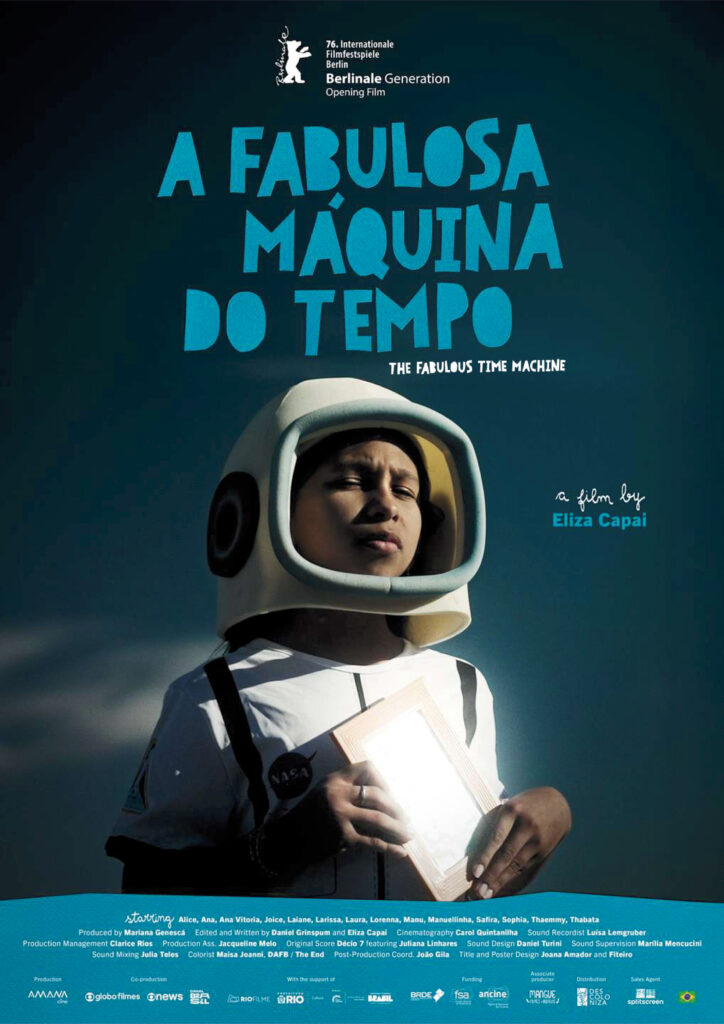
A fabulosa máquina do tempo
Directed by Eliza Capai
Screenplay by Eliza Capai and Daniel Grinspum
Produced by Amana Cine
Starring Manu, Manuellinha, and Sophia
Brazil
This method reveals a stark contrast between the young and the old. While the girls worry about school, TikTok, and the advent of adolescence, their mothers and grandmothers speak of hunger, abusive husbands, taxing childcare responsibilities, and ceaseless work. Meanwhile, footage of the girls in class or at home is interspersed with theatrical skits during which they act out memories or simply dance and giggle together, blending reality with fantasy and tempering moments of seriousness with levity.
This interplay makes for a tender portrait of a new form of childhood in Guaribas, one in which girls who face less poverty can dream and play. Yet it also airbrushes the difficulties and suffering that many of Capai’s subjects still endure. For example, at one point, one of the main characters, Sophia, admits that her father was absent during a painful period of her young life. Later, her mother clarifies that he was an alcoholic and that only after he joined an Evangelical church was his addiction treated. We never hear from this man or learn more about how his substance abuse affected his family.
Ultimately, this gap hints at a problem with A fabulosa máquina do tempo: For all its probing questions and quirky scenes, Capai’s explorations remain surface-level. The older women’s yearning for the future suggests many of the poverty-related problems they encountered have not been fully resolved, while the girls’ curiosity about the past shows how they might want to cling to a childhood they’re on the verge of losing. Using the time machine as a container, Capai aims to highlight Bolsa Família’s success, drawing a sharp contrast between the before and after in Guaribas. Inadvertently, her hypothetical suggests something else. For all the positive changes, old and new generations alike come across as disconnected from their present, eager to travel away.
ABOUT THE AUTHOR

Ena Alvarado
Reading Time: 3 minutesAlvarado is a writer and former assistant editor at The Atlantic.

Female Rage in a Country on Edge
An ambitious film misses the mark in depicting a temperamental teenager at the turn of the millennium in Argentina.
Remembering South America’s Longest Dictatorship
A riveting new documentary connects the Stroessner regime to broader forces beyond Paraguay’s borders.