



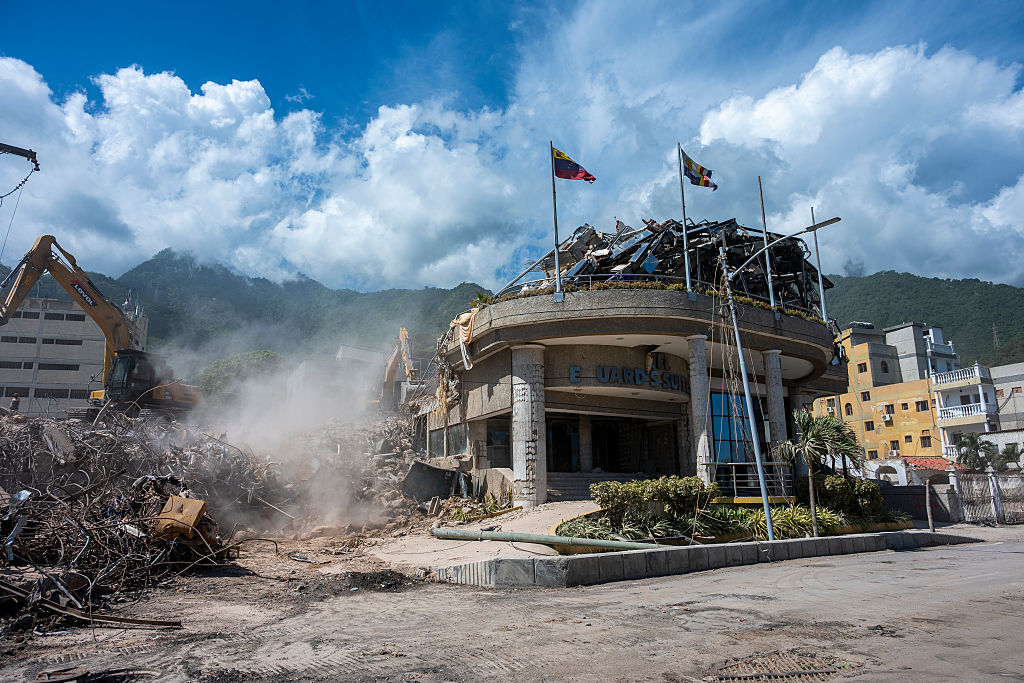
CARACAS—Barely three weeks ago, the debate over Venezuela’s economy focused on how fast it was expected to grow this year — 6%, 8%, or 10%. The unfathomable human tragedy caused by the June 24 twin earthquakes upended that optimistic outlook. The key questions now are what challenges might arise from the dire new circumstances, and what the country must do next.
Before the disaster, 2026 growth projections stood at around 8%, driven by higher oil production, greater access to hard currency, a gradual stabilization of the exchange rate—slower than expected, which had already lowered expectations earlier in the year—and a recovery in private consumption. We have since revised our 2026 GDP growth forecast down to about 5.8%. Under this new estimate, private consumption—one of the drivers originally expected to support growth this year—would grow by 4.3%, down from the earlier estimate of 7.2%. This shows a significant effect on consumption, services, and logistics in the affected regions.
The most immediate impact is on the rising cost of living. Inflation, which was projected to hit 230% annually, will most likely end at around 350%, once again the world’s highest rate. The earthquakes added several inflationary pressures to the lives of regular citizens and corporations already burdened by years of scarcity and high prices. These include localized shortages in some areas, higher logistics costs, greater demand for hard currency to fund emergency imports, and expanded government spending that can be financed through monetary expansion.
The economic cost of the disaster is sizable. Preliminary estimates suggest direct physical damage of $6.7 billion (according to the UNDP), but our forecast puts that figure at around $9 billion. Once business interruptions, lost production, disrupted logistics, and other indirect effects are included, the total economic cost could reach roughly $10.5-$12.2 billion, or about one-tenth of national output. However, in our view, rebuilding will require even more—$12-$15 billion—well beyond the state’s current fiscal capacity and equivalent to nearly 80% of the expected annual government revenue.
If reconstruction proceeds with a minimum of coordination, much of the national investment rebound could materialize as early as next year. But it’s too early to make that determination with precision. The speed and scope of the recovery will hinge on the government’s openness to channel resources from international cooperation, foreign investment, multilateral financing, and the local private sector. It will also depend on the renewal of basic political agreements, which could enable a new nation to emerge from the rubble.
The impact on the oil industry
The quakes had a minor effect on the nation’s oil industry, the main source of hard currency and a significant portion of fiscal revenue. The epicenter was located in Venezuela’s north-central industrial and manufacturing belt, far from the main hydrocarbon-producing regions (the eastern shore of Lake Maracaibo in Zulia, and the Orinoco Belt in Anzoátegui, Monagas, and Guárico). The sectoral breakdown of direct damage confirms this: Industry, logistics, and ports account for only 5-8% of the estimated physical loss, well below housing and buildings (40-45%) or public infrastructure (20-25%).
That does not mean the oil sector is immune from the fallout from the earthquakes, but rather that the effects may be seen in potential competition for hard currency and fiscal space, which is now heavily dependent on oil rents, emergency spending, reconstruction, and the state’s everyday needs.
The earthquakes are squeezing public finances from two directions at once: less non-oil revenue and greater demand for available oil revenue. As far as the preliminary evidence indicates, this is a moderate effect, fiscal and logistical in nature, rather than a supply shock to crude production. For this reason, we do not expect much impact on crude oil production, with year-end production expectations of around 1.3 million barrels per day, not significantly above current levels. However, this result would be 20% higher than the average for the last quarter of 2025.
Comparisons to other natural disasters
The literature on seismic disasters offers a consistent finding: The physical magnitude of an earthquake explains less the final economic damage than the affected country’s preexisting institutional strength.
Hit by a magnitude-8.8 quake in 2010, Chile’s damage was equivalent to 18% of GDP, and it recovered in under four years without enduring a credit rating downgrade because of its prior robust fiscal capacity and functioning technical institutions. Haiti, struck in 2010 by a less intense earthquake (7.3) but already in a collapsed state, accumulated losses equivalent to 120% of GDP, and remains trapped in a trajectory it has yet to fully escape. Last year, Myanmar confirmed this pattern in a political context as fragile as Venezuela’s: The World Bank is estimating a 2.5% contraction in GDP for fiscal year 2025/26, with direct damage equivalent to 14% of output.
Venezuela’s estimated recovery costs of 10-11% of GDP place it in an intermediate position: far below the Haitian extreme but considerably more severe than cases with greater fiscal buffers and deeper insurance penetration, such as Mexico in 2017 (0.15-0.3% of GDP). The differentiating factor is not just the physical magnitude of the damage and the prevention policies, but the absence of fiscal space and of orderly access to external financing to sustain the response.
An earthquake alone does not determine the economic outcome. Rather, the combination of transparency, coordination, and financing over the coming months will be the ultimate determining factor.
Building new bridges
With reconstruction needs of $12-15 billion—far beyond what the public sector can finance on its own—Venezuela will need a strategy built on four pillars: international cooperation, multilateral institutions, private investment, and organized civil society.
Comparative experience suggests institutional quality matters as much as the volume of resources: Countries with smaller physical damage but weak institutions took more than a decade to recover their productive capacity. Meanwhile, economies with larger damage rebuilt within a few years due to coordination between the state, the private sector, and international organizations.
How much transparency governs the use of resources; how much coordination exists among the state, the private sector, and international cooperation; and how much institutional legitimacy supports the reconstruction process are of paramount importance. These factors will determine whether Venezuela repeats the pattern of a prolonged trap or seizes—while there is still time—the window the disaster opened. No reconstruction program of this scale will be sustainable without that backing.
But coordination and transparency on the institutional front require broad agreement among sectors of the democratic opposition and other actors representing citizens’ needs. Venezuela should renew its national pacts and transcend political differences. Reviving accords in the spirit of Spain’s Moncloa Pacts or Venezuela’s own Punto Fijo Pact (1958) is imperative to address the earthquake emergency.
How the country responds to this moment could matter as much as the billions eventually invested in rebuilding roads, homes, and public infrastructure. Of all the pieces dearly needed at this juncture, this may be the most fundamental bridge to build in the months ahead.
ABOUT THE AUTHORS

Asdrúbal Oliveros
Reading Time: 4 minutesOliveros is a Venezuelan economist and consultant. He was a partner and director of Ecoanalítica, a Caracas-based economic and financial advisory firm. He has worked as a consultant for multilateral organizations and as a professor at UCAB and UCV.

Jesús Palacios Chacín
Reading Time: 4 minutesPalacios Chacín is an economist and consultant. He is an economics professor at UCAB and IESA, and a researcher for the Institute of Economic and Social Sciences at UCAB.