



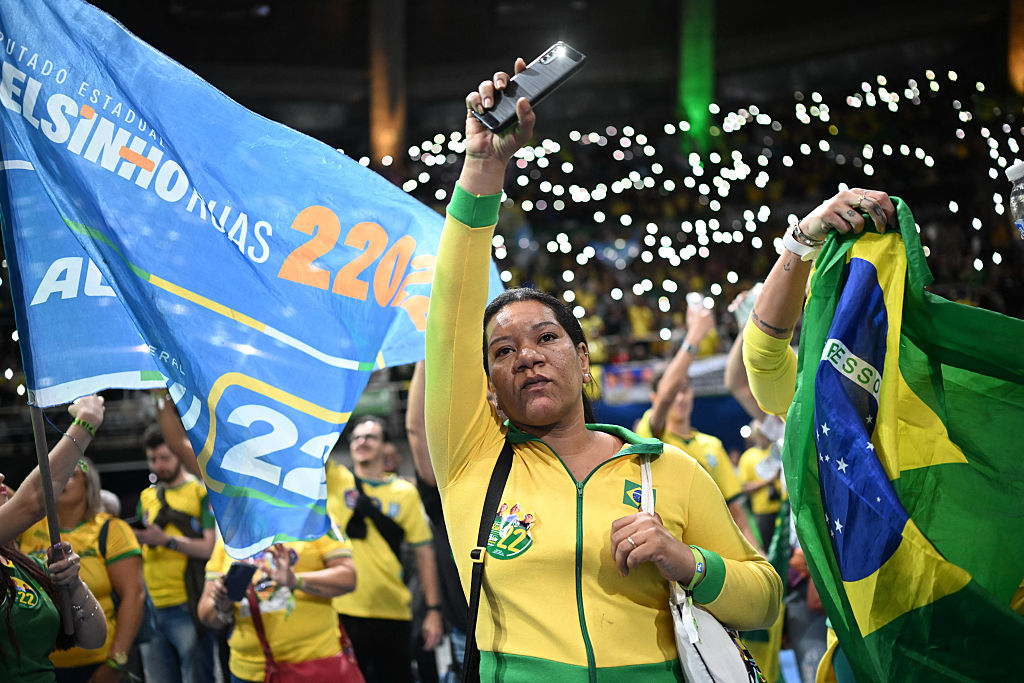
RIO DE JANEIRO—When Flávio Bolsonaro’s first official campaign ad on Brazilian television aired on Saturday, he appeared alongside his wife, his two daughters and his mother. “Everyone knows my father,” he said, referring to former president Jair Bolsonaro, “but my daughters, my wife and my mother made me the way I am.”
“My father was always working,” the 45-year-old candidate continued, “and I spent most of childhood with my mother. Later, I met Fernanda”—his wife. The video then shows Fernanda saying to Flávio: “I changed you a lot, I re-educated you. No wonder you are now the moderate Bolsonaro.”
The montage reflects a broader truth: Women look like the key swing voters in Brazil’s October election. Flávio Bolsonaro currently trails President Luiz Inácio Lula da Silva among women by nine points in the latest Quaest poll. Among voters overall, Bolsonaro only trails by three.
There is history here. The elder Bolsonaro also struggled with women voters, as have many similar far-right candidates around the world including Javier Milei and Donald Trump. Many observers believe Jair Bolsonaro narrowly lost his reelection bid to Lula in 2022 largely because of his disastrous handling of the COVID vaccination campaign—an issue that female voters at the time considered the most important in the election.
That disadvantage was particularly painful because women are more likely than men to cast ballots in Brazil—women made up 53% of all votes in the 2022 election. It is highly unlikely that, four years later, Flávio Bolsonaro will win among female voters; but, if he is to have any chance of winning the election, he must narrow the gap.
However, Bolsonaro’s television ad highlights one of the biggest problems facing his candidacy: the absence of his stepmother, Michelle. A Senate candidate in the Federal District, Michelle is Brazil’s most prominent female evangelical political figure and had a recent public clash with her stepson. In a video posted back in June, she accused Flávio Bolsonaro of mistreating her, dismissing her political views and, alongside his brother, encouraging a hate campaign against her on social media. Weeks later, the two publicly reconciled, but the distance between them remains evident. One of Flávio’s politically active brothers, Eduardo, endorsed another Senate candidate on the grounds that Michelle “could not be trusted.”
Flávio Bolsonaro’s platform includes a specific section devoted to women’s issues, promising financial-literacy courses, special credit lines for female entrepreneurs, and the creation of an AI assistant to receive reports of domestic violence. That last proposal is somewhat uncharted territory for the family—after all, his father Jair Bolsonaro was known for frequent sexist remarks, and used to dismiss the debate over violence against women as “whining.”
Flávio also may have missed a key opportunity when, after months of saying he would nominate a woman as his running mate, he instead chose Alfredo Gaspar, a congressman from his own party. Flávio had previously offered the job to Tereza Cristina Corrêa, a conservative senator, but her party blocked her from taking the job.
On the same day Flávio Bolsonaro appeared on television with his family, Lula took part in a gathering in Belo Horizonte with 7,000 female candidates from the Workers’ Party. In his speech, Lula claimed that 40,000 perpetrators of violence against women had been arrested over the past three months thanks to a federal government program and that, if reelected, he would introduce gender equality classes in schools.
It’s not clear which candidate’s message will prove more effective this time around. A breakdown of the latest Quaest poll shows that Brazil’s undecided voters are predominantly women aged 25 to 40. They are often mothers of young children, Catholic, lower-middle class, self-identified as mixed-race, with a high school education, and living on the outskirts of large cities in the Southeast. Most of them are single mothers. Over 51% of Brazilian families are headed by women, a figure often referred to here as mãe coragem (“mother courage”).
Many of these women hold more than one job. They are nursing assistants, bakers, hairdressers, caregivers, housecleaners, nannies, retail clerks, bank tellers, Natura sales representatives, and Uber drivers.
“They work so much and devote so much of themselves to their families that they have no time to follow political news. They only start paying attention in the days before the election, and their decision is not based on values, but rather on tangible proposals that could improve their lives or those of their children,” said political scientist Felipe Nunes, director of Quaest.
The demographic profile of these swing voters is closer to Lula’s electorate than Bolsonaro’s. Still, dissatisfaction with the cost of living and public safety has pushed many of them away over the course of Lula’s latest term. Now, the political futures of Lula and Bolsonaro hinge to a large degree upon mãe coragem.
ABOUT THE AUTHOR

Thomas Traumann
Reading Time: 3 minutesThomas Traumann is a political analyst at GloboNews TV and the O Globo newspaper. He is a member of Americas Quarterly’s editorial board.
Brazil: Meet the Candidates 2026
President Luiz Inácio Lula da Silva and Senator Flávio Bolsonaro lead polling ahead of the October 4 first-round vote.