




A stubbornly high informal employment rate is often blamed for Latin America and the Caribbean’s subpar economic performance. Today, roughly half of the region’s 325 million workers lack a formal labor contract, which means they are not covered by mandatory social security programs, paid leave, minimum wages, or other benefits. Many in the informal sector are self-employed, represented largely by small family companies, plumbers, and electricians who provide essential services to society. What motivates this critical group of entrepreneurs, and is their vast number a problem?
A recent World Bank publication, Rationalizing Informality: Social Protection, Job Quality and Growth, explores why we should care about the region’s high rate of self-employment, and outlines a strategy to foster greater formality. We want families of informal workers to have access to basic social protections, and, in fact, that has often been treated as the definition of quality jobs, which we seek more of. But regional growth remains lackluster—the World Bank forecasts the region’s GDP will expand 2.1% this year after growing 2.4% in 2025—and informality is thought to be related, both as a symptom of underlying distortions/market failures that require reform, and due to the concentration of workers in informal micro firms that tend to be of low productivity.
The informal self-employed are central players in many developing-country labor markets; as owners of “mom and pop” businesses with fewer than five employees, they account for roughly 30% of the region’s labor force and employ 85% of informal workers. As a particularly dramatic case, Bolivia comes to mind: Around 60% of its workforce is self-employed—one of the highest rates in the hemisphere.
While these figures may give some pause, in global and historical context, Latin America and the Caribbean don’t have a pathologically high share of informal self-employment. Self-employment rates today range from under 15% in advanced countries to 90% in Africa to 25-70% in Latin America. It clearly decreases consistently with each country’s level of economic development.
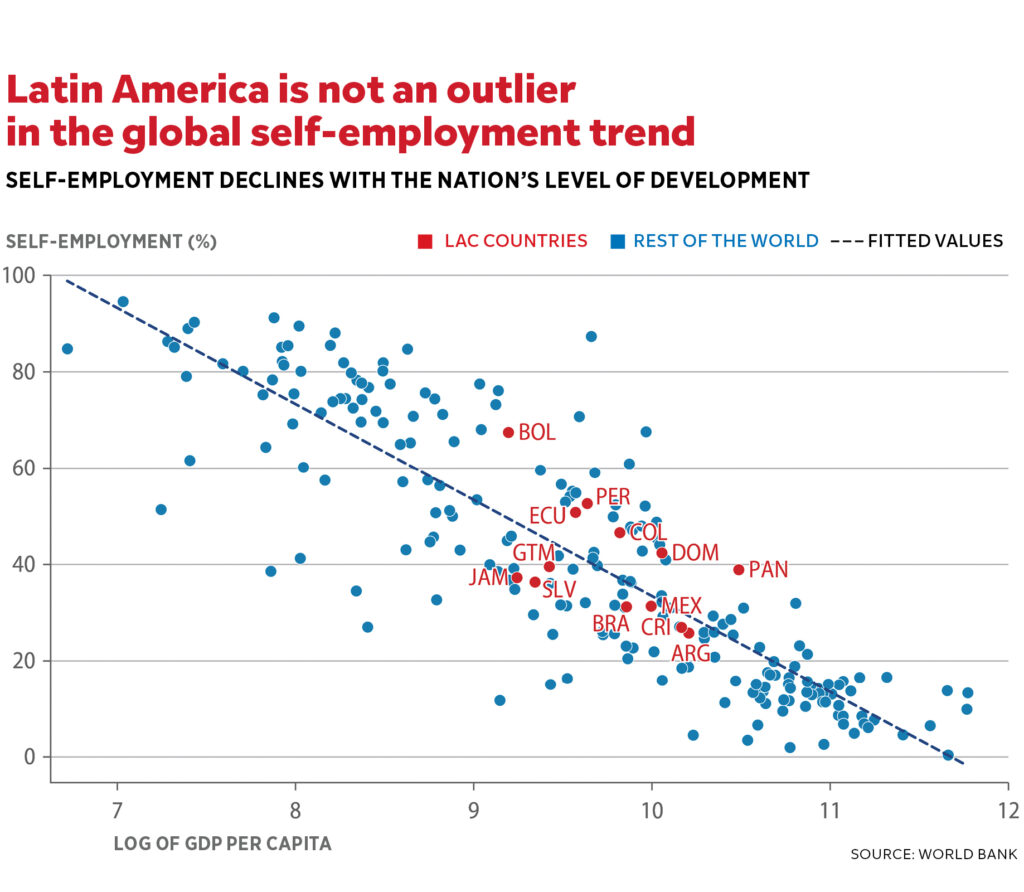
Latin America is broadly on-trend: Argentina, Brazil, Costa Rica, El Salvador, Jamaica, Guatemala, and Mexico fall on or below what would be expected for countries of their level of income, while Bolivia, Colombia, the Dominican Republic, Ecuador, Panama and Peru are substantially above. Further, across history, Latin America and the Caribbean’s self-employment is more or less where Korea’s and Japan’s were at the same development level, and yet … they grew!
Enticing amenities
So why are so many people informal self-employed, if not due to distortions and other market dysfunction? Somewhat surprisingly, a large share of payroll workers around the world report that they would prefer to be self-employed. The International Social Science Program shows that 20% would prefer to be self-employed in Belgium, Finland, and Norway, but that rate rises to over 70% in the Dominican Republic, Mexico, and the Philippines, broadly consistent with the trend of actual self-employment with development.
The World Bank study argues that the downward trend results from the appeal of the amenities self-employment offers relative to salaried work. The workers cite as reasons for entering the sector—desire for flexibility, independence, or being one’s own boss—the same amenities cited in advanced countries; it’s just that in Latin America the value of these amenities appears to exceed the wages and benefits of formal work for a much larger share of the population.
Running one’s own informal taqueria may be preferable—in terms of agency, status, and even income—to the grind of washing dishes in a formal restaurant. The self-employed report they value these amenities at around 50% of actual earnings while they value formal sector benefits far below their cost to workers and employers. This is not to say that these workers are prosperous or happy, only that among the limited options they’re qualified for, the cost-benefit calculus favors self-employment. And that same calculus extends to the low value placed on formalizing their firm; if your employees are family, and your clients are your neighbors, only if you are one of the very few with the skills and aspirations to grow will you require credit and the services of the state, and hence pay to register to get access to them.
Policy toward the informal sector
This vision gives policymakers and entrepreneurs an urgent reform agenda. First is the need to raise skills across all types of human capital and remedy a critical skills mismatch: 30% of bigger companies in the region report they can’t grow for lack of qualified labor, yet a vast reservoir of undereducated workers find their best job opportunity as informal self-employed. Addressing Latin America and the Caribbean’s longstanding educational shortfalls would encourage growth while better matching informal workers with more productive formal jobs. The region also lacks high-quality “transformational” entrepreneurs to create these jobs, so we need to expand quality tertiary education opportunities and build entrepreneurial capabilities.
Second, we need reforms to increase the dynamism of the formal sector beyond the skills shortfall, addressing the distortions in our business climate that prevent growth. The World Bank’s Business Ready (B-READY) indicators suggest substantial distortions and market failures. Even large firms report an inability to access credit to grow. More generally, the recent Reclaiming the Lost Century of Growth study highlights the region’s need to raise its preparedness for technological adoption and innovation, which the 2025 Nobel Prize economics laureates, Joel Mokyr, Philippe Aghion, and Peter Howitt, have stressed as critical ingredients for growth.
It is also important to revisit labor market regulations. Recent evidence suggests that at moderate levels, raising minimum wages can increase worker earnings without adverse employment consequences, but beyond a certain point, it deters formal job creation and segments the labor market. Unlike the self-employed, many informal salaried workers say they would rather hold a formal job but can’t find one.
Finally, we need to review the design of social protection systems. Although the reform debate is often framed as a fight between workers’ rights and firm cost reduction, the reality is that the current system serves neither firms nor workers well. In most countries, workers value formal-sector benefits at about half their cost to society, which discourages formal job creation and incentivizes working off the books. For example, the well-intentioned expansion of social protection systems—universal health and pension systems—lowers the implicit value of formality and its benefits, and shifts the cost-benefit analysis toward opening or working in an informal micro firm. Ensuring workers value statutory benefits, improving state efficiency, and treating social protection as an integrated whole are key to reducing the bias against working in the formal sector.
What probably won’t get us much kick are efforts to formalize micro firms. As in the United States, most of these “mom and pop” firms report no desire to expand and limited demand for credit that would require formalization. This is consistent with mounting empirical evidence showing disappointing results from programs that facilitate firm formalization: They weren’t going to grow anyway. The wellsprings of growth need to be sought in a more entrepreneurial and innovative large-firm sector.
In sum, from a growth and social protection perspective, Latin America and the Caribbean have too many informal self-employed people today. However, the sector’s large size reflects workers’ rational choices given the realities they face, and in that sense, it is normal, even optimal. Perhaps counterintuitively, the policies required to reduce informality are those that don’t specifically target it: overhauling our education systems, fostering the growth of medium and large formal firms, and reforming social protection systems in an integrated way.
ABOUT THE AUTHOR

William Maloney
Reading Time: 5 minutesMaloney is a non resident fellow at the Center for Global Development and the former chief economist for Latin America and Caribbean at the World Bank

Overcoming Latin America’s Stubborn Productivity Gap
One of the region’s most pressing issues offers an opportunity to governments and private companies alike.