



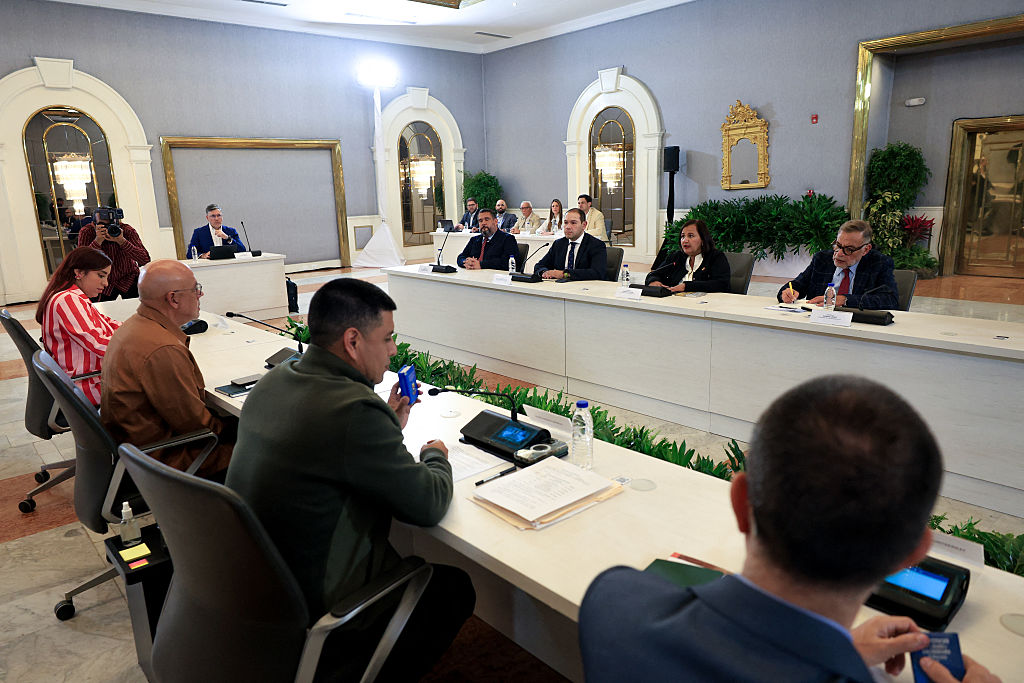
By the end of the year, Venezuela is set to appoint a new Supreme Tribunal of Justice, the country’s highest court, whose packing two decades ago began an era of unchecked repression. It is hard to overstate how much rides on this process—including the nation’s chances for a real, rights-respecting democratic transition.
In a visit to Caracas earlier this month, we met with people directly involved in the selection process and in U.S.-backed talks between the government and part of the opposition. We also spoke with relatives of political prisoners who are hoping the new court will finally have their loved ones released, and with opposition leaders who are cautiously optimistic that a new court can be the foundation Venezuela needs for real change. What we heard convinced us that, if done well, selecting a new court could lay the groundwork for a democratic, rights-respecting transition. This is the first test of whether the political talks, which formally started in August and whose fourth round is scheduled to conclude today, can deliver.
Venezuela’s slide into authoritarianism began, in large part, in the Supreme Tribunal of Justice. In 2004, Hugo Chávez’s allies passed a law expanding the court from 20 to 32 seats and filled the new ones with loyalists. Unlike in the U.S., Venezuela’s top court also appoints, transfers, and removes lower-court judges. So, the court’s packing soon meant the end of judicial independence—and, eventually, the dismantling of any checks on the power of Chávez and his successor, Nicolás Maduro.
Over the following two decades, the Supreme Tribunal endorsed virtually every abusive move by the government, from stripping the opposition-controlled legislature of its powers to appointing government supporters to leadership posts in opposition parties and ratifying Maduro’s widely derided 2024 reelection. In recent years, its seats were filled in part with allies of the former dictator and his wife, Cilia Flores, both of whom the U.S. captured following an unprecedented military operation on January 3.
A complex path
The first obstacle to creating an independent and credible court is that the appointment process remains unclear, even to those running it. The parties to the U.S.-backed talks will agree on the final candidates, and the Chavista-controlled National Assembly is expected to appoint them. But the process that determines which candidates reach that point is complex and, in some ways, murky.
Candidates are screened by a Judicial Nominations Committee, recently expanded to include 11 lawmakers and 12 civil society representatives, some of whom are seen as having ties to the government. It is chaired by Adm. Giuseppe Alessandrello, a Chavista lawmaker who led earlier committees that produced loyalist courts. Eight of the 11 legislators belong to the ruling coalition party, Gran Polo Patriótico. The committee’s bylaws, which set how it votes and decides, have not been made public.
To counterbalance it, the negotiating table created a parallel body, known as the Credentials Review Council, of seven lawyers: four chosen by the opposition delegation and three by the government. The council is also reviewing applications, but no one has said what will happen if it objects to a candidate the official committee chooses.
Both bodies will use a 100-point scoring table to assess candidates, the first time in more than two decades that such a document has been made public. Drafting it raised a difficult issue: How do you score people with experience as judges in a Chavista-controlled judiciary? Does that count for or against a candidate? In the end, the committee agreed to grant experienced judges up to 12 points but also to award some points to lawyers who have taken on other, more independent roles.
The scoring table also gives significant latitude to award points to candidates through non-public interviews—a mechanism Venezuelan human rights groups fear could be used to reward loyalists. Holding the interviews in public could help mitigate that risk. Despite concerns about the process, many lawyers have decided to run, encouraging others to follow. More than 1,000 lawyers, including some highly respected jurists, applied.
The challenge
The real test will be whether the selection process rewards the strongest candidates and places independent justices in three of the court’s chambers. The Constitutional Chamber has the final word on how the Magna Carta is interpreted and has been used repeatedly to rubber-stamp repression against critics and opponents. The Electoral Chamber will rule on any disputes over the elections that a transition may produce. The Criminal Chamber could eventually deal with cases that, according to Venezuelan human rights groups, are keeping between 300 and 450 political prisoners behind bars. Authorities are also expected to fill an often overlooked but important post: the inspector general of courts, who investigates and brings disciplinary cases against judges across the country.
U.S. Secretary of State Marco Rubio has said elections should “ideally” be held next year. The new Supreme Tribunal is a crucial step to make that possible. The new court will decide who can run and will be the final arbiter of electoral disputes, including eventual challenges to the results.
If the talks deliver an independent court, Venezuela will have taken its first real step back toward the democracy its constitution requires, in the same institution where the slide into repression began two decades ago.
ABOUT THE AUTHORS

Juan Pappier
Reading Time: 3 minutesPappier is the deputy Americas director at Human Rights Watch
Martina Rapido Ragozzino
Reading Time: 3 minutesRapido Ragozzino is an Americas research assistant at Human Rights Watch.