


BUENOS AIRES – As Argentina prepares for the March 1 opening of Congress, President Javier Milei is flying high. Buoyed by President Donald Trump’s $20 billion bailout and a strong performance in the midterms last October, he commands a congressional bloc large enough to fend off unfavorable legislation and drive his pro-market agenda. But in Argentina, euphoria can turn into panic in the blink of an eye, and there is reason for caution in the coming months.
With Milei in his third year in office, inflation remains under control—though it has risen again for five consecutive months and will likely exceed 30% this year. Debt remains high, hard currency reserves are low, and economic growth is weak: Amid strict public spending, the country’s GDP grew by 0.3% in the third quarter of last year compared to the previous three months.
As an economist, Milei has plans to solve those problems. His biggest liability, however, does not appear on any spreadsheet. It lies in Argentina’s fragmented opposition, where the most vocal and confrontational wing of Peronism still defines itself in opposition to Milei’s economic liberalization. That unsettles investors and greatly amplifies uncertainty.
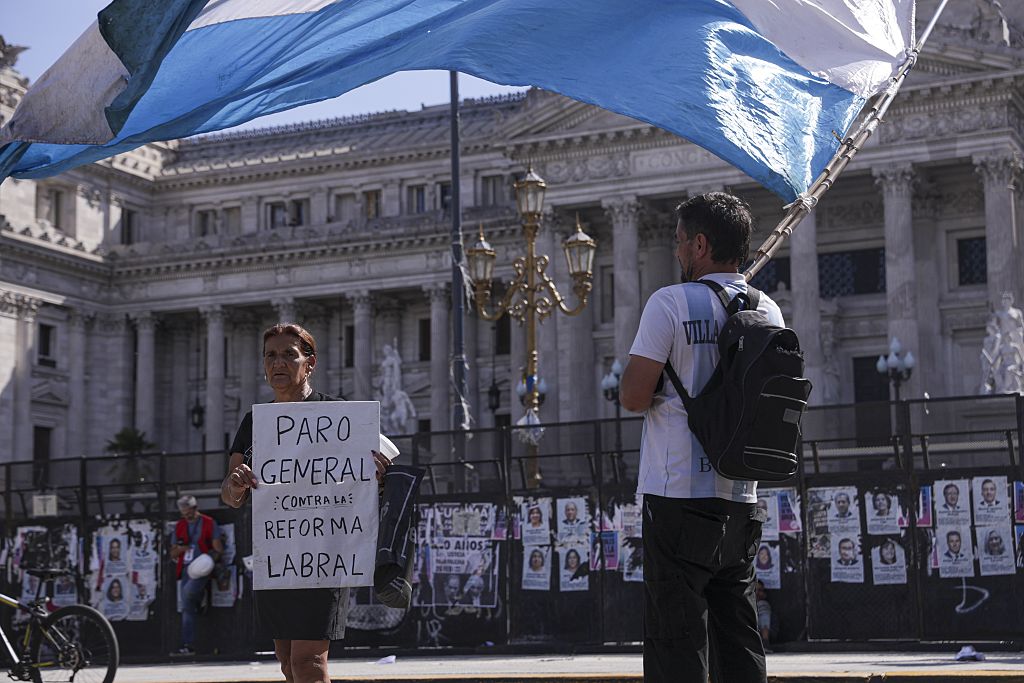
The clash with the opposition and other civil forces was on display on February 20, when the lower house of Congress approved a labor reform backed by Milei amid a nationwide strike a day earlier protesting the bill. The new law now moves to the Senate for a final vote.
Yet the labor reform is only one of the tests before Milei and his team. Other key issues and, consequently, votes are on the horizon that will gauge whether Milei is capable of building a durable, multiparty coalition committed to his modernization plan.
The agenda ahead
In many ways, Peronism has been Milei’s greatest ally. The leftist wing of that chameleon-like political movement governed Argentina for most of the period after the 2001 crisis, and its poor performance weakened confidence in the once-powerful party. Since Milei’s win in 2023, Peronism’s internal conflicts have diverted the opposition from mounting a coherent challenge.
Peronism still influences Argentina’s global image, which is a problem for Milei. The party is dominated by two dogmatic figures who reject Milei’s economic agenda lock, stock, and barrel: former President Cristina Fernández de Kirchner and her rival, Buenos Aires Governor Axel Kicillof. Both favor high public spending and tentacular state interventionism.
During a special summertime congressional session, Milei is testing his legislative mettle. In the midterms, his La Libertad Avanza party won a third of the seats in the Chamber of Deputies and significantly increased its representation in the Senate, though it fell far short of a majority in either chamber.
Milei has big plans. “We’re changing history,” Senator Patricia Bullrich, Milei’s former interior minister, wrote on X, where she posted an animation of a lion, a symbol of the president, leaping over the congressional palace. She expects reforms to labor and criminal law, as well as the EU-Mercosur trade agreement, to receive congressional approval.
Milei also hopes to reform the tax code, codify and accelerate his deregulation drive, and overhaul the pension system. To do so, he will need to bargain with members of the center-right PRO, center-left Radical Party, and a group of provincial governors–including moderate Peronists–who have influence over lawmakers.
His unexpected success in the midterms incentivized cooperation, but that might not last. In the run-up to the midterms, moderate lawmakers had defected and passed several bills over Milei’s objections. That could happen again as the 2028 presidential election approaches.
Milei believes that an economic recovery is the best way to build a national consensus and a stable legislative coalition for budget surpluses, deregulation, and open markets. So far, however, “shock therapy” budget cuts and business-friendly reforms have significantly reduced inflation but have not sparked investment or created jobs. Argentines have been unhappy to see Milei’s “chainsaw” cut through subsidies that, for decades, made electricity, natural gas, and public transportation some of the cheapest in the region.
That all gives little incentive for Peronism’s hardline wing to move toward the center. For now, its leading actors–Kirchner and Kicillof, and also Kirchner’s son, Máximo, and lawmaker Juan Grabois–are uniformly far-left.
Breaking the cycle
At the moment, Milei is not losing sleep over the “Riesgo Kuka”–investor anxiety over a possible Peronist comeback. But his political and economic successes could be undone by a single misstep or another corruption scandal.
That is because Argentines have been conditioned by repeated defaults and dizzying policy reversals. For the same reason, foreign investors keep their parachutes close by, having been lured time and again by hints of a pro-market revolution only to see Argentina’s economy convulse. Milei, like all his recent predecessors, started behind the eight ball, where two years later, he remains.
Even after the midterms expanded Milei’s legislative muscle, firms are pricing in not only economic risk, but also succession risk. To break the cycle, Milei will have to accomplish what no Argentine president has done in decades: build a durable, multiparty coalition committed to a pro-market agenda, and codify reforms in legislation. That type of consensus has greatly reduced the drama of elections in countries such as Chile, Uruguay, and even Peru, where investors have been largely unfazed even as the country cycled through eight presidents in seven years in a wild series of political scandals.
For Milei, building broad support for his economic vision might be harder than wrestling inflation and slaying Argentina’s giant budget deficit, particularly for such a polarizing, pugilistic figure. But in the long run, it is the best insurance against a relapse into anti-market populism that would erase everything Milei has been fighting for.
ABOUT THE AUTHORS

Facundo F. Robles
Reading Time: 4 minutesRobles is an international relations analyst based in Buenos Aires, Argentina. He is a former Fulbright scholar and former Program Coordinator at the Wilson Center’s Latin America Program.
Benjamin N. Gedan
Reading Time: 4 minutesGedan is a Senior Fellow and Director of the Latin America Program at the Stimson Center