


BOGOTÁ—Africa feels distant from a Latin American and Caribbean perspective. Media coverage is sporadic, diplomatic channels are frail, and transportation connectivity is almost non-existent. Africa, however, is steadily increasing its presence and political clout, a trend that demands our attention.
Together, the regions have more than two billion people, more than a third of the world’s freshwater resources, and the two largest rainforests on Earth. They also hold significant reserves of the critical minerals on which the global energy transition depends. While their cultural connections are as strong as ever, both regions have, until now, failed to interact more closely.
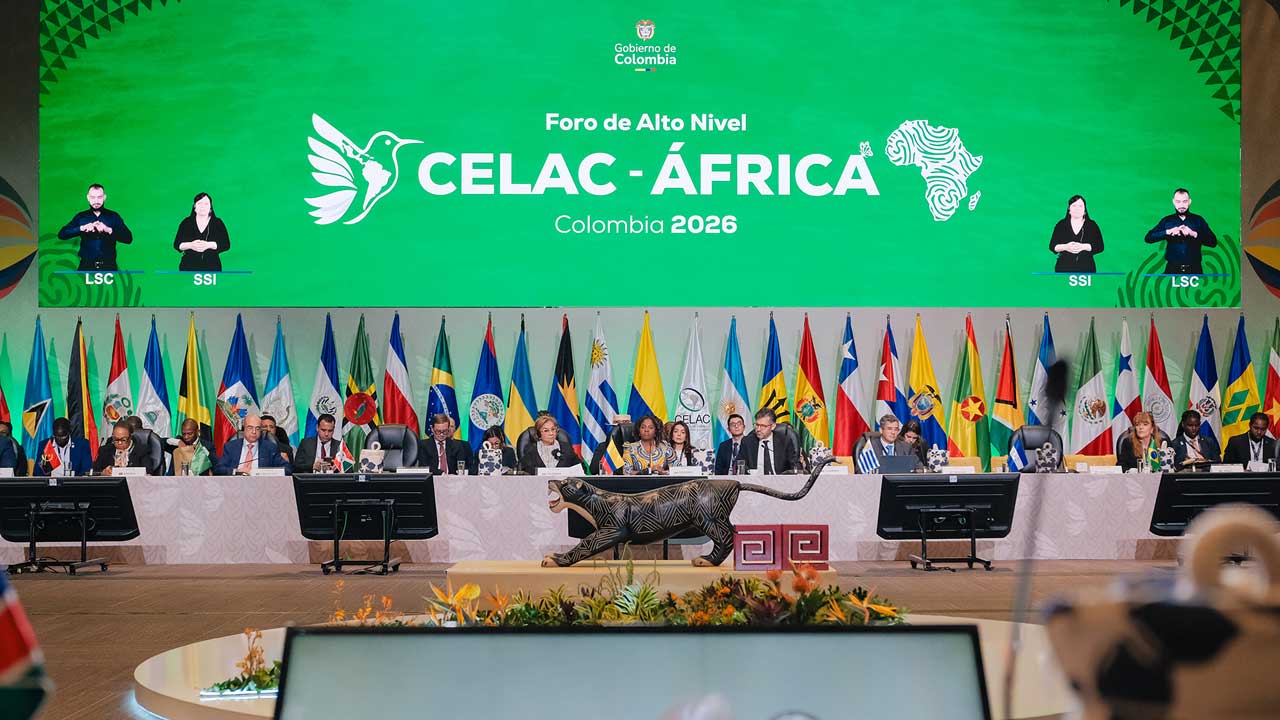
In Bogotá this March, the regions held a landmark conference aimed at pushing forward a more ambitious cooperation agenda, the first-ever ministerial-level meeting between the Community of Latin American and Caribbean States (CELAC) and Africa. Following the High-Level Forum, Ghana and Colombia agreed to establish a direct shipping route between the ports of Tema and Cartagena, bypassing the European hubs that have long added cost and time to transatlantic South-South trade.
This is not the regions’ first attempt to build closer ties, but this time around, cooperation may be longer lasting. Today’s weak multilateral order is pushing countries across the globe to think strategically, and outside the box, about their economic and political partnerships.
South-South coalitions are not just expressions of solidarity; they are considered tools of power. The regions hold a combined 87 votes, almost half the UN General Assembly, representing a bloc that could set broader high-level agendas. Strategic cooperation between the regions has the potential to change the global economic rules that constrain policy options in both Africa and Latin America and the Caribbean.
How the regions engage
Early efforts and results are encouraging. Brazil has the most extensive engagement with Africa, and its state-owned corporation, Embrapa, runs an agricultural innovation platform that connects Brazilian, African, Latin American, and Caribbean researchers to jointly develop research projects.
In 2021, Colombia’s Presidential Agency for International Cooperation signed an agreement with the African Union’s development agency that covers areas such as entrepreneurship, the orange economy, food security, and climate resilience. Colombia’s Ella Exporta a África program has backed over 100 women-led companies entering African markets, and Colombia is the only country in the region with a formal Africa Strategy (2022-2026).
“In the current geopolitical context, it is crucial that both regions act and react as a bloc promoting and enhancing the multilateral values that are at stake,” Mauricio Jaramillo Jassir, Colombia’s Vice Minister for Multilateral Affairs, told AQ. “This is the time for Global South to take the lead.”
According to the WTO, CELAC’s exports to Africa make up just 0.3% of global trade, and African exports to CELAC are almost non-existent. However, the private sector is not waiting for the numbers to catch up. For CLAF (the Latin African Chamber of Commerce), “The next decade represents a unique window of opportunity to advance a pragmatic South-South agenda, focused on strengthening trade, logistics, investment, and food security,” said Angélica Herrera Muñoz, its executive president and co-founder.
Latin America and the Caribbean’s exports to Africa have increased by more than 60% in the last decade. The main types of exports are agricultural products and consumer goods, economic areas that hold significant growth potential for the region.
The Development Bank of Latin America and the Caribbean, CAF, has highlighted the region’s role in providing agricultural products to Africa, a net food importer whose population is forecasted to grow to 2.5 billion by 2050. CAF recently co-published its first joint report with the African Union, which reads like a business plan for a relationship that has waited too long to be taken seriously.
New diplomatic energy
Next year, under the presidencies of Uruguay for CELAC and Burundi for the African Union, the blocs could hold a first Heads of State CELAC-Africa Summit in Addis Ababa. “Uruguay believes that South-South cooperation is not a complement to the global agenda. It is the agenda,” Martín Clavijo, executive director of Uruguay’s Agency for International Cooperation, told AQ.
The push for deeper cooperation is not new. An initial serious attempt came in 2006 with the Africa-South America Summit, which established a forum for cooperation. Summits were also held in 2009 and 2013, but neither was able to sustain the momentum needed to build a robust partnership. The Caribbean Community (CARICOM) has been more consistent: They have held two formal summits with the African Union, in 2021 and again last year.
Diplomatic ties are gradually building. In recent years, Ecuador opened an embassy in Morocco, and Colombia opened embassies in Ethiopia and Senegal. In 2019, the Organisation of Eastern Caribbean States inaugurated a shared diplomatic mission in Morocco.
Culture and climate
The regions share deep cultural ties, and according to the United Nations, there are around 153 million Afro-descendants in Latin America and the Caribbean, accounting for 24% of the region’s estimated 628 million people. March’s forum produced a Strategic Alliance of African, Afro-descendant, and Indigenous Women, a platform for joint leadership that reflects the role figures like Vice President Francia Márquez have played in driving this agenda.
The regions also agreed to a joint roadmap to amplify the Global South’s voice in energy transition negotiations, with a focus on closing the energy access gap that leaves millions without reliable power on both sides of the Atlantic. Last year, the CARICOM Development Fund and Afreximbank established a blended finance mechanism for climate projects in both regions. Taken together, these are modest but concrete steps toward a new partnership.
How to strengthen cooperation
Despite their importance, both regions remain sidelined in the global economic and political order. They are trapped by the same international financial architecture: trade regimes that penalize the deployment of national industrial strategies and policies, financial agreements that are too expensive and too conditional, and technology rules designed to preserve rather than transfer capabilities and knowledge.
For the regions to amplify their voices, the bi-regional cooperation agenda and roadmaps should be integrated into CELAC’s institutional framework rather than relying on the political will of individual administrations. This entails institutionalizing regular summits between the heads of state of CELAC and the African Union, and targeting a short list of priorities aligned with the economic transformation of both regions, such as increasing external financing and managing external debt.
For CELAC, moving in this direction requires a pragmatic consensus between countries, some of which are prioritizing their African ties more determinedly than others. While leftist governments in Latin America and the Caribbean have been among the first to engage with Africa, economic cooperation should transcend political alignments.
Seizing the opportunity
In the end, not seeking or assuring a strategic partnership with Africa may be a missed opportunity for Latin America and the Caribbean. Coordinated positions in multilateral trade negotiations could resist provisions that constrain industrial policy tools such as subsidies, local content requirements, and strategic procurement. In terms of finance, united and cohesive advocacy between the two regions could push for reforms to global liquidity mechanisms, the removal of harmful conditionalities on development finance, and an update to multilateral development banks’ approach to pricing risk in both regions.
What is emerging is not only friendly bilateral relations but also a form of multipolar autonomy. Global South nations are broadening their economic and diplomatic ties with multiple partners and growing more resilient amid the current fragmentation of the international order. Governments should take the lead in developing a clear proposal for collaboration, but it is crucial that other private-sector actors also engage. This is a long-term process, but one that should begin now.
ABOUT THE AUTHORS

Andrea Ordóñez
Reading Time: 5 minutesOrdóñez is a senior adviser on green industrial policy at the Global Cooperation Institute (GCI)

Alejandra Meneses
Reading Time: 5 minutesMeneses is a policy and advocacy officer at the Global Cooperation Institute (GCI)