



This article is adapted from AQ’s special report on the Trump Doctrine
When Alma Guillermoprieto began her career as a journalist in 1978, she was excited to cover a fervent popular rebellion against a nasty dictator, Anastasio Somoza, in Nicaragua. And, well, that revolution has not gone quite as she expected.
Close to 50 years later, here she is, in her latest, and last according to her, reportage collection, profiling what she calls “the most dreadful duumvirate”—Nicaragua’s presidential couple Daniel Ortega and Rosario Murillo. “My colleagues and I (…) never imagined that forty years later we would be writing about how Ortega (…) has surpassed Somoza in sheer arbitrary evil.”
This is how the veteran chronicler of Latin America feels about much of what she has followed over the past half-century across the region. “I couldn’t stop writing just because the stories that turned up weren’t the stories that I would have wanted to write (…) I had ended up with a career in journalism, and I was trying to see my way through the murk,” she writes in the introduction to this collection, The Years of Blood.
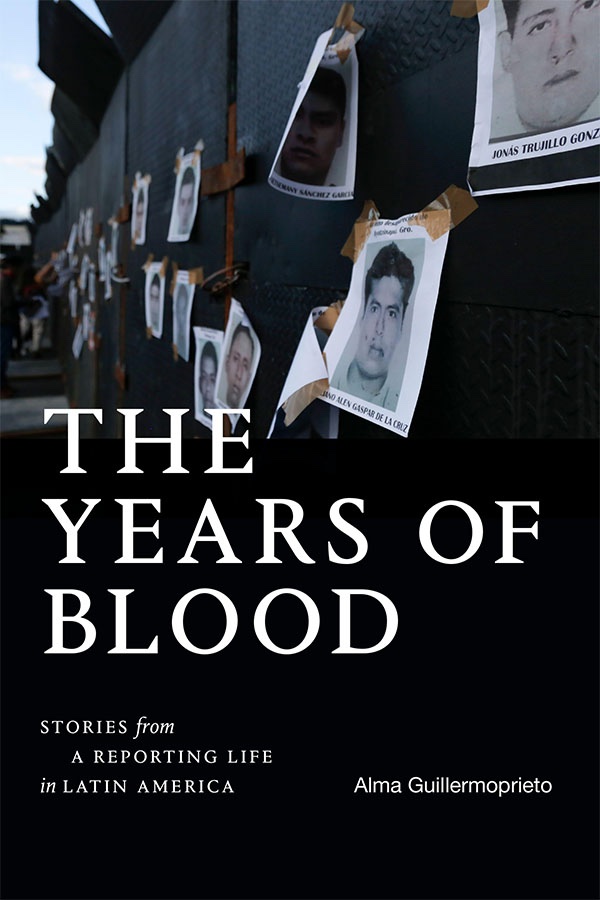
The book’s title and its cover, which shows photos of Ayotzinapa students on the eighth anniversary of their abduction from Iguala, Guerrero, might cause a reader unfamiliar with Guillermoprieto to expect a relentless sequence of brutal tales. There is no shortage of violence and sordid politics in this collection, but such an impression doesn’t do the book justice. Reading it feels more often like what she writes about in the introduction—seeing our way through complicated, fascinating, human murk.
We follow Guillermoprieto’s reporting from the first 20 or so years of the millennium, most of it written since 2010, covering the rise and demise of Evo Morales in Bolivia; the appeal of Hugo Chávez, the original 21st century populist; the complex web of violence in Colombia; El Salvador’s descent from a peace treaty in 1992 to one of the world’s most violent nations, due in large part to U.S. policy decisions; and the bloodshed in her home country of Mexico.
We leave with a strong view-from-the-ground understanding of both the allure and limits of populism and authoritarianism across the region. From the perspective of someone who saw the end of the Cold War-era dictatorships, the ballot has proven insufficient to convince citizens of the benefits of democracy.
In that vacuum, pragmatism, more than ideology, reigns. If you work at a food stall in San Salvador, like one of Guillermoprieto’s characters does, and MS-13 and Barrio 18 charge you “la renta,” a small fee, and you have to deal with them showing up, taking goods from your stand, and leaving without paying, you may support Bukele. If your country is the world’s richest in oil, your elite is corrupt, and you, like most of the citizenry, still live in poverty, you may support Chávez.
Some of Guillermoprieto’s best moments come when she takes a piece of culture and explores what it says about a country at large. In 2004, she writes about the host of Mexico’s most influential news show: a clown, El Payaso Tenebroso, who broke one of the biggest corruption stories of that age. “I was very happy to have such strong material on the program,” he said to her. “But on the other hand, it was very sad to confirm that all the politicians were part of the same underworld.” This kind of scandal, he said, “makes people, in their depression, turn dangerously away from the voting booth. But we couldn’t just make believe that nothing was going on!” Neither could Guillermoprieto.
ABOUT THE AUTHOR

Luiza Franco
Reading Time: 3 minutesFranco is an editor, writer and podcast producer at AQ.
Following British Footsteps in South America
A new book revisits the fascinating but often overlooked history of the British presence across the continent.
Pope Francis, In His Own Words
The late pontiff’s autobiography provides a rare window into the inner and outer life of a beloved and complicated man.