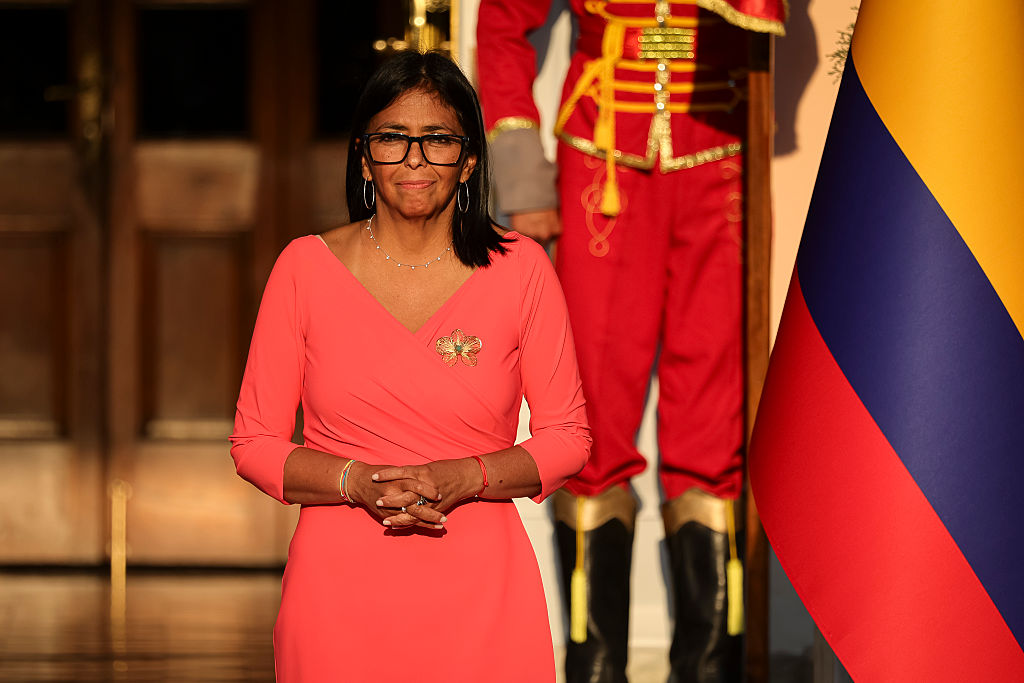
CARACAS – Four months after January 3, Venezuela’s political process is beginning to take clearer shape. The country is not moving through a democratic transition. Instead, it is moving toward economic normalization without meaningful political conditions—a strategy the government of Delcy Rodríguez is pursuing with notable tactical discipline.
The sequence of recent events suggests a coherent plan rather than improvisation: a new agreement with Chevron in the Orinoco Belt; OFAC General Licenses 56 and 57; Rodríguez’s registration as eventual presidential candidate under the U.S. Foreign Agents Registration Act (FARA) as reported by some media; the unilateral termination of the Amnesty Law while 473 political prisoners remain detained; and the capture of the so-called Citizen Power branch through the appointment of her allies Larry Devoe as attorney general and Eglée González Lobato as ombudsman. These moves point to an effort not merely to govern, but to consolidate power under new terms.
There has been some pushback. María Corina Machado’s European gatherings—which included meetings in France, the Netherlands, Portugal, and Spain—confirmed that the opposition still retains key international support. The April 22 reception in Washington of Dinorah Figuera, head of the 2015 National Assembly, by Michael Kozak, the U.S. acting assistant secretary for Western Hemisphere affairs, shows that the Trump administration also continues to receive opposition figures despite its positive relationship with Rodríguez. Figuera was a key legislative figure who helped interim president Juan Guaidó to try to dislodge the former dictator Nicolás Maduro from power.
But neither of these efforts changes the central variable: whether economic normalization will be tied to meaningful political conditions. So far, it has not been.
European leaders continue to speak of a “peaceful democratic transition.” Kozak referred to a “stable, orderly and consolidated transition.” Yet these formulas remain diplomatic language, not enforceable benchmarks. Sanctions relief and economic openings have not been clearly linked to verifiable electoral milestones, institutional reforms, or the release of remaining political prisoners.
That ambiguity may be working in Rodríguez’s favor.
A new chargé d’affaires
The appointment of John Barrett as the United States’ chargé d’affaires, replacing Laura Dogu, and his statement upon arrival in Caracas that he would continue implementing the Trump administration’s three-phase plan—stabilization, recovery and transition—offers a useful framework. The problem is that the third phase remains undefined.
U.S. Energy Secretary Chris Wright has said elections would occur “during the Trump administration,” implying they could take place at any time before January 2029. He also suggested that organizing them would require at least nine to ten months once a coordinated effort begins. In the best-case scenario, that would place elections in mid-2027, after the U.S. midterms this November.
By then, Washington’s domestic political balance may have changed significantly. So may the priority it assigns to Venezuela.
This is the variable part of the opposition tends to underestimate: time favors the government. Each week that economic normalization advances without political conditions strengthens Rodríguez and weakens Washington’s leverage.
The recent appointments to Citizen Power illustrate the point. Devoe spent years defending the Venezuelan state before the Inter-American Commission on Human Rights. González Lobato was promoted by a sector of the so-called “non-radical opposition.”
Their installation serves two purposes. First, it helps shield the current ruling coalition from a future electoral transition. A loyal attorney general reduces the likelihood that any investigation reaches the outgoing power structure. Second, and more importantly, it gives the government influence over the consequences of any negotiated transition. If change does come, institutions such as the attorney general’s office and ombudsman will shape who is investigated, what assets are recovered, and how accountability is pursued.
Political prisoners
The same logic applies to the Amnesty Law. Rodríguez declared it finished on April 23, even though the law contains no expiration clause. The measure had already served its initial purpose: 8,616 releases, though Foro Penal says only 186 were true political prisoners. Ending it now preserves the government’s remaining leverage and signals to opponents that selective repression remains available.
Rodríguez also appears to be converting each step of economic normalization into a step toward her own political normalization without Maduro.
Her FARA registration as a presidential candidate formalizes before the U.S. what had previously been inferred: she is not managing a temporary arrangement. She is building an electoral platform and seeking U.S. recognition.
At the same time, the regime’s internal calculus still favors selective institutionalized repression so long as the external costs remain low. Reports of abuses at El Rodeo I prison, repeated delays in the hearings of teenager Samantha Hernández, who was 16 years old at the time of her detention by officers of the Directorate General of Military Counter-Intelligence (DGCIM). The detention was denounced by human rights organizations as arbitrary, and its apparent purpose was to force the surrender of her brother, an exiled military officer and opposition figure. The case was cited by the Chairman of the Norwegian Nobel Committee, Jørgen Watne Frydnes, during the presentation of the 2025 Nobel Peace Prize.
The greatest risk
Cases like this and the continued detention of military prisoners excluded from amnesty all suggest a strategy of testing Washington’s limits one step at a time.
The greatest risk, then, is not simply the absence of a transition. It is the simulation of one.
That could mean a noncompetitive election in 2027, with Rodríguez already normalized internationally, the attorney general’s office and the ombudsman aligned with the government, the electoral calendar imposed unilaterally, and with international pressure exhausted by earlier economic concessions.
Such an outcome would amount to normalization without a genuine transition.
Avoiding this scenario requires tying economic concessions to measurable political benchmarks. Three urgent steps are needed: linking future sanctions relief to the appointment of an independent electoral authority and the full release of political prisoners; using Barrett’s arrival in Caracas to set clear public conditions for further engagement; and formally challenging the unilateral closure of the Amnesty Law before this window of leverage closes.
Rodríguez may yet fail. But for now, she appears to understand something her opponents and foreign counterparts often overlook: in Venezuela, the transition process is being shaped less by speeches than by sequencing. So far, she is sequencing it well.
ABOUT THE AUTHOR
Benigno Alarcón Deza
Reading Time: 4 minutesAlarcón Deza is a political analyst, researcher, and former Director of the Center of Government and Political Studies at Universidad Católica Andrés Bello in Caracas. He’s also a professor at UCAB and UCV and a Managing Partner at Polis Consultores.