



This article is adapted from AQ’s special report on the Trump Doctrine
In Autobiography of Cotton, Pulitzer Prize winner Cristina Rivera Garza asks what it means to understand ourselves “as guests in a radically shared world,” a task that requires, she writes, “living in a continual state of alert” to the threads connecting humans, plants, animals—even stones. Her book is woven from these threads, binding together intimate family memory, political history, and the ecological forces that have shaped the Mexico–U.S. borderlands.
Using a hybrid narrative that links past and future across various literary genres, she traces her grandparents’ journey from the mining towns of northern Mexico to the cotton fields that briefly thrived along the border in the early 20th century.
This family story intersects with a second story: that of Mexican writer and dissident José Revueltas, who traveled in 1934 to Estación Camarón, a small farming town in Tamaulipas, to support a cotton workers’ strike. Rivera Garza opens her book by imagining the 19-year-old Revueltas in this place—young, passionate and politically energized—and wonders whether he might have crossed paths with her own grandparents, who lived there at the same time.
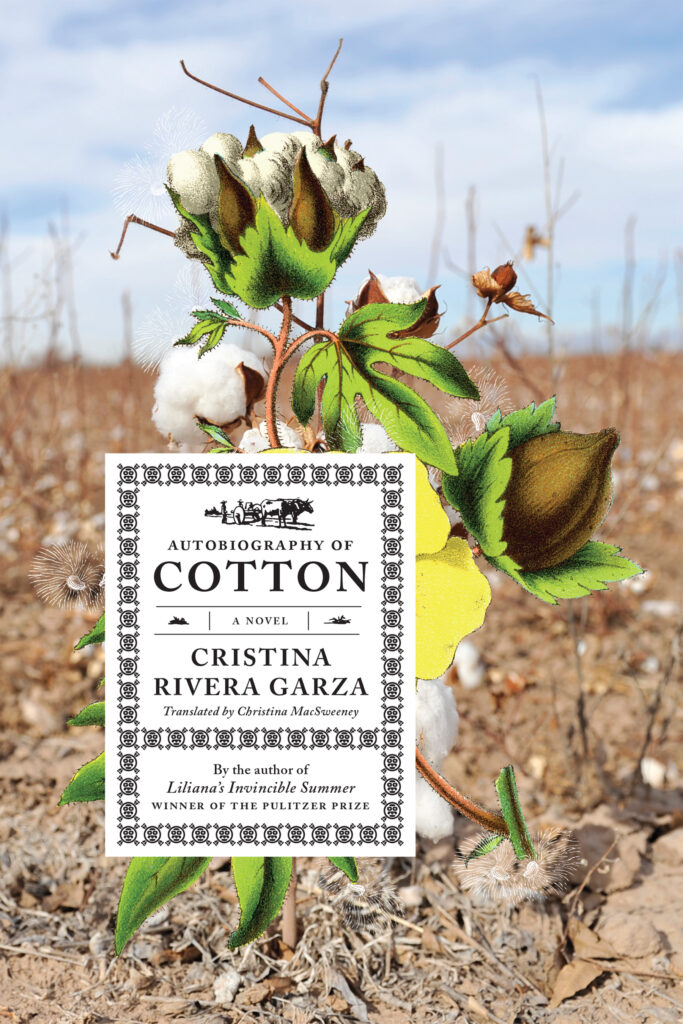
Autobiography of Cotton
Cristina Rivera Garza
Translated by Christina MacSweeney
Graywolf Press
288 pages
Rivera Garza’s narrative is fractured and overlaid. This can leave the reader unmoored. Still, we learn from her attempt to shed light on the porous boundaries between personal memory and national history. Can she come to know her grandparents by traveling to the towns they once called home, by searching for graves that may or may not still exist? The book becomes a probe into what persists, what fades away, and what can be reimagined in the spaces between documented fact and lived experience.
Her grandfather, José María Rivera Doñez, married her grandmother, Petra Peña, after abducting her in 1927. Rivera Garza notes that while illegal, marriages- by-abduction were not uncommon in rural Mexico. The couple left their mining community in 1927, lured by the promise of newly irrigated land prepared for cotton cultivation in northern Tamaulipas.
Cotton offered the chance for stability and upward mobility, but the dream was fragile. By 1937, severe drought, salinity and soil exhaustion had ravaged the region, forcing families like Rivera Garza’s to relocate again—this time to the sorghum fields further south. Later generations migrated to the U.S. in search of work, investing in new futures.
Threaded through this personal history is a broader look at environmental engineering and its effects. Rivera Garza shows how water projects, land deals and development plans helped cotton grow in areas where little had before. But these same actions also sped up the region’s ecological decline. The disappearance of cotton serves as a warning for the damage to come: the rise of U.S.-owned mega-farms after NAFTA, the growth of Canadian mining, and the displacement of communities from ejidos by polluted soil and water. Rivera Garza’s ancestors experienced the early changes of these shifts; today’s migrants live through the consequences.
A central theme of the book is the search for what has vanished. Rivera Garza moves through ghost towns, overgrown potters’ fields, and archives where the struggles and daily lives of cotton workers have all but disappeared. It feels like a miracle, then, when Petra briefly comes into focus: a grim-faced photograph taken by U.S. border authorities in 1929, marking her entry into Texas. The border, in this case, becomes not a barrier but a rare fixed point, a bureaucratic imprint anchoring a life that would otherwise remain nearly invisible.
Autobiography of Cotton seeks to restore the stories of those who shaped the region but are rarely recognized in its official histories. In doing so, Rivera Garza makes a vital, heartfelt contribution to our understanding of the Americas—and warns us about what we lose when entire communities, landscapes and archives are allowed to fade away.
ABOUT THE AUTHOR

Alejandra Oliva
Reading Time: 3 minutesOliva is an essayist and embroiderer based in Chicago. Her writing has been included in Best American Travel Writing 2020, and her book, Rivermouth: A Chronicle of Language, Faith and Migration, was published by Astra House.

A Classic Cortázar Novel Is Back
"A Certain Lucas" gets a new edition at an opportune moment.
A Medieval Dancing Mania Sweeps Mexico in a New Novel
Daniel Saldaña París reconstructs a centuries-old tale for this age of wildfires and pandemics.