


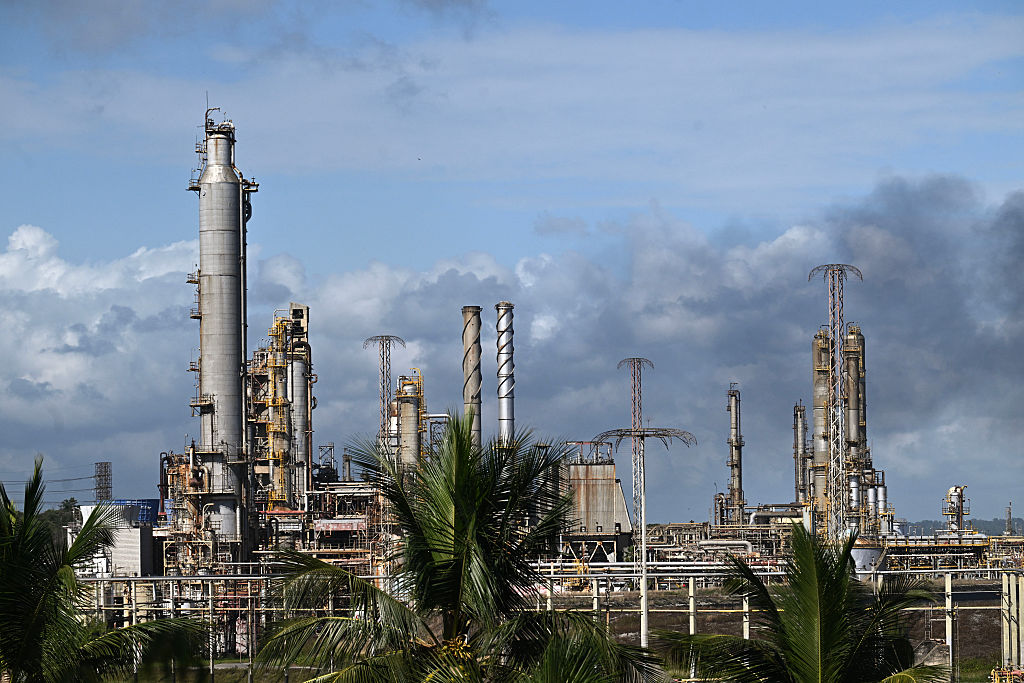

When President Trump announced the capture of Venezuela’s autocrat, Nicolás Maduro, and suggested that American oil giants would swoop in to fix the country’s battered oil infrastructure, it sounded like a straightforward business proposition. After all, Venezuela boasts some of the world’s largest oil reserves, and U.S. refiners are uniquely equipped to process its heavy crude. Moreover, the United States can sell Venezuela the condensates and refined products that it needs to blend with the extra-heavy oil.
The economic logic is compelling: competitive extraction costs (lower than in Canada and the U.S.), rapid production growth potential, and a strategic fit for both nations. Moreover, even though in the short run Venezuela cannot make a big difference in an already oversupplied global market, the country’s production growth could prove crucial to avoid a global oil crunch in the next decade if global oil demand continues to rise.
Yet today Venezuela produces less than 1% of global output—a stark contrast that highlights both its untapped potential and the formidable challenges ahead.
Beneath the initial optimism lies a sobering reality: The obstacles to Venezuela’s oil renaissance are neither technical nor geological. They are political and institutional, rooted in decades of policy instability, broken contracts, and a legacy of resource nationalism. Fixing the industry requires deep institutional reform.
How we got here
For a quarter-century, the country’s oil sector has been stymied by risks above the ground, not below it. If Venezuela’s oil fields were in Texas or Alberta, they would be gushing at record levels. Instead, output languishes and recovering production above peak levels, to around 4 million barrels per day, would require close to $100 billion and a decade of sustained effort.
Venezuela emerged as a major oil producer in the 1920s, quickly becoming the world’s largest exporter. In particular, the post-World War II era brought prosperity, led by international giants like Shell and Exxon operating under favorable concessions that split profits evenly with the state.
However, in the 1960s, resource nationalist governments increased oil taxes and announced that concessions would not be renewed, leading to a decline in foreign investment. As a founding member of OPEC, Venezuela championed higher prices and taxes through cartel coordination.
By the early 1970s, underinvestment led to falling reserves and production. Nationalization followed in 1976, with PDVSA—the national oil company—taking control. While PDVSA initially reversed the investment decline, OPEC quotas limited production growth.
By the late 1980s, OPEC quotas were eliminated, and PDVSA rapidly began increasing production but lacked the financial capacity or technology to develop the vast extra-heavy reserves and to maintain production in some declining marginal fields. So, the international oil companies were invited back in the 1990s. Conoco, Total, Chevron and Exxon became the largest investors in the country.
Hugo Chávez came to power in 1999 just in time to take advantage of the more than 1 million barrels per day of added capacity and the oil price boom, which resulted in the largest revenue windfall in the region’s history and made him very popular. Chávez asserted political control over PDVSA, dismissed most of its leadership and technical staff, and forcefully renegotiated contracts to raise taxes and secure majority state ownership.
Some companies, like Conoco and Exxon, refused the new terms and left, seeking international arbitration. Most others, including Chevron, accepted the conditions. But Chávez and his successor, Maduro, kept reneging on deals with foreign investors, driving most of them out of the country.
Venezuela’s production collapsed from 3.4 million barrels per day at the start of the Chávez administration to under 1 million barrels per day today. Output in fields operated solely by PDVSA, without the help of foreign partners, collapsed by 85%. In a counterfactual scenario, without Chavez’s policy interventions, the country would be producing significantly more than 4 million barrels per day.
Only three major foreign players remain with a relevant share of oil production: Chevron (25%) and the Chinese and Russian national oil companies (about 10% each). This decline stems from mismanagement, corruption and the government’s systematic appropriation of profits. U.S. sanctions have exacerbated the situation, but the downward trend was well underway before they were imposed. In fact, production was already at 1.3 million barrels per day when oil sanctions began in 2019, only 300,000 barrels above today’s level.
The past seven decades of Venezuela’s oil industry are marked by broken contracts and resource nationalism. No agreement has survived to maturity without significant deterioration of terms. The dominant role of the state has significantly limited the role of private capital. Political elites have consistently chosen greater political control over a smaller pie rather than generating a larger one that could bring greater long-term economic benefits to the nation.
Steps to recovery
What would it take to turn things around? First, Venezuela needs stable, constructive relations with the U.S. and Europe, and a permanent end to oil sanctions. Investors must see genuine political stability and a durable consensus among the country’s leadership and society to reopen the sector to foreign participation. Most critically, a credible legal framework must be enacted and enforced by legitimate institutions, and that requires a transition to democracy.
Some argue that removing sanctions alone would unleash a flood of investment. In reality, sanctions relief is necessary, but far from sufficient. Without firm legal protections, policy continuity, and political legitimacy, the kind of long-term, large-scale investment needed to rebuild Venezuela’s oil industry will remain elusive.
In the absence of genuine institutional change, Venezuela may still attract limited “low-hanging fruit” investments—projects with high short-term returns and fast cost recovery. While these could generate modest gains, they would do little to rebuild the industry or restore the country’s production capacity over the long run.
Chevron is in a unique position to help because it is already on the ground, has contracts with significant development potential, and can reinvest some of its cash flow. Repsol, and perhaps ENI, would be able to add more modest increments. However, major projects requiring substantial fresh capital and long maturity will remain out of reach.
A meaningful recovery is possible, but only if it is grounded in durable political change, credible institutions, and a long-term commitment to restoring investor confidence. Only then can Venezuela reclaim its place as an energy powerhouse and deliver on the promise of its vast oil wealth.
ABOUT THE AUTHOR

Francisco Monaldi
Reading Time: 4 minutesMonaldi is the director of the Latin American Energy Program at Rice University’s Baker Institute for Public Policy

Venezuela: A 2026 Snapshot
AQ tracks key indicators and political and economic trends to watch in 2026.
Hostile Takeover and Abandonment Explain U.S. Actions in Venezuela
Two analogies can help us understand today’s state of play and the consequences of Trump’s policy in the country.