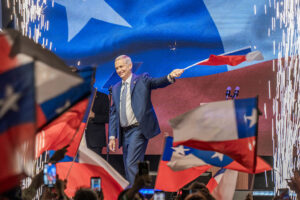



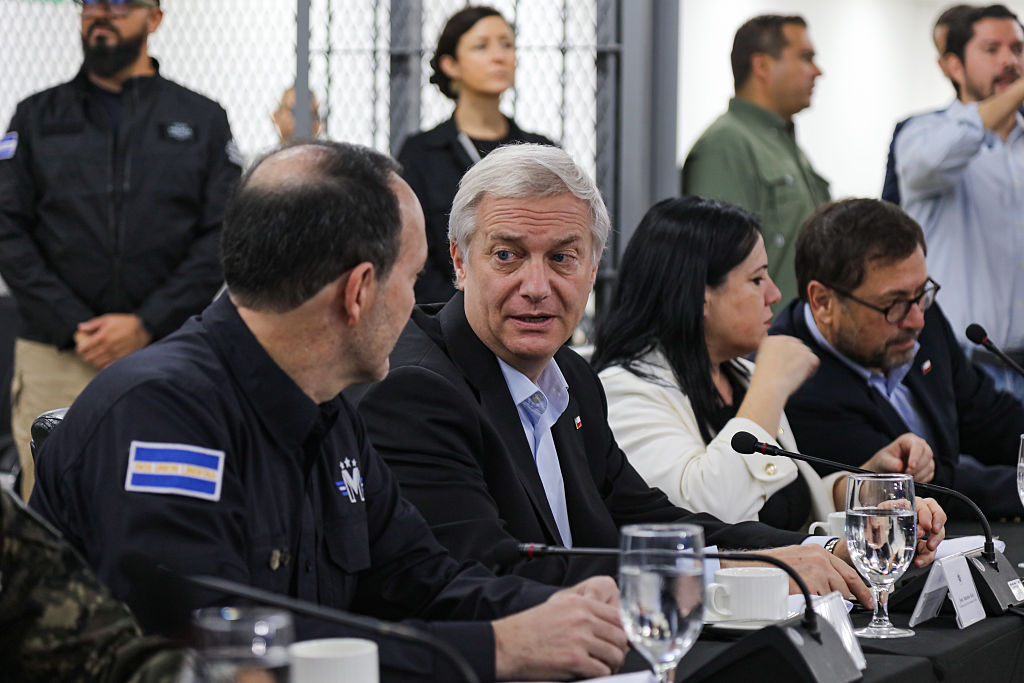
As José Antonio Kast takes office on Wednesday, a single question hovers over him: Would he govern more as a pragmatic conservative or a radical right populist?
The stakes could not be bigger for Chile. After more than seven years of uncertainty, beginning with the protests of 2019 and continuing through two failed constitutional-reform processes and the shaky, inexperienced leadership of outgoing President Gabriel Boric, Chile now has an opportunity to return to a certain normal.
Indeed, the road to success requires Kast, 60, to be a consensus builder. He does not have the charisma necessary to co-opt or otherwise force moderate-right parties and centrists in Congress to adopt the radical agenda he often espoused as a candidate on issues like immigration and security. Rather, Kast will need to find common ground to build a working legislative majority—and maintain the support of the Chilean people.
So, is that the route Kast will ultimately take? There is evidence on both sides, although a careful read of Kast’s past suggests moderation as the more likely path.
The agenda ahead
A career politician, Kast is widely considered part of the rising wave of far-right leaders worldwide and in Latin America. As if he were seeking to confirm that perception, Kast recently attended the Shield of the Americas summit convened by President Donald Trump in Florida. He previously traveled to Europe to meet with Italian Prime Minister Giorgia Meloni and Hungarian Prime Minister Viktor Orbán. After his election, he also visited Argentina and El Salvador to meet with Javier Milei and Nayib Bukele.
Kast spent much of the past eight years building a far-right party and campaigning as a radical right candidate. He has promised massive deportations (including self-deportations for those who want to apply for legal status in Chile), the digging of a ditch on the Chilean/Bolivian border to curb illegal entry, the use of armed forces to protect the border, restrictions on abortion rights, punitive populist policies for criminals, less strict gun ownership laws, protection for self-defense against suspected criminals, and stronger attributions for police officers to use force against suspects. But some of his promises are also simply neoliberal in nature, not part of the populist right agenda.
Kast wants a stronger role for private providers in the health system, the strengthening of the voucher program for private education, and the elimination of red tape and the loosening of environmental protections to facilitate construction permits and new investment projects. With a law degree from the Pontifical Catholic University, the church-attending father of nine, who has been married for 37 years and continues to hold hands with his wife in public, also has a conservative biography.
Kast’s political background makes him seem more like a traditional conservative politician who promotes moral values and deeply believes in market-friendly policies. Kast served for 16 years in the Chamber of Deputies as a member of the Independent Democratic Union (UDI), the party most closely associated with the legacy of the Augusto Pinochet dictatorship (1973-1990). Kast resigned from the party in 2016 and launched an independent presidential bid in 2017 to challenge the former president Sebastián Piñera, whom Kast criticized as being too moderate. After getting 8% in the first round, Kast supported Piñera in the runoff. But he did not join Piñera’s government and instead focused on building a new far-right party, Partido Republicano.
In the aftermath of the 2019 riots and throughout the constitution-writing process, Kast emerged as the strongest defender of the market-friendly economic model that had served Chile well but had failed to sufficiently reduce inequality to meet popular expectations. As a vocal opponent of the constitution-writing process, Kast was in the minority when Chileans overwhelmingly voted in 2020 to replace the Pinochet-era constitution with a new text. But as the constitution-writing process derailed, and as the far left, with a majority in the convention, drafted a text that was too radical, Kast gained popularity and respect. In the 2021 first-round presidential vote, Kast received a plurality of 28% but failed to attract moderate voters and was defeated by Gabriel Boric in the runoff by 56% to 44%.
In the second attempt to write the constitution in 2023, Kast’s Partido Republicano had a plurality of seats, but failed to lead a consensual process to draft a document that could receive popular support in the exit plebiscite. Instead, the document drafted by the Constitutional Council was again too radical – this time on the conservative side – and Chileans ultimately chose to stick with the 1980 constitution (which has been reformed multiple times under democratic rule). The lesson is clear: There is precedent for Kast overinterpreting a popular mandate and insisting on radical policies out of step with the Chilean majority.
A moderate Kast
Nevertheless, Kast now takes office amid widespread expectations in Chile that he has evolved over the years to become at least somewhat more moderate. In November’s first round, Kast received 23.9% of the votes and a comfortable 58.2% in the runoff, as many Chileans hoped he would pursue a less radical path. Indeed, unlike many other far-right leaders who advocate protectionist policies, Kast is adamantly in favor of free trade agreements. Kast believes in free markets, unlike tariff-loving state-intervention conservatives. He is morally conservative, but Chileans are increasingly liberal on moral issues. He embraces strong anti-immigration views, but so do most Chileans, who have seen the immigrant population grow from 2% 20 years ago to 10% today. Kast promises mano dura policies against crime, but crime is the biggest concern among Chileans.
The Chilean left often criticizes Kast because his German-born father joined the Nazi army in 1941 as a young conscript. Criticizing Kast for his unwavering support of the Pinochet dictatorship would be more appropriate, although Kast has also occasionally criticized human rights violations as excesses committed by the authoritarian regime. Kast is a conservative catholic who opposes abortion rights and holds traditional views on gender roles, but he is also a career politician who knows that successful politicians are those who can broker agreements with other politicians who embrace different views. Although Kast has a history of fighting with ideological friends and foes alike, he also knows that successful Chilean presidents have been those who broker agreements to move the country forward.
In Argentina, Kast declared that he is not into chainsaws—marking a difference with the aggressive rhetoric used by Milei. In El Salvador, Kast explained that Chile has a different legal system and thus, he would not attempt to implement anti-crime policies in the same manner as Bukele has done (Kast also made no mention of promoting bitcoin as the national tender in Chile). In Europe, he talked about economic growth, immigration, and Western values, but he did not repeat his radical and improbable promise of promoting massive deportations of hundreds of thousands of undocumented migrants. For his economic agenda, Kast has explained that simply tweaking rules and regulations, a presidential prerogative, can help solve many red-tape issues that slow down investments and hinder economic growth.
Navigating muddled waters
In addition to the domestic front, Kast will need to navigate an uncharted minefield in international relations. China is Chile’s most important trading partner (40% of exports and 25% of imports), but the U.S. is also a major one (15% of exports and 20% of imports). Most importantly, the U.S. has been Chile’s most vital strategic and security partner for the past four decades. Chile considers the U.S. its best friend among superpowers, but China is its key business partner. Kast’s ideological closeness to President Trump will be useful, especially after Boric, unwisely and ineffectively, attempted to punch above Chile’s weight and criticized Trump’s foreign policy.
A recent controversy over the Boric government’s decision to authorize a Chinese company to build an undersea communication cable between Hong Kong and Chile underlines the challenges Kast will face as president. The U.S. government actively opposed the project. On February 20th, the State Department revoked visa privileges for three officials in Boric’s government for moving forward with the project. The project, which the public did not know about before the U.S. revoked the visas, is now on hold. President Kast will likely kill it, but he will need to work hard to keep good relations with China.
Ultimately, Kast will need to strike similar balances at home as well. Chileans voted for change, but they did not unconditionally endorse the kind of change that radical-right candidates elsewhere promise. In a long address on election night, which Chilean media acerbically dubbed his “Make Chile Boring Again” speech, Kast called on Chileans to respect the rules, get up early to go to work, and do things right. Far-righters hoping for a call for radical change were disappointed.
That speech reflected what seems today like the more likely path for Kast – one of relative moderation. Chileans still remember when, in 1971, socialist President Salvador Allende declared that he was not the president of all Chileans. Since democracy returned in 1990, all presidents have made it a point to commit to being the president of all Chileans. Today, there is a similar hunger for normalcy. If Kast chooses to govern as the career politician he is, with his conservative and traditional way of life and implementing pragmatic reforms, he could truly make Chile Great Again.
ABOUT THE AUTHOR

Patricio Navia
Reading Time: 6 minutesPatricio Navia is a professor of liberal studies at NYU and a professor of political science at Diego Portales University in Chile.
Kast’s Cabinet Set to Confront Distinctly Political Challenges
Chile’s president-elect has rolled out a pro-business cast of ministers, tasked with finding political solutions, an expert writes.
Chile: A 2026 Snapshot
AQ tracks key indicators and political and economic trends to watch in 2026.