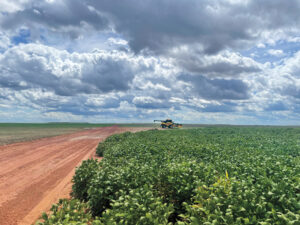



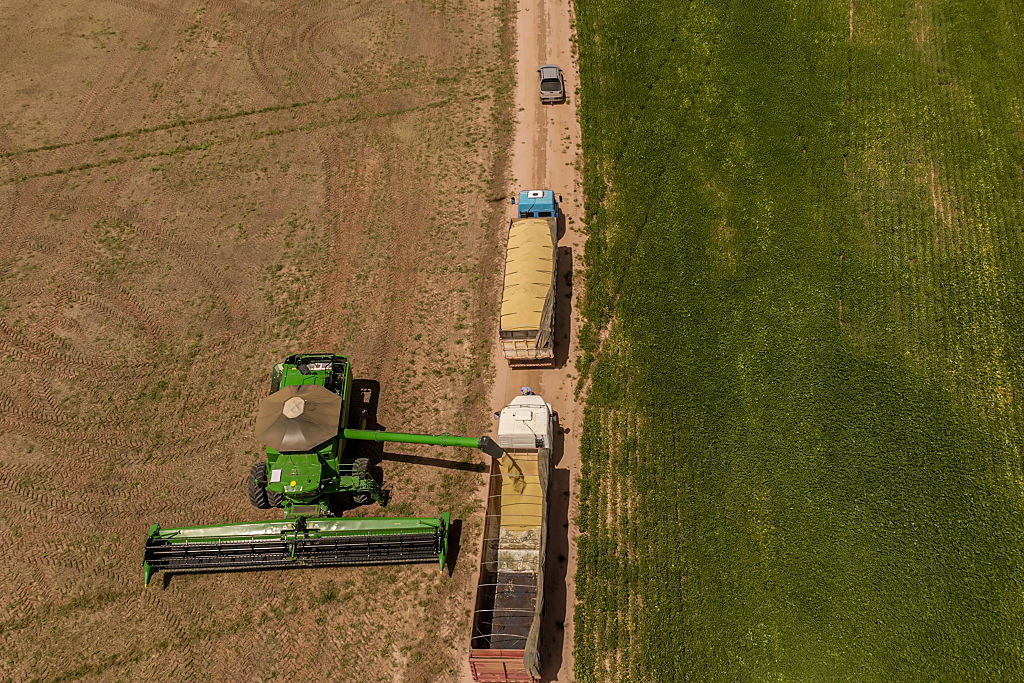
SÃO PAULO—For years, the conventional read on Brazil’s agricultural heartland has been to follow trade flows. If China buys its soy and beef, the reasoning goes, the eleven producing states must lean toward Beijing. Still, a survey about the political inclinations of the region, known as the agricultural frontier, shows that the reasoning is wrong.
China has been Brazil’s largest trading partner since 2009, and bilateral trade reached a record high of $171 billion last year, according to the Brazil-China Business Council (CEBC). Brazil exported roughly $100 billion to the Asian giant in 2025, and the agricultural frontier contributed roughly 36% of the exports, according the Brazilian Ministry of Development, Industry, Trade and Services. The region, which spans the Midwest and northern parts of Brazil, is relevant not only for its economic weight but also for what it reveals about the nation’s political alignment.
A survey by the School of International Relations of the Getulio Vargas Foundation, an original, regionally representative, face-to-face public opinion poll of how the frontier sees the wider world, was conducted among 1,000 adults across 70 selected municipalities between late October and mid-November of last year.
Notably, even though the fieldwork was conducted while Brazil was absorbing a 50% U.S. tariff imposed that August, the survey records a curious pattern: The region sells to China without trusting it, accepts European rules without embracing them, and trusts the U.S. without depending on it commercially. This leads Brazil into a situation of interdependence without alignment, in which economic influence does not automatically translate into political trust.
In 2022, China absorbed 80% of the frontier’s soybean exports and 86% of its beef, a sign of apparently unrivaled commercial dominance. Still, only 12.6% of frontier residents call China “very trustworthy,” compared to 21.8% for the U.S. When asked about political influence, more than 40% say Washington holds “a lot” of sway over Brazilian politics; just 22.6% say the same of Beijing. China is clearly read as an economic actor; however, its political role is not readily accepted.
The U.S., on the other hand, buys almost none of the agricultural frontier’s output directly, yet its firms sit at both ends of the production chain. On the way out, traders—ADM, Cargill and Bunge—handle nearly half the region’s soy shipments to China. Further upstream, American technology supplies the inputs: Tampa-based The Mosaic Company provides about a fifth of the fertilizer used by Brazil, while the seeds, agrochemicals and machinery are also largely American in origin.
This presence is real but nearly invisible and shows an American advantage that is the mirror image of Beijing’s current situation. We would argue that the trust the U.S. enjoys, rather than relying on a direct commercial footprint that barely exists, could be resting on something else: familiarity and perceived reliability throughout the frontier.
The Europe factor
Europe also plays an important role. Nearly three-quarters of respondents agree that meeting EU environmental requirements would strengthen Brazil’s reputation. Two-thirds also believe that compliance would erode the competitiveness of Brazilian goods, and 61.5% suspect the rules primarily serve European economic interests rather than the environment. Although these views are held across all respondents, they do not cancel each other out; They coexist as a posture we identify as pragmatic compliance. The frontier is bracing for a market-access condition it expects to pay for, rather than embracing a shared creed.
Tying these postures together is a distinctive political culture, as most frontier residents (83%) identify as either centrists or right-leaning. Majorities say that government interferes too much in daily life and that regulating business does more harm than good, and two-thirds favor relaxing Brazil’s own environmental rules.
Looking at the agricultural frontier, with its market-minded and state-skeptical characteristics, is the most plausible lens for the rest of the region’s postures: at ease with rules carried by markets, wary of those imposed by the state. Nonetheless, the survey results may potentially help to explain why EU conditionality abroad is tolerated while regulation at home is resisted, and why power associated with open markets edges out power associated with state capitalism.
The political angle
Moreover, Brazil’s agricultural frontier is becoming an increasingly significant region politically. Its states hold roughly 15% of the national electorate, more than 22 million people, and are overrepresented in key political offices, such as the Ministry of Agriculture. As that weight grows, the region’s attitudes harden into a constraint on what any government in Brasília can credibly do.
A foreign policy seen as tilting too far toward Beijing will meet resistance from the very places that earn Brazil’s export dollars. EU compliance terms become negotiable from a position of domestic strength rather than weakness. Commitments imposed from above, without closer consultation, might struggle on the ground.
For outside powers, the lesson runs the same way. China’s dominance buys volume, not loyalty: Should trade tensions rise, or credible alternatives appear, the constituency that trusts Beijing least may be the quickest to look elsewhere. The U.S. holds an asset it neither paid for nor advertises, and as this year’s renewed tariff threats show, the U.S. can put this asset at risk. The EU, for its part, should remember that how a rule is implemented will matter as much as what it says.
In short, Brazil’s agricultural frontier is not yet anyone’s client. It is part of the global economy and committed to none of the powers that integrate it, standing as a reminder that in export-dependent regions, trade flows are a poor indicator of where loyalties lie.
ABOUT THE AUTHORS

Matias Spektor
Reading Time: 4 minutesSpektor is a professor of politics and international relations at the FGV School of International Relations in São Paulo

Guilherme Fasolin
Reading Time: 4 minutesFasolin is a PhD candidate at Vanderbilt University

Enrico Recco
Reading Time: 4 minutesRecco is an associate researcher and project assistant at the FGV School of International Relations in São Paulo
China Doubles Down on Latin America
The recent China-CELAC forum underscores how LAC must position itself strategically amid shifting geopolitics.
Brazil Deepens Its Bond With China
The already important relationship is gaining momentum, as U.S. policies drive Brazil to seek closer collaboration with China.