


CARACAS—When representatives of the Venezuelan government and the opposition meet at the negotiating table on August 1, international attention will once again focus on the possibility of a lasting political agreement. Still, history urges caution. Venezuelans have reason to hope, but even greater reason to be skeptical.
Even as U.S. Secretary of State Marco Rubio announced days ago that the new talks will mark the beginning of the “transition process,” President Donald Trump tempered expectations by saying that the country is “not ready yet” to hold elections. In the almost seven months since Nicolás Maduro’s capture, the nation has navigated an external tutelage that has morphed into normalization with the regime run by the former dictator, leaving limited space for a long-awaited democratic transition.
With expectations again running high, one fact remains unchanged: Venezuela’s problem has never been the absence of dialogue. It has been the absence of genuine negotiation—and of the conditions that would make it rational for both sides to honor the agreements they reach.
Over the past 27 years, Venezuela has seen at least 17 dialogue initiatives between Chavismo and its opponents. Seven of those held between 2002 and 2022 were major formal negotiation processes, according to a study by the Universidad Católica Andrés Bello. Some yielded limited results: the release of political prisoners, modest electoral reforms, humanitarian agreements, or mechanisms for international cooperation. None resolved the central question: who governs, under what rules, and with what guarantees of democratic alternation.
The explanation goes far beyond flaws in design or mediation. As American scholar I. William Zartman argued, negotiations produce lasting agreements only when both parties simultaneously perceive that the cost of continuing the conflict exceeds the cost of negotiating, and that there is an acceptable way out for both sides. Venezuela has rarely met those conditions.
For Chavismo, repression consistently proved less costly than making concessions. For years, oil revenue, the support of international allies, institutional control, and a relatively small governing coalition kept the costs of preserving the status quo low. The opposition, by contrast, entered each negotiation with greater legitimacy than coercive capacity. The government negotiated from a position of strength; the opposition, from a position of necessity.
Under those circumstances, the talks became instruments for managing the conflict rather than resolving it. Without any genuine intention on the government’s part to negotiate binding agreements, the dialogues served to ease international pressure, divide the opposition, buy time, and restore governability without altering the real distribution of power. They did not fail because of a lack of dialogue, but because there was no real negotiation. They failed because the incentives favored noncompliance.
Today, however, the incentive structure is different.
A reconstruction on two tracks
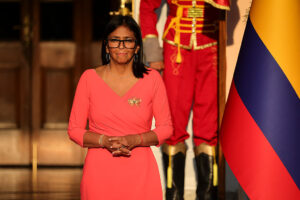
Maduro’s departure from power, the establishment of an interim government led by Delcy Rodríguez, and the new role assumed by the U.S. have altered variables that remained virtually unchanged for more than two decades. The Venezuelan government fears the possibility of another military intervention like the one carried out on January 3. It also needs access to oil revenues controlled by Washington: President Trump admitted earlier this week that the U.S. has sold more than $13 billion of Venezuela’s oil.
The country also needs international financing, investment, access to markets, and external legitimacy in order to function normally—and even more so now as it confronts reconstruction after the June earthquakes. None of these objectives can be fully achieved without the cooperation of the U.S. administration.
Economic reconstruction is moving much faster than institutional reconstruction, and the recent humanitarian tragedy caused by the twin earthquakes simply compounds the urgency of the moment. Oil already has timelines, investment plans, and implementation mechanisms. Democratization has little more than declarations of good intentions. Rebuilding the economy without rebuilding democratic institutions could produce a more efficient state, but not necessarily a more democratic one.
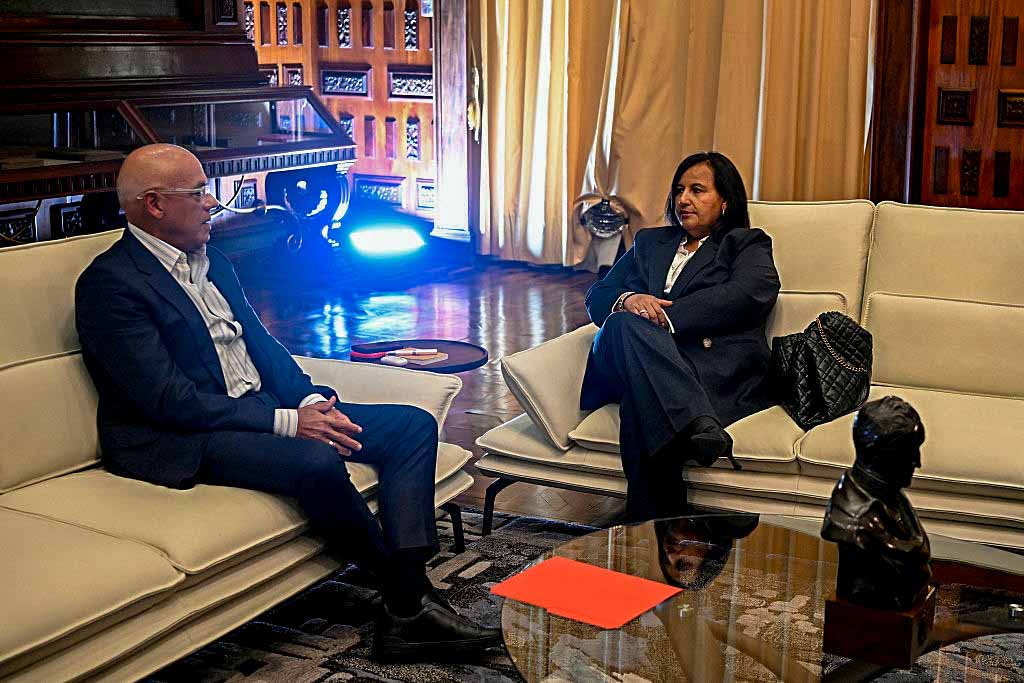
The new talks face a political representation problem that the negotiations must address quickly. Dinorah Figuera, a political leader who returned to the country after eight years in exile, brings the institutional legitimacy derived from the National Assembly elected in 2015. However, the political mandate delivered to the opposition in the 2024 presidential election cannot be dismissed as merely symbolic. María Corina Machado and Edmundo González remain the leaders around whom Venezuela’s democratic majority has rallied. If those who received that mandate do not participate meaningfully in the key decisions—or lack the authority to validate any agreements reached—the political legitimacy of the process will be weakened from the outset.
These factors make the U.S. more than a facilitator and raise the stakes of the entire process. Leading up to the talks, U.S. officials and opposition leaders have held meetings in Spain in preparation for the formal dialogue set to take place in Caracas. While it remains unclear how the new talks will be structured and evolve, the U.S. can serve as an arbiter capable of imposing penalties and rewards to ensure compliance. For the first time, it has the capacity to alter the strategic calculations of both sides throughout the negotiation process. Yet that is precisely where the greatest risk lies.
How to ensure compliance
History shows that no negotiation succeeds on the goodwill of negotiators and mediators alone. It requires verifiable mechanisms to ensure compliance. This negotiating round should establish a clear sequence of commitments: the release of political prisoners, guarantees for the return of exiles, the restoration of civil liberties, the strengthening of electoral and judicial institutions, the updating of the voter registry both inside and outside the country, robust international election observation, and a credible timetable for competitive elections whose results will be respected by all parties.
The August 1 dialogue should be judged by whether it succeeds in changing the incentives that caused every previous negotiation to fail. Neither optimism nor skepticism offers an adequate guide today. Optimism overlooks the fact that 17 previous negotiation processes failed to produce a democratic transition. Skepticism ignores the fact that, for the first time, there is an external actor with the real capacity to alter the balance of power that condemned those earlier efforts to failure.
The success of this opportunity hinges less on the willingness of the parties to talk than on the ability to make compliance a real choice for the Chavista regime. That is the difference between managing a conflict and beginning to resolve it. And that is also the responsibility that now rests, to a large extent, with Washington.
ABOUT THE AUTHOR
Benigno Alarcón Deza
Reading Time: 4 minutesAlarcón Deza is a political analyst, researcher, and former Director of the Center of Government and Political Studies at Universidad Católica Andrés Bello in Caracas.
Venezuela’s Shattered Post-Quakes Economy
The twin earthquakes are reshaping the economic outlook and upping pressure for new political agreements, two experts write.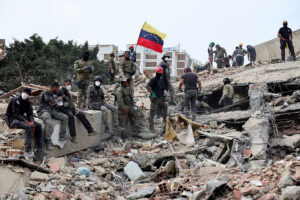
Venezuela’s Earthquakes Are Exposing the Fault Lines in U.S. Policy
A nation coping with an epic disaster is pressing for answers on its democratic transition, an expert writes.