


One decision has marked Bernardo Arévalo’s term as president of Guatemala perhaps more than any other: He has not tried to unilaterally remove the Attorney General, Consuelo Porras, who sought to prevent him from taking office.
Guatemalans have endlessly discussed the merits of this choice. As Arévalo has noted, the law does not allow him to unilaterally remove the attorney general. Arévalo asked Congress to change the legislation, but lawmakers refused. Some have also cited his limited political power: He was barely able to take office amid seemingly political efforts to prosecute his party, which has only a small presence in Congress. Critics have dismissed his decision as naïve in a country where corruption and abuse of power are rampant—but of course that logic poses its own kind of threat to the rule of law.
The fact is that Porras’ continued tenure has confined Arévalo to a narrow path as he pushes for badly needed government reforms, especially as his Cabinet spends much of its time defending itself against arbitrary prosecutions by the attorney general. Despite these limitations, Arévalo’s administration has a rare chance to make lasting institutional change.
For the first time in decades, Guatemala in a single year is naming all five members of the Constitutional Court (who are supposed to be replaced every five years), the Electoral Tribunal (every six), and the Attorney General (every four). Many former members of these institutions have been accused of corruption or abuse, making this a golden opportunity to bolster the rule of law, the justice system, investigations into organized crime, and the ability to conduct free and fair elections.
When I visited Guatemala last month, many people I spoke with seemed mildly optimistic. The newly appointed Constitutional Court includes some respected jurists. Much of the credit is due to a coalition of young lawyers who mobilized people to the ballot box in large numbers, despite threats of criminal prosecution, efforts to disfranchise voters, and intimidating raids.
The recent appointments to the electoral tribunal, tasked with organizing the 2027 elections, are similarly encouraging. Some of its members openly opposed Porras’ attempt to overturn the results in the elections Arévalo won in 2023. One of them, Quelvin Jiménez, has for years defended the rights of long-neglected Indigenous people in the country. There seems to be a growing consensus among the members to ensure that, unlike in 2023, all eligible candidates are allowed to run.
The opportunity at hand
Perhaps the most crucial moment, however, lies with the appointment of the next attorney general, whose term will begin in May. Porras has used this office to arbitrarily prosecute anti-corruption judges and prosecutors, forcing many into exile. While the attorney general’s office doesn’t control judges or courts, it exerts a near-monopolistic power over criminal prosecution in the country. Her office led efforts to prevent Arévalo from competing in the 2023 runoff and, once he won the contest, tried to impede him from taking office. Several international observers equated these maneuvers with an attempted coup d’etat. About 40 countries have sanctioned Porras for misusing the nation’s criminal law. (Porras denies any wrongdoing.)
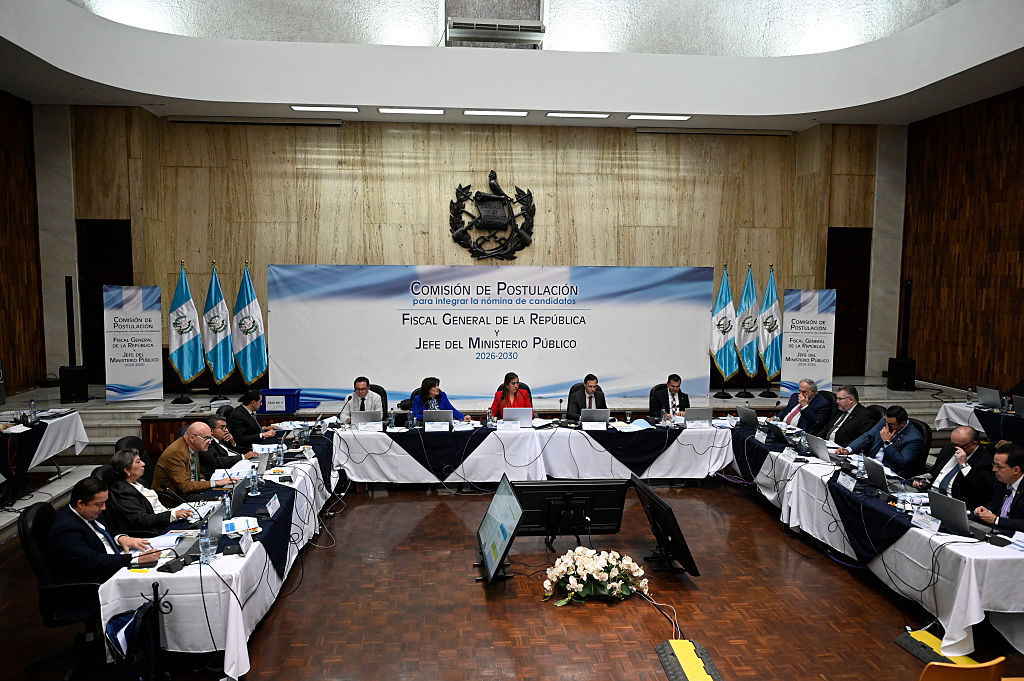
Earlier this week, a 15-member commission finalized the list of six candidates from which Arévalo will choose the next attorney general by May 16. Its members include leaders from the bar association, a Supreme Court justice, and law school deans, some of whom are from so-called “garage” universities that appear to have been created in part to influence this process. To the dismay of many, Porras again presented herself as a candidate and obtained a high scorein the commission’s evaluation. But after four rounds of voting, the commission left her off the short list.
The decision to exclude Porras creates a real opportunity, but Arévalo will still need to navigate last-ditch legal maneuvers that appear designed to sabotage the selection process. The Organization of American States (OAS) and the European Union, which know well how much is at stake, have sent an observation mission to monitor the events. The decision is unusual for this kind of judicial process.
In a letter to the U.S. State Department earlier this month, Senators Michael Lee (R) and Tim Kaine (D) urged Secretary of State Marco Rubio to ensure “constructive” engagement with Guatemalan authorities on the ongoing selection processes to “support and strengthen democratic institutions.”
Independent analyses show that, under Porras, prosecutors have achieved significantly fewer convictions against cartels and organized crime than under the previous attorney general. Today, only 5% of reported extortion cases—the most common crime in the country—make it to trial.
The U.S. State Department, the OAS, and the European Union should help Guatemala seize this chance. They can use their diplomatic weight to help ensure that Arévalo is allowed to appoint a new attorney general free from undue influence or restrictions. They should also offer funding and technical support to help build an Attorney General’s Office that enjoys the trust of Guatemalans and investigates corruption and organized crime impartially. With international support, Arévalo’s patience may pay off. And against all odds, his administration may lay the groundwork for a safer, more democratic Guatemala.
ABOUT THE AUTHOR
Juan Pappier
Reading Time: 3 minutesPappier is the deputy Americas director at Human Rights Watch
In Arévalo’s Guatemala, It’s Not “Spring” Quite Yet
The center-left president’s approval has fallen to 35% amid disappointment with public security and infrastructure.