


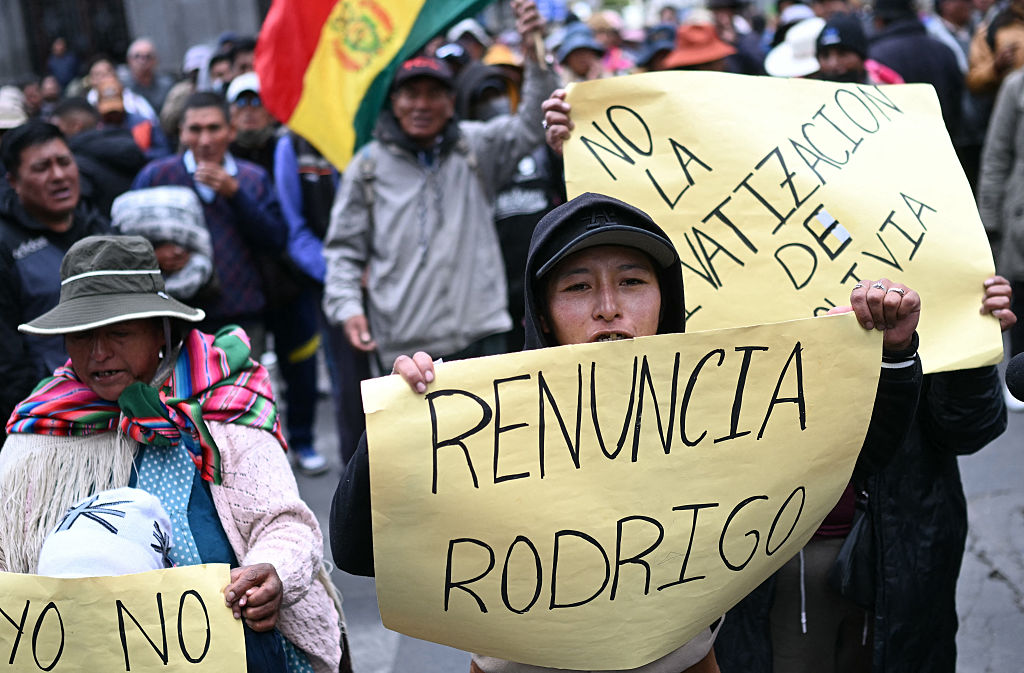
LA PAZ – As Bolivia enters its fourth week of roadblocks and protests, this city feels strangely empty. Fresh food has become scarce. Prices for chicken, eggs, and other essential food items have skyrocketed. While Bolivians are accustomed to cycles of social conflict, the duration and intensity of the current unrest are severe even by local standards.
Outside Bolivia, there is a tendency to interpret this crisis through familiar narratives: right-left polarization, the country’s perennial instability, and above all the role of Evo Morales, the president from 2006-19 who remains an influential opposition figure.
But these explanations risk missing a deeper story.
Indeed, Bolivia’s current unrest seems to reflect a broader crisis of political representation and governance. And it is stemming largely not from the opposition per se, but from sectors that once supported President Rodrigo Paz.
Paz’s support base is fracturing
Paz, the 58-year-old son of a former president, campaigned last year as something of a centrist – a reassuring figure who would lead Bolivia out of the economic crisis caused by Morales’ Movement for Socialism (MAS), but not move as far right as his conservative opponent in the runoff vote, former President Jorge Quiroga.
Paz built a broad base that included some disaffected MAS supporters, and chose as his running mate Edman Lara, 40, a former police officer from a modest background who won a large social media following by speaking out against corruption. Quiroga and several political analysts later said Lara, and the voters he represented, were the decisive factors in Paz’s surprise victory.
But soon after taking office last November, Paz entered alliances with more conservative political actors such as business and agro-industrial sectors, particularly in Santa Cruz. His market-oriented policies, aimed at addressing Bolivia’s fiscal deficit and encouraging more foreign investment, have alienated parts of the administration’s original support base.
Lara himself recently publicly apologized to voters. He revisited campaign promises that have not materialized, such as avoiding further international debt, increasing the state pension for senior citizens and reforming the police force and the justice system. More strikingly, Lara stated that he and President Paz have not spoken since January.
Notably, the geography of today’s roadblocks overlaps with regions that strongly supported the Paz–Lara ticket only months ago. As much as the policies themselves, Paz’s seeming inability to communicate his broader evolution seems to be fueling popular anger.
In fact, many protesters are not fundamentally rejecting modernization, economic restructuring or international investment. The issue appears not to be reform itself. Rather it is about the perception that ordinary citizens are being asked to absorb its costs without being meaningfully consulted on decision-making.
An accumulation of crises
In early May, teachers’ unions flooded La Paz. They demanded higher wages in response to rising inflation. During the era of MAS, Morales’ party, the government traditionally announced wage increases around Workers’ Day on May 1. This year, fiscal constraints inherited from previous administrations have narrowed the government’s room for maneuver. After days of protests, teachers ultimately accepted a compromise. They left with an annual bonus rather than structural wage increases.
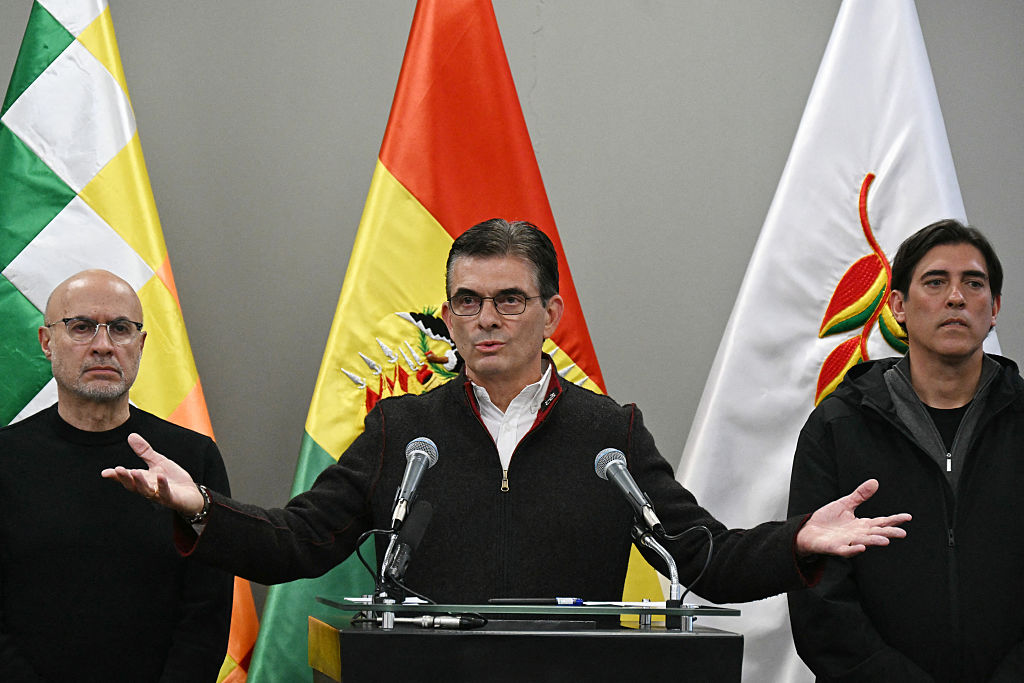
In parallel, small farmers marched from Bolivia’s lowlands to protest Law 1720, a controversial agrarian reform measure. They viewed it as a threat to land rights and criticized it for lacking consultation mechanisms. The law was eventually repealed. It is expected to be revised in the coming months.
Bolivia has also seen an emergency around fuel quality, popularly referred to as gasolina basura, or “garbage gasoline,” which began surfacing in February. Since then, government explanations for the deterioration in fuel quality have been inconsistent, ranging from allegations of sabotage to claims involving transnational smuggling networks. Many citizens complained that poor fuel quality damaged vehicles. It created substantial costs for people who depend on their cars for daily income. Criticism grew. Not only because of the problem itself, but because of an absence of effective solutions.
The situation deteriorated further when President Paz recently referred to protesters as “vandals”, while simultaneously calling for dialogue. The comments were interpreted as further evidence of a widening gap between the government and protesters.
At the same time, prolonged roadblocks and disruptions are imposing substantial social and economic costs on ordinary urban citizens. The tactics employed by some protest groups have generated frustration and anger, risking deepening social divisions. Patience among ordinary citizens is wearing thin. It raises concerns that prolonged paralysis could trigger localized confrontations between groups of citizens themselves.
An uncertain road ahead
Throughout this crisis, former President Morales has continued to dominate headlines and comment frequently on events. He is confined to the Chapare region, facing an arrest warrant linked to allegations of sexual abuse involving a minor. While he remains an important opposition leader, his role is receiving disproportionate attention. He now is more a political beneficiary, in terms of visibility, than the principal organizer. Moreover, changing regional dynamics and the reduced influence of former geopolitical allies including Venezuela further constrain Morales’ position.
Lara’s role, meanwhile, may have been underestimated. His exclusion from the executive was widely interpreted as symbolic of a broader sense of marginalization among the sectors that brought the government to power.
Overall, the current tensions say less about the return of old political actors than about the emergence of new fractures within Bolivia’s post-MAS political landscape. The country’s political landscape today is considerably more fragmented than during the height of the party’s dominance. Recent subnational election results reflected that shift. Governing has become more difficult, but political power is also less concentrated than before.
What happens next remains highly uncertain. The government’s move on May 24 towards the option of a state of emergency, after having ruled out such measures only days earlier, illustrates how rapidly events are evolving. Emergency measures may create temporary political and logistical breathing space, buying the government time. But time itself is unlikely to resolve the structural sources of discontent on their own.
Another possibility of de-escalation is the recently proposed Economic and Social Council, which could reopen channels of dialogue between the government and social movements. Yet, previous rounds of negotiations have often struggled to produce lasting agreements.
A broader cabinet reshuffle was also announced. It could help rebuild trust, legitimacy and broaden representation within the government.
The most destabilizing scenario would be a presidential resignation, followed by constitutional succession under Vice President Lara. This still appears unlikely, but would almost certainly generate new tensions and potentially deepen regional and political divisions. So far, Lara has largely projected a constructive tone. But it remains unclear whether President Paz is willing or able to incorporate that approach into a broader de-escalation strategy.
ABOUT THE AUTHOR

Gabriela Keseberg Dávalos
Reading Time: 4 minutesKeseberg Dávalos is a Bolivian independent foreign policy adviser. She previously served as Senior Foreign Policy Adviser to the Vice-President of the European Parliament for Human Rights and Democracy and as Director of Global Public Affairs for a network of 70 think tanks from the Global South.
Bolivia’s Reform Agenda Is Moving, but Slowly
President Rodrigo Paz promised to turn the country around, yet he is shying away from his own agenda.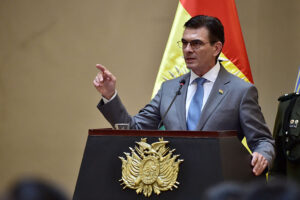
In Bolivia, Rodrigo Paz Faces an Electoral Stress Test
The March 22 subnational elections are a critical bellwether of support for the president in Bolivia’s shifting political landscape.