




This article is adapted from AQ’s special report on Latin America’s space race
Greek tragedies memorialize heroes, Mexico’s corridos the outlaws. In Dahlia de la Cerda’s latest book, Medea Sang Me a Corrido, characters see them as two sides of the same coin.
In this collection of stories, Mexican writer and activist De la Cerda embraces literary appropriation. By transposing Greek tragedy into the worlds of fictional Aztlán and San Miguelito, De la Cerda highlights the universality of the Mexican experience, narco-violence included. Through six linked short stories guided by the mythical Medea—the Greek sorceress and princess of Colchis—she narrates how people survive when the institutions around them have collapsed, and guides us through the lives of women searching for missing children, teenagers who believed fake promises of success, and the networks that rule where the state has failed.
Each story reveals another layer of Aztlán’s complicated reality. Paulina searches for her boyfriend while deciding whether to continue a pregnancy. Antonia fights to protect a desperately wanted baby because being a mother is her form of rebellion. Jordán is recruited into organized crime from a young age. Reina searches through unmarked graves for her son’s body, while Perla is trapped in a relationship with a drug lord who enjoys corridos that brag about arsenals, but he doesn’t know how to use them.
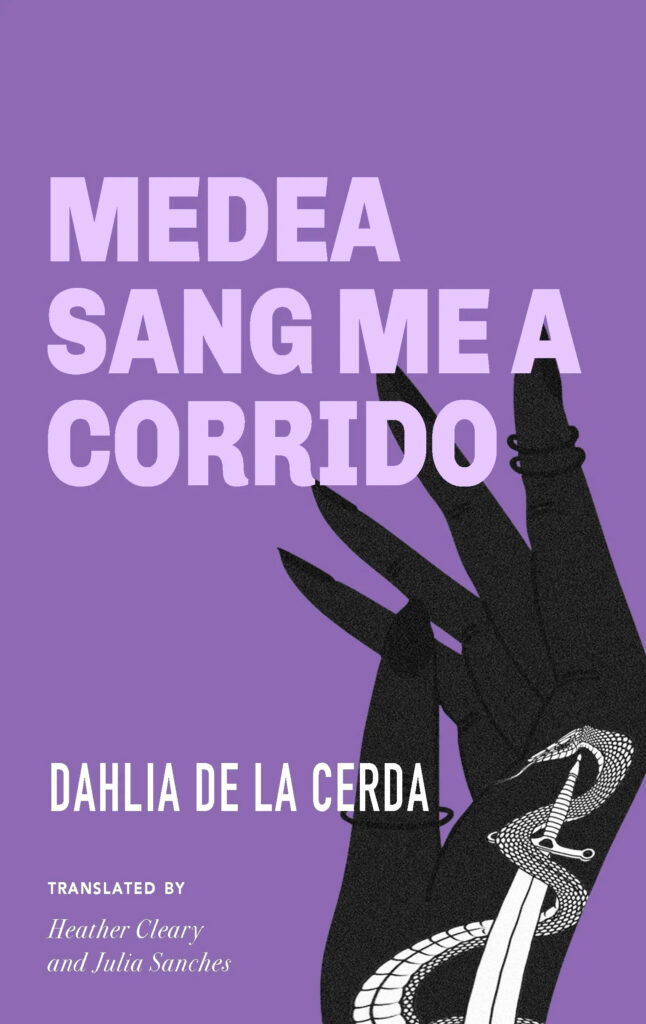
Medea Sang Me a Corrido
Dahlia de la Cerda
Translated by Julia Sanches and Heather Cleary
Feminist Press
July 2026
112 pages
Each tale is individual and unique, but they also accumulate into a collective portrait of systemic failure amid Mexico’s security crisis and cartel violence. “The government cut off one head thinking it would kill the monster, but the monster grew twenty stupid, crude, violent heads in its place,” explains one character, Antonia, about the situation in her town.
In the final story, Medea finally speaks for herself. She shows up at people’s doorsteps driving a tuned-up Jetta with vertical-opening doors, cornrows in her head, and snake tattoos on her arms. Through the book, she becomes a witness to the war and a companion for women moving the infrastructures of care they built in lieu of institutional support. In that space, Medea even gets to enjoy herself: She drinks Kittychelas at festivals, gets her perreo on, learns corridos by heart, and sings them with strangers at night.
The corridos—narrative Mexican ballads and folk songs—promise a form of immortality. Fight, die young, and they’ll sing your name forever. In the book, they become a part of these characters’ lives, always in the background, blasting from car speakers, parties, town festivals, and the house radio. Jordán was seventeen when he first fell for their narrative. “Troy is my favorite movie,” he says, “That shit blew my mind—like, imagine being a legend!” When he was later recruited into the narco-trade, his girlfriend waited for him to come home.
Medea chose to come to Aztlán deliberately. Although her grandfather, the Sun God, warned her it was dangerous even for the gods—a land of war, bloodshed, and no hope—she went anyway, mostly to purge the guilt of killing her children after Jason’s betrayal. Greek tragedies would’ve made her flat, but De la Cerda gives Medea a present instead: A chance to be imperfect, to repent. Medea becomes capable of both harm and care. In Aztlán, she finds horror worse than anything she witnessed in Greece, but she also finds resistance, sorority, and women who won’t let the war have the final word. That’s what makes her stay. As she says, “a redemption that embraces all the shit and turns it into resistance.”
De la Cerda, co-founder of feminist collective Morras Help Morras, was raised in working-class Aguascalientes and rural Jalisco, which she describes as deeply conservative communities enmeshed with organized crime. She brings that background into the collection, where contradictions within motherhood, love, safety, fear, and womanhood coexist.
In Medea Sang Me a Corrido, translators Julia Sanches and Heather Cleary worked in tandem to navigate the book’s oral rhythms and code-switching, which range from street slang to deep philosophical reflections and mythmaking all at once. Their collaboration mirrors the book’s own insistence on sorority: Two women working together to carry these stories across languages is something Medea herself would have blessed.
Overall, the book insists on free will over fate: one character cites Jean-Paul Sartre to say, “We aren’t what they made of us, but rather what we make of what they made of us.” Medea, the tragic story of a scorned woman betrayed by her husband, was first written by Euripides. These Mexican women are written by violence that the state either perpetuates or fails to stop. De la Cerda gives all of them agency: The ability to turn themselves into something beyond what circumstances tried to force them to be.
ABOUT THE AUTHOR
Daniela Ordoñez Delgado
Reading Time: 4 minutesOrdoñez Delgado is a Colombian writer, literary translator and editorial assistant at Sundial House. Her translation of 69 38 78, by Juan Carlos Méndez Guédez, is forthcoming in October.

A Mapuche Writer Renders Life in Urban Chile
A new short story collection by Daniela Catrileo follows Mapuche youth through the cramped blocks and slow violence of Santiago.
Visions of the U.S.-Mexico Borderlands
Family history, politics, and ecology remake one another in the new book “Autobiography of Cotton.”