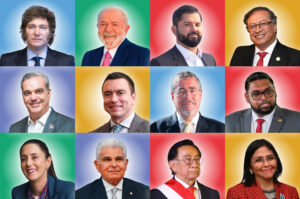



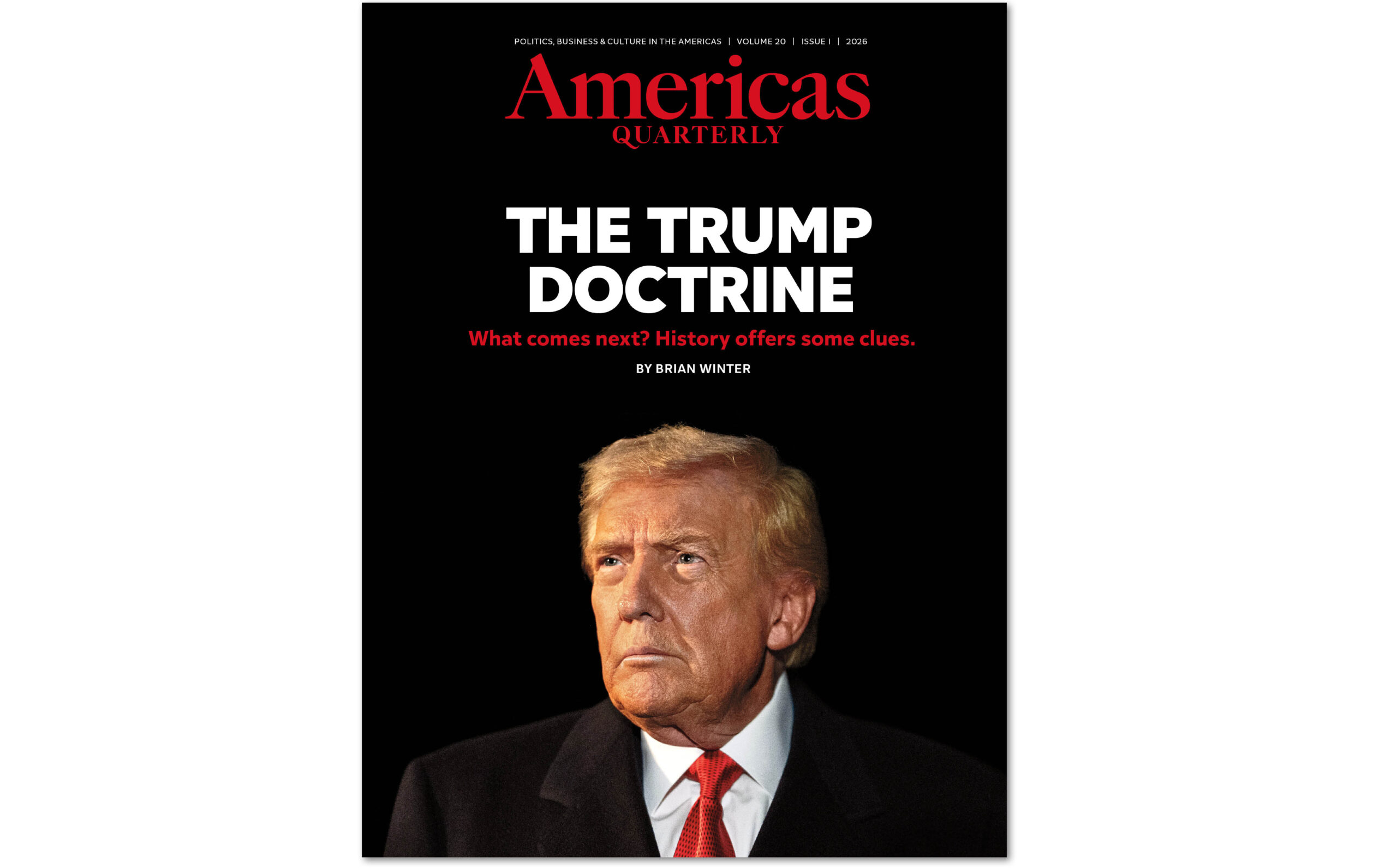
This article is adapted from AQ’s special report on the Trump Doctrine
If there were any doubts that Washington has again embraced the “big stick” diplomacy of Theodore Roosevelt, they ended with the dramatic January 3 operation to capture Nicolás Maduro. Mere hours later, President Donald Trump explicitly proclaimed that “American dominance in the Western Hemisphere will never be questioned again.”
The rhetoric felt like a throwback to the 19th or 20th century. But as our editor-in-chief Brian Winter notes in our cover story, Latin America and the Caribbean appear to have changed in ways that may ultimately benefit Trump. At a time when the region’s politics appear to be shifting in a more conservative direction, it is not obvious that a return to U.S. interventionism will prompt an immediate backlash. Indeed, polling suggests that Maduro’s removal was more popular elsewhere in South America, where more people felt the consequences of his government’s failures, than it was in the United States.
Nevertheless, there are still lessons to be drawn from history. As Winter writes, it’s usually a mistake to expect U.S. presidents to be consistent in their approach—to have a “doctrine” that they rigorously obey. Even Roosevelt migrated away from his heavy-handed approach in Latin America, telling an audience that “I am seeking the very minimum of interference necessary to make them good.” Woodrow Wilson told a crowd in 1915 that “If the Mexicans want to raise hell, let them raise hell. We have got nothing to do with it.” He invaded Mexico a year later.
Trump also seems different in important ways. Unlike leaders like Wilson who were guided by grand plans of bringing democracy to Latin America, the current president seems focused on a relatively narrow—“transactional,” to use the popular term—set of issues like reducing the flow of drugs and migrants, and countering the rise of China. His lack of a moralizing agenda, and willingness to engage with leftist leaders like Mexico’s Claudia Sheinbaum, has opened at least the possibility of a successful agenda.
The end of Maduro signals a new era, not just for Latin America but for the United States. Whether it’s characterized by a backlash against the return of a hegemonic Washington, or a new era of collaboration on issues like security and supply chains, still remains to be seen.

What History Tells Us About Trump’s “Big Stick”
AQ’s editor-in-chief dives into the archive of U.S.-Latin America relations, and emerges with four takeaways.
Venezuela’s Generational Democratic Opportunity
The viability of a political transition depends on credibility and the restoration of democracy.