


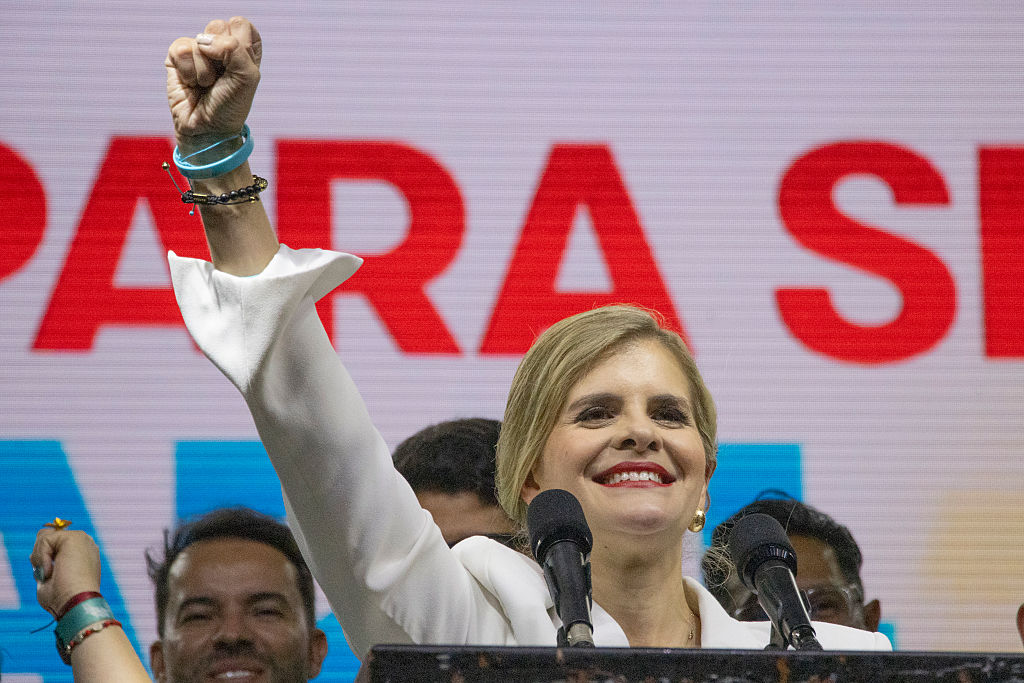
Costa Ricans voted for president as well as all 57 seats in the legislature on February 1. Laura Fernández, the protégé and former chief of staff of outgoing President Rodrigo Chaves, earned about 48% of the vote for the president, preventing a runoff.
Fernández’s victory in a crowded field was convincing; her closest rivals garnered around 33% and 5% of the vote, respectively. Her party, Partido Pueblo Soberano (PPSO), secured a majority of 31 seats in the legislature, which will allow it to pass a range of laws unilaterally but is not enough to reform the constitution.
Her campaign focused on Costa Rica’s rising crime rate, which has been top of mind for voters. “Change will be deep and irreversible,” she said at her victory speech as she promised a new political era. “It’s up to us to build the third republic,” she said, calling Costa Rica’s second republic founded in 1948 “a thing of the past.”
AQ asked analysts to share their reactions and perspectives.

Lucas Perelló
Assistant professor of political science at Florida Atlantic University
Laura Fernández’s impressive Sunday night victory offers three key takeaways and leaves one open question. First, her win signals that the movement of her mentor, President Rodrigo Chaves, is here to stay—and will continue shaping Costa Rican politics for years to come. Running on the slogan of continuidad del cambio (continuity of change), Fernández secured 48% of the votes with high levels of turnout, avoiding a runoff—a first since 2010. Her party, the conservative Partido Pueblo Soberano (PPSO), also gained 54% of the 57-member unicameral Asamblea Legislativa, with 31 seats.
Second, Fernández’s victory confirms that the political opposition has been unable to react to the disruptive force of Chavismo. Many of those parties, including the Partido de Liberación Nacional, Coalición Agenda Ciudadana, and Frente Amplio, are seen by voters as elitist and out of touch. If they plan to regain the presidency, they will have to make serious efforts at rebranding and coalition-building.
Third, unlike Chaves, who blamed the Asamblea Legislativa for blocking his initiatives, Fernández will have a governing majority capable of passing key reforms in areas of security and economic growth. Her party is still below the qualified majority (38 seats) required to pass constitutional reforms. Nonetheless, this time around, the government won’t be able to blame others if it fails to deliver on its promises to voters.
Finally, a big question that remains is how much influence Chaves will have under Fernández’s presidency. In Latin America, mentor-protégé ties often fray after elections. We will soon find out if this holds for Costa Rica.

Argentina Artavia Medrano
Professor of political science and international relations at the University of Costa Rica (UCR) and the National University of Costa Rica (UNA)
Fernández will become the 50th president, the second woman to assume the presidency in Costa Rica, after Laura Chinchilla Miranda did so in 2010. Exceeding the threshold of 40% of valid votes cast has not happened since that election, and this reflects significant support for the start of her term. The president-elect was emphatic in stating that she will continue the economic and political legacy of President Chaves, with rhetoric that continues the president’s confrontational line, on the one hand proposing a government of dialogue and national harmony, but on the other, warning the opposition that they must be respectful of the will of the people, not an “obstructionist and sabotaging” opposition, which she blamed for institutional erosion and obstacles to achieving prosperity and well-being.
With 31 of 57 seats in the legislature, she will have a majority for some of the changes she promised to make, but without reaching the qualified majority needed to reform the Constitution or convene a National Constituent Assembly, which were two of her party’s objectives. In her victory speech, she said, “Costa Rica knows that I will fight mercilessly to keep our country on the path of economic growth, freedom, and, above all, progress for our people.”
February 1, 2026, will go down in Costa Rica’s political and electoral history as a day when the country was polarized between continuity and a weakened opposition, the result of an erosion of leadership, but also of opposition parties that have failed to respond to the demands of the public. Of the opposition parties that currently have blocs in the legislature, two of them will have no seats in the next term, and another will go from nine seats to just one. For its part, the main opposition bloc will maintain its current size. It should be noted that the sum of the opposition parties retains the ability to legislatively block certain issues that, according to the Constitution, require two-thirds of the legislators.
This implies that, despite the ruling party’s comfortable victory in the presidential election, it will necessarily have to build agreements with the opposition on some issues.
Fernández’s victory comes in a difficult sociopolitical context marked by deep social inequality and growing concerns over public safety, as well as an alarming reduction in investment in education and health—two of the pillars of the Costa Rican state—to levels never before seen in the country’s history. The State of Education 2025 Report warned of an increasingly deep crisis and revealed serious setbacks: in recent years, investment in education has seen its worst decline in four decades. In terms of public health, between 2023 and 2025, 5,700 people died while on the surgical waiting list of the Caja Costarricense de Seguro Social, or national social security fund.
The most pressing challenges facing the president-elect involve addressing the root causes of these problems, that is, providing a comprehensive solution in line with the way in which the Costa Rican state has dealt with these situations since the 1940s, with social investment that has enabled Costa Rica to position itself and stand out in Latin America and the world.

Cristina Eguizábal
Political scientist and professor at the University of Costa Rica (UCR)
In yesterday’s vote for president and a new legislature, 20 political parties presented candidates, but only five presented real options. Fifteen were what we call “taxi parties,” parties created with the sole purpose of participating in the current election.
The 2026 election has been the most consequential election for Costa Rica of the 21st century. It was presented by the current administration as a plebiscite of sorts on President Rodrigo Chaves, a former high-ranking official at the World Bank, but a newcomer to Costa Rican politics who could not run again. Two different sociopolitical alternatives were presented to the voter: a liberal alternative along the traditional lines of Costa Rican democracy, and Chaves’ radical populist project whose aim is to establish a more powerful executive branch of government, indefinite presidential reelection, and diminished checks and balances. All this would require profound constitutional reforms. Some in his party call for the founding of a “Third Republic” to replace the Second Republic founded by Pepe Figueres in 1948.
Costa Rican society is under severe stress: public health and public education have systematically deteriorated since 2000, public transportation is in shambles, narco-trafficking has become an important part of the economy, and traffickers are very influential at the local level in many parts of the country. Drug-driven crime is rampant.
The big unknown is how much independence will Laura Fernández have vis-á-vis her predecessor. She has repeatedly mentioned that she would like to have him in her government, perhaps as chief of staff, called in Costa Rica the minister of the presidency, the most powerful position in the Cabinet.